Yu Liu-Ying, Ren Gao-Peng, Hou Xiao-Jing, Wu Ke-Jun, He Yuchen
Zhejiang Provincial Key Laboratory of Advanced Chemical Engineering Manufacture Technology, College of Chemical and Biological Engineering, Zhejiang University, Hangzhou 310027, China.
Institute of Zhejiang University-Quzhou, Quzhou 324000, China.
ACS Cent Sci. 2022 Jul 27;8(7):983-995. doi: 10.1021/acscentsci.2c00157. Epub 2022 Jul 14.
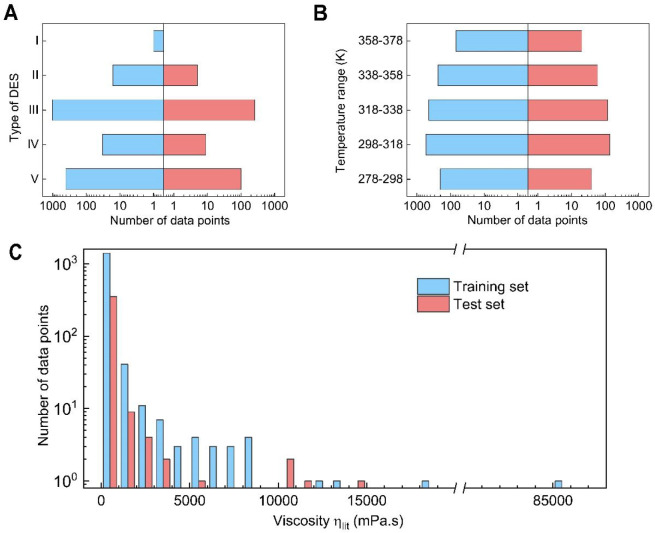
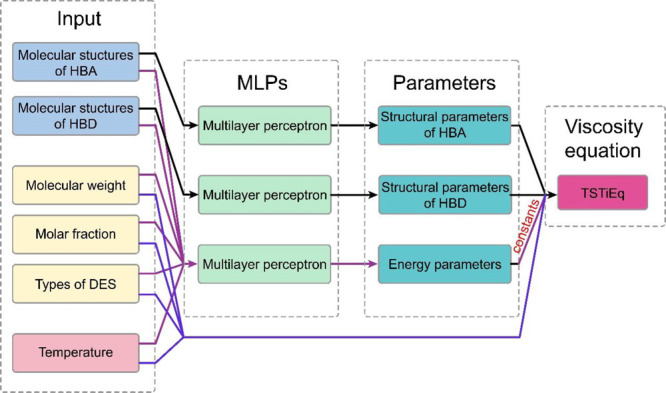
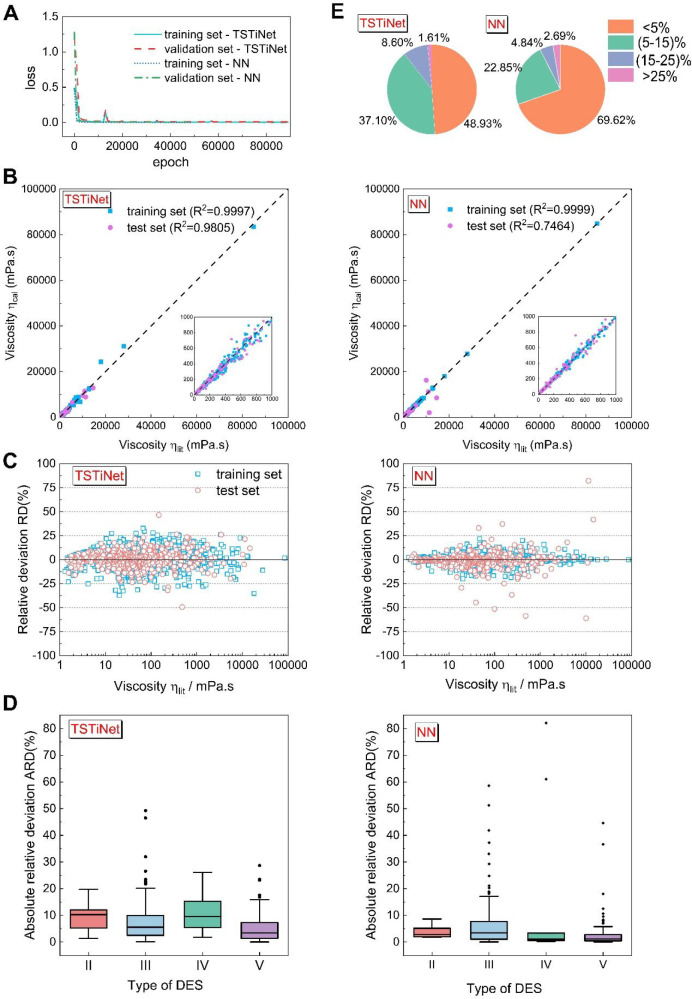
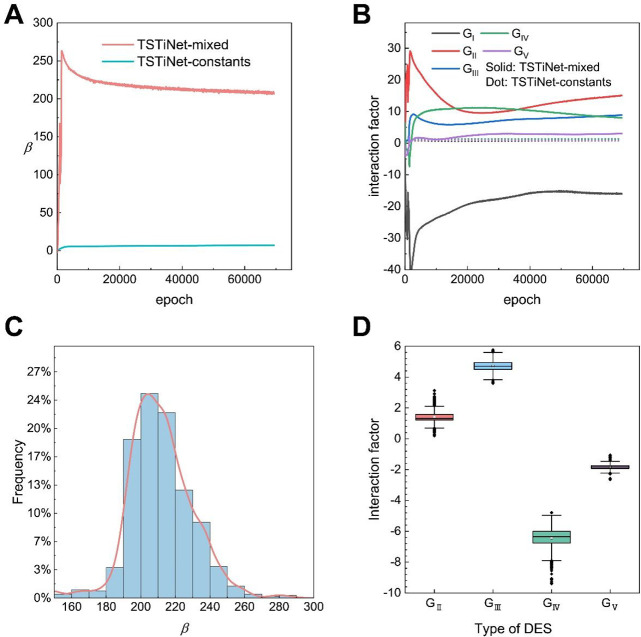
The lack of accurate methods for predicting the viscosity of solvent materials, especially those with complex interactions, remains unresolved. Deep eutectic solvents (DESs), an emerging class of green solvents, have a severe lack of viscosity data, resulting in their application still staying at the stage of random trial and error, and it is difficult for them to be implemented on an industrial scale. In this work, we demonstrate the successful prediction of the viscosity of DESs based on the transition state theory-inspired neural network (TSTiNet). The TSTiNet adopts multilayer perceptron (MLP) for the transition state theory-inspired equation (TSTiEq) parameters calculation and verification using the most comprehensive DESs viscosity data set to date. For the energy parameters of the TSTiEq, the constant assumption and the fast iteration with the help of MLP can allow TSTiNet to achieve the best performance (the average absolute relative deviation on the test set of 6.84% and of 0.9805). Compared with the traditional machine learning methods, the TSTiNet has better generalization ability and dramatically reduces the maximum relative deviation of prediction under the constraints of the thermodynamic formulation. It requires only the structural information on DESs and is the most accurate and reliable model available for DESs viscosity prediction.
缺乏准确预测溶剂材料粘度的方法,尤其是那些具有复杂相互作用的材料,这一问题仍未得到解决。深共熔溶剂(DESs)作为一类新兴的绿色溶剂,严重缺乏粘度数据,导致其应用仍停留在随机试验和试错阶段,难以实现工业化规模应用。在这项工作中,我们展示了基于受过渡态理论启发的神经网络(TSTiNet)成功预测DESs粘度。TSTiNet采用多层感知器(MLP)来计算受过渡态理论启发的方程(TSTiEq)参数,并使用迄今为止最全面的DESs粘度数据集进行验证。对于TSTiEq的能量参数,常数假设以及借助MLP的快速迭代能够使TSTiNet实现最佳性能(测试集上的平均绝对相对偏差为6.84%,相关系数为0.9805)。与传统机器学习方法相比,TSTiNet具有更好的泛化能力,并且在热力学公式的约束下显著降低了预测的最大相对偏差。它仅需要DESs的结构信息,是目前可用于DESs粘度预测的最准确、最可靠的模型。