African Centre of Excellence for Genomics of Infectious Disease, Redeemer's University, Ede, Osun, Nigeria.
Redeemer's University, Ede, Osun, Nigeria.
Microbiol Spectr. 2022 Aug 31;10(4):e0036622. doi: 10.1128/spectrum.00366-22. Epub 2022 Aug 1.
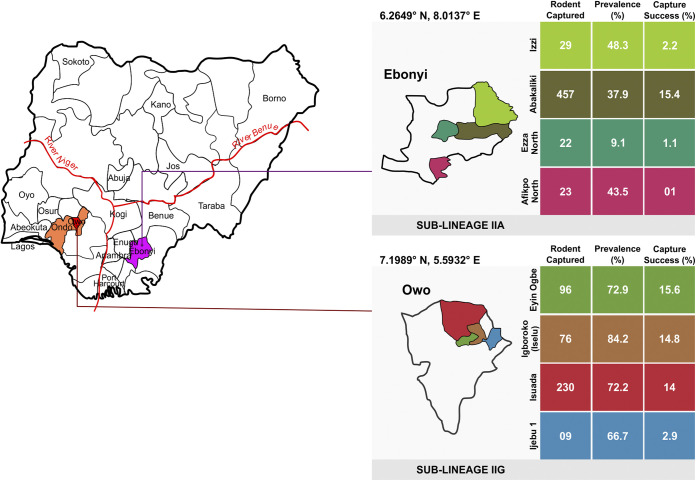
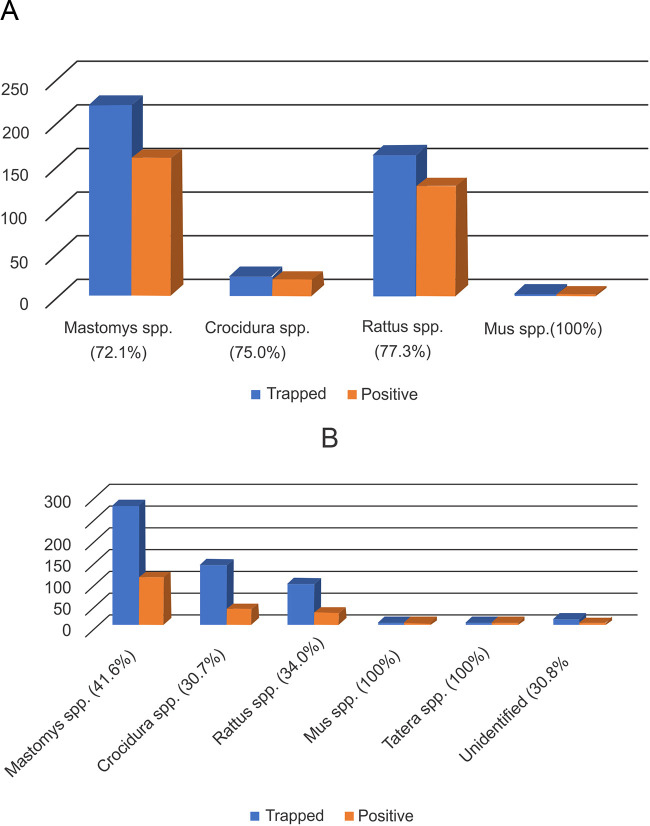
The dynamics of Lassa virus (LASV) infections in rodent reservoirs and their endemic human caseloads remain poorly understood. During the endemic period, human infections are believed to be associated with the seasonal migration of Mastomys natalensis, thought to be the primary reservoir that triggers multiple spillovers of LASV to humans. It has become imperative to improve LASV diagnosis in rodents while updating their prevalence in two regions of Lassa fever endemicity in Nigeria. Rodents (total, 942) were trapped in Ondo (531) and Ebonyi (411) states between October 2018 and April 2020 for detection of LASV using various tissues. Overall, the LASV prevalence was 53.6%. The outbreak area sampled in Ondo had three and two times higher capture success and LASV prevalence, respectively, than Ebonyi State. This correlated with the higher number of annual cases of Lassa fever (LF) in Ondo State versus Ebonyi State. All rodent genera (, , , , and ) captured in both states showed slightly variable LASV positivity, with spp. being the most predominantly infected (77.3%) rodents in Ondo State versus spp. (41.6%) in Ebonyi State. The tissues with the highest LASV positivity were the kidneys, spleen, and testes. The finding of a relatively high LASV prevalence in all of the rodent genera captured highlights the complex interspecies transmission dynamics of LASV infections in the reservoirs and their potential association with increased environmental contact, as well as the risk of zoonotic spillover in these communities, which have the highest prevalence of Lassa fever in Nigeria. Our findings show the highest LASV positivity in small rodents ever recorded and the first direct detection of LASV in spp. Our findings also indicate the abundance of LASV-infected small rodents in houses, with probable interspecies transmission through vertical and horizontal coitus routes. Consequently, we suggest that the abundance of different reservoir species for LASV may fuel the epizootic outbreaks of LF in affected human communities. The high prevalence of LASV with the diversity of affected rodents has direct implications for our understanding of the transmission risk, mitigation, and ultimately, the prevention of LF in humans. Optimal tissues for LASV detection in rodents are also presented.
拉沙病毒 (LASV) 在啮齿动物宿主中的动态以及其地方性人类病例仍未被充分了解。在地方性流行期间,人类感染被认为与 Mastomys natalensis 的季节性迁徙有关,这种动物被认为是主要的宿主,会引发 LASV 向人类的多次溢出。因此,迫切需要提高啮齿动物中的 LASV 诊断水平,并更新尼日利亚两个拉沙热流行地区的啮齿动物流行率。2018 年 10 月至 2020 年 4 月,在翁多州(531 只)和埃博尼州(411 只)用各种组织捕获啮齿动物(共 942 只),以检测 LASV。总体而言,LASV 的流行率为 53.6%。在采样的暴发地区,翁多州的捕获成功率和 LASV 流行率分别比埃博尼州高 3 倍和 2 倍。这与翁多州每年拉沙热(LF)病例数高于埃博尼州有关。在这两个州捕获的所有啮齿动物属(,,,, 和 )的 LASV 阳性率略有不同,在翁多州感染最严重的是 spp. 啮齿动物(77.3%),而在埃博尼州感染最严重的是 spp. 啮齿动物(41.6%)。LASV 阳性率最高的组织是肾脏、脾脏和睾丸。所有捕获的啮齿动物属中 LASV 均有较高的流行率,这突出了 LASV 感染在宿主中的复杂种间传播动态,以及与增加环境接触的潜在关联,以及这些社区中出现人畜共患病溢出的风险,这些社区是尼日利亚拉沙热发病率最高的地区。我们的研究结果显示,这是有记录以来 LASV 在小型啮齿动物中最高的阳性率,也是首次直接检测到 spp. 中的 LASV。我们的研究结果还表明,LASV 感染的小型啮齿动物在房屋中大量存在,可能通过垂直和水平交配途径进行种间传播。因此,我们认为 LASV 不同宿主物种的丰度可能会引发受影响人群社区中的 LF 爆发。高流行率的 LASV 和受影响的啮齿动物多样性对我们理解传播风险、减轻和最终预防人类 LF 具有直接影响。我们还提出了检测啮齿动物中 LASV 的最佳组织。