Zhou Yanan, Wang Junbin, Cao Ranran, Yang Yun, Feng Yuliang, Tang Cong, Yang Hao, Huang Qing, Yu Wenhai, Wang Haixuan, Shi Jiandong, Ding Kaiyun, Yuan Longhai, Dai Qing, Zhao Xingping, Li Haiyan, Yang Mengli, Luo Fangyu, Zhu Fanli, Zhang Yong, Wu Daoju, Yang Xiaorong, Lu Shuaiyao, Sun Qiangming, Zhang Li, Wang Youchun
National Kunming High-Level Biosafety Primate Research Center,State Key Laboratory of Respiratory Health and Multimorbidity Institute of Medical Biology Chinese Academy of Medical Sciences and Peking Union Medical College Kunming China.
Sichuan Center for Disease Control and Prevention Chengdu China.
MedComm (2020). 2025 Aug 3;6(8):e70315. doi: 10.1002/mco2.70315. eCollection 2025 Aug.
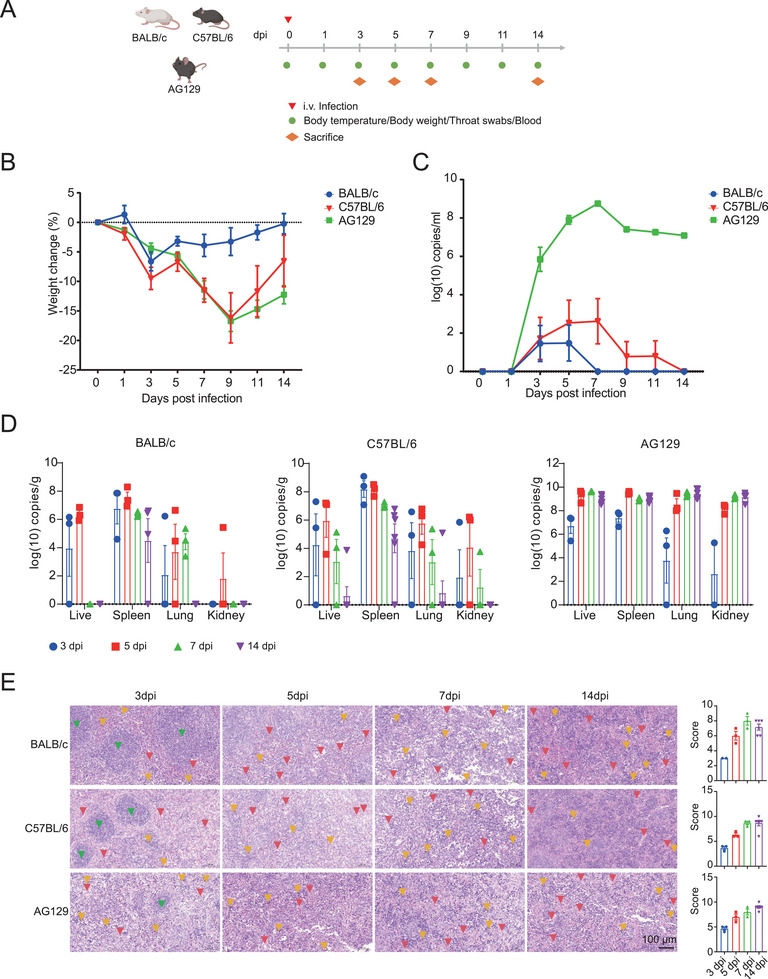
Lassa fever (LF) is a fatal hemorrhagic disease caused by the Lassa virus (LASV), which mainly spreads in Africa. As China's interactions with Africa become more frequent, the risk of LF being imported into China also rises, making the study of LASV increasingly urgent. In this study, the Lineage IV LASV strain was successfully isolated from the first imported case in China. Compared with the LASV genome, the isolated strain may exhibit greater infectivity and interspecies transmission capabilities. We successfully established BALB/c, C57BL/6, and AG129 mouse infection models and found that intranasal inoculation was the most stable infection method. Select the anti-LASV drug LHF-535 for preliminary evaluation, further confirming the stability of the model. In summary, the isolated strain exhibits enhanced transmission capabilities and may spread between mice via the respiratory tract, meriting greater attention and emphasis. This study will bridge the gap in China's independent P4-level pathogen isolation, meet national biosafety and strategic needs, and provide certain support for LASV research.
拉沙热(LF)是一种由拉沙病毒(LASV)引起的致命性出血热疾病,主要在非洲传播。随着中国与非洲的交流日益频繁,拉沙热输入中国的风险也在上升,使得对拉沙病毒的研究愈发紧迫。在本研究中,成功从中国首例输入病例中分离出IV型拉沙病毒株。与拉沙病毒基因组相比,分离出的毒株可能表现出更强的感染力和种间传播能力。我们成功建立了BALB/c、C57BL/6和AG129小鼠感染模型,并发现经鼻接种是最稳定的感染方法。选用抗拉沙病毒药物LHF-535进行初步评估,进一步证实了该模型的稳定性。综上所述,分离出的毒株表现出增强的传播能力,可能通过呼吸道在小鼠之间传播,值得高度关注和重视。本研究将填补中国自主P4级病原体分离的空白,满足国家生物安全和战略需求,并为拉沙病毒研究提供一定支持。