• 文献检索
  • 文档翻译
  • 深度研究
  • 学术资讯
  • Suppr Zotero 插件Zotero 插件
  • 邀请有礼
  • 套餐&价格
  • 历史记录
应用&插件
Suppr Zotero 插件Zotero 插件浏览器插件Mac 客户端Windows 客户端微信小程序
定价
高级版会员购买积分包购买API积分包
服务
文献检索文档翻译深度研究API 文档MCP 服务
关于我们
关于 Suppr公司介绍联系我们用户协议隐私条款
关注我们

Suppr 超能文献

核心技术专利:CN118964589B侵权必究
粤ICP备2023148730 号-1Suppr @ 2026

文献检索

告别复杂PubMed语法,用中文像聊天一样搜索,搜遍4000万医学文献。AI智能推荐,让科研检索更轻松。

立即免费搜索

文件翻译

保留排版,准确专业,支持PDF/Word/PPT等文件格式,支持 12+语言互译。

免费翻译文档

深度研究

AI帮你快速写综述,25分钟生成高质量综述,智能提取关键信息,辅助科研写作。

立即免费体验

开源和商业自动胰岛素输送系统实用指南:面向支持胰岛素依赖型糖尿病患者的医疗保健专业人员的指南。

Practical Guidance on Open Source and Commercial Automated Insulin Delivery Systems: A Guide for Healthcare Professionals Supporting People with Insulin-Requiring Diabetes.

作者信息

Lewis Dana M, Hussain Sufyan

机构信息

OpenAPS, Seattle, WA, USA.

Department of Diabetes and Endocrinology, Guy's and St Thomas' NHS Foundation Trust, London, UK.

出版信息

Diabetes Ther. 2022 Sep;13(9):1683-1699. doi: 10.1007/s13300-022-01299-9. Epub 2022 Aug 1.

DOI:10.1007/s13300-022-01299-9
PMID:35913655
原文链接:https://pmc.ncbi.nlm.nih.gov/articles/PMC9399331/
Abstract

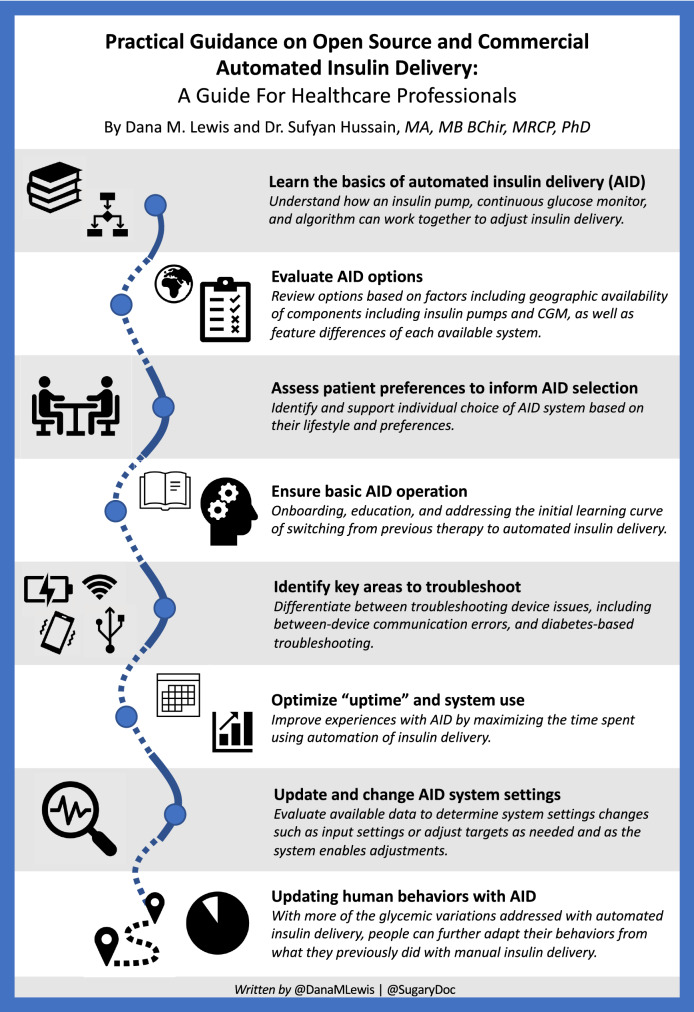
As increasing numbers of people with insulin-managed diabetes use automated insulin delivery (AID) systems or seek such technologies, healthcare providers are faced with a steep learning curve. Healthcare providers need to understand how to support these technologies to help inform shared decision making, discussing available options, implementing them in the clinical setting, and guiding users in special situations. At the same time, there is a growing diversity of commercial and open source automated insulin delivery systems that are evolving at a rapid pace. This practical guide seeks to provide a conversational framework for healthcare providers to first understand and then jointly assess AID system options with users and caregivers. Using this framework will help HCPs in learning how to evaluate potential new commercial or open source AID systems, while also providing a guide for conversations to help HCPs to assess the readiness and understanding of users for AID systems. The choice of an AID system is not as simple as whether the system is open source or commercially developed, and indeed there are multiple criteria to assess when choosing an AID system. Most importantly, the choices and preferences of the person living with diabetes should be at the center of any decision around the ideal automated insulin delivery system or any other diabetes technology. This framework highlights issues with AID use that may lead to burnout or perceived failures or may otherwise cause users to abandon the use of AID. It discusses the troubleshooting of basic AID system operation and discusses more advanced topics regarding how to maximize the time spent on AID systems, including how to optimize settings and behaviors for the best possible outcomes with AID technology for people with insulin-requiring diabetes. This practical approach article demonstrates how healthcare providers will benefit from assessing and better understanding all available AID system options to enable them to best support each individual.

摘要

随着越来越多使用胰岛素治疗的糖尿病患者使用自动胰岛素输送(AID)系统或寻求此类技术,医疗保健提供者面临着陡峭的学习曲线。医疗保健提供者需要了解如何支持这些技术,以帮助进行共同决策,讨论可用选项,在临床环境中实施这些技术,并在特殊情况下指导用户。与此同时,商业和开源自动胰岛素输送系统的种类越来越多,且发展迅速。本实用指南旨在为医疗保健提供者提供一个交流框架,以便他们首先了解,然后与用户和护理人员共同评估AID系统选项。使用这个框架将帮助医疗保健专业人员学习如何评估潜在的新商业或开源AID系统,同时也为交流提供指导,以帮助医疗保健专业人员评估用户对AID系统的准备情况和理解程度。选择AID系统并不像判断该系统是开源还是商业开发那么简单,实际上,选择AID系统时需要评估多个标准。最重要的是,糖尿病患者的选择和偏好应成为围绕理想的自动胰岛素输送系统或任何其他糖尿病技术的任何决策的核心。这个框架突出了AID使用中可能导致倦怠或感知失败,或可能导致用户放弃使用AID的问题。它讨论了AID系统基本操作的故障排除,并讨论了更高级的主题,即如何最大限度地利用在AID系统上花费的时间,包括如何优化设置和行为,以便使用AID技术为需要胰岛素治疗的糖尿病患者带来最佳可能的结果。这篇实用方法文章展示了医疗保健提供者将如何从评估和更好地理解所有可用的AID系统选项中受益,从而能够最好地支持每一个人。
https://cdn.ncbi.nlm.nih.gov/pmc/blobs/64bf/9399331/8609b63971a5/13300_2022_1299_Fig1_HTML.jpg

相似文献

1
Practical Guidance on Open Source and Commercial Automated Insulin Delivery Systems: A Guide for Healthcare Professionals Supporting People with Insulin-Requiring Diabetes.开源和商业自动胰岛素输送系统实用指南:面向支持胰岛素依赖型糖尿病患者的医疗保健专业人员的指南。
Diabetes Ther. 2022 Sep;13(9):1683-1699. doi: 10.1007/s13300-022-01299-9. Epub 2022 Aug 1.
2
Association of British Clinical Diabetologists, Diabetes Technology Network UK and Association of Children's Diabetes Clinicians Survey of UK Healthcare Professional Attitudes Towards Open-Source Automated Insulin Delivery Systems.英国临床糖尿病学家协会、英国糖尿病技术网络以及儿童糖尿病临床医生协会关于英国医疗保健专业人员对开源自动胰岛素输送系统态度的调查。
Diabetes Ther. 2022 Feb;13(2):341-353. doi: 10.1007/s13300-022-01203-5. Epub 2022 Jan 31.
3
Why #WeAreNotWaiting-Motivations and Self-Reported Outcomes Among Users of Open-source Automated Insulin Delivery Systems: Multinational Survey.为什么#我们不等待-开源自动化胰岛素输送系统使用者的动机和自我报告结果:多国调查。
J Med Internet Res. 2021 Jun 7;23(6):e25409. doi: 10.2196/25409.
4
Leveraging advances in diabetes technologies in primary care: a narrative review.利用初级保健中的糖尿病技术进步:叙述性评论。
Ann Med. 2021 Dec;53(1):805-816. doi: 10.1080/07853890.2021.1931427.
5
Barriers to Uptake of Open-Source Automated Insulin Delivery Systems: Analysis of Socioeconomic Factors and Perceived Challenges of Caregivers of Children and Adolescents With Type 1 Diabetes From the OPEN Survey.开源自动胰岛素输送系统应用的障碍:基于开放调查对1型糖尿病儿童和青少年照顾者的社会经济因素及感知挑战的分析
Front Clin Diabetes Healthc. 2022 Jul 25;3:876511. doi: 10.3389/fcdhc.2022.876511. eCollection 2022.
6
Learning challenges of healthcare professionals supporting open-source automated insulin delivery.医疗专业人员支持开源自动化胰岛素输送的学习挑战。
Diabet Med. 2022 May;39(5):e14750. doi: 10.1111/dme.14750. Epub 2021 Dec 7.
7
Do-It-Yourself and Commercial Automated Insulin Delivery Systems in Type 1 Diabetes: An Uncertain Area for Canadian Health-care Providers.1 型糖尿病的 DIY 和商业化自动胰岛素输送系统:加拿大医疗保健提供者面临的不确定领域。
Can J Diabetes. 2022 Dec;46(8):863-870. doi: 10.1016/j.jcjd.2022.06.003. Epub 2022 Jun 22.
8
Real-world evidence on clinical outcomes of people with type 1 diabetes using open-source and commercial automated insulin dosing systems: A systematic review.基于开源和商业自动化胰岛素输注系统的 1 型糖尿病患者临床结局的真实世界证据:一项系统评价。
Diabet Med. 2022 May;39(5):e14741. doi: 10.1111/dme.14741. Epub 2021 Nov 24.
9
Point-Counterpoint: The Need for Do-It-Yourself (DIY) Open Source (OS) AID Systems in Type 1 Diabetes Management.观点对撞:1 型糖尿病管理中 DIY 开源 (OS) AID 系统的必要性。
Diabetes Technol Ther. 2024 Oct;26(10):689-699. doi: 10.1089/dia.2024.0073. Epub 2024 May 13.
10
The Do-It-Yourself Artificial Pancreas: A Comprehensive Review.自制人工胰腺:全面综述
Diabetes Ther. 2020 Jun;11(6):1217-1235. doi: 10.1007/s13300-020-00823-z. Epub 2020 Apr 30.

引用本文的文献

1
Navigating the Unique Challenges of Automated Insulin Delivery Systems to Facilitate Effective Uptake, Onboarding, and Continued Use.应对自动胰岛素输送系统的独特挑战,以促进有效采用、引入和持续使用。
J Diabetes Sci Technol. 2025 Jan;19(1):47-53. doi: 10.1177/19322968241275963. Epub 2024 Aug 30.
2
[Position paper: Open-source technology in the treatment of people living with diabetes mellitus-an Austrian perspective : Technology Committee of the Austrian Diabetes Association].[立场文件:奥地利视角下开源技术在糖尿病患者治疗中的应用:奥地利糖尿病协会技术委员会]
Wien Klin Wochenschr. 2024 Jul;136(Suppl 9):467-477. doi: 10.1007/s00508-024-02400-x. Epub 2024 Aug 28.
3

本文引用的文献

1
Safety and Glycemic Outcomes With a Tubeless Automated Insulin Delivery System in Very Young Children With Type 1 Diabetes: A Single-Arm Multicenter Clinical Trial.一种无管自动化胰岛素输送系统在 1 型糖尿病非常年幼儿童中的安全性和血糖控制效果:一项单臂多中心临床试验。
Diabetes Care. 2022 Aug 1;45(8):1907-1910. doi: 10.2337/dc21-2359.
2
Closed-Loop Insulin Delivery Versus Sensor-Augmented Pump Therapy in Older Adults With Type 1 Diabetes (ORACL): A Randomized, Crossover Trial.闭环胰岛素输注与传感器增强型泵治疗老年 1 型糖尿病患者的随机交叉试验(ORACL)
Diabetes Care. 2022 Feb 1;45(2):381-390. doi: 10.2337/dc21-1667.
3
Use of automated insulin delivery systems in people with type 1 diabetes fasting during Ramadan: An observational study.
Retrospective Comparison of Commercially Available Automated Insulin Delivery With Open-Source Automated Insulin Delivery Systems in Type 1 Diabetes.
1型糖尿病中商用自动胰岛素输注与开源自动胰岛素输注系统的回顾性比较
J Diabetes Sci Technol. 2024 Feb 16:19322968241230106. doi: 10.1177/19322968241230106.
4
Mapping the Landscape of Do-it-Yourself Medicine.描绘自助医疗的全景。
Citiz Sci. 2022;7(1). doi: 10.5334/cstp.553. Epub 2022 Dec 15.
在斋月期间禁食的 1 型糖尿病患者中使用自动化胰岛素输注系统:一项观察性研究。
J Diabetes Investig. 2022 Apr;13(4):647-651. doi: 10.1111/jdi.13720. Epub 2021 Dec 15.
4
Learning challenges of healthcare professionals supporting open-source automated insulin delivery.医疗专业人员支持开源自动化胰岛素输送的学习挑战。
Diabet Med. 2022 May;39(5):e14750. doi: 10.1111/dme.14750. Epub 2021 Dec 7.
5
Open-source automated insulin delivery: international consensus statement and practical guidance for health-care professionals.开源自动化胰岛素输送:面向医疗保健专业人员的国际共识声明和实用指南。
Lancet Diabetes Endocrinol. 2022 Jan;10(1):58-74. doi: 10.1016/S2213-8587(21)00267-9. Epub 2021 Nov 13.
6
Real-world evidence on clinical outcomes of people with type 1 diabetes using open-source and commercial automated insulin dosing systems: A systematic review.基于开源和商业自动化胰岛素输注系统的 1 型糖尿病患者临床结局的真实世界证据:一项系统评价。
Diabet Med. 2022 May;39(5):e14741. doi: 10.1111/dme.14741. Epub 2021 Nov 24.
7
Management of Type 1 Diabetes Mellitus Using Open-Source Automated Insulin Delivery During Pregnancy: A Case Series.孕期使用开源自动胰岛素输注管理1型糖尿病:病例系列
Diabetes Technol Ther. 2022 Mar;24(3):227-230. doi: 10.1089/dia.2021.0260. Epub 2021 Oct 11.
8
Efficacy and safety of closed-loop insulin delivery versus sensor-augmented pump in the treatment of adults with type 1 diabetes: a systematic review and meta-analysis of randomized-controlled trials.闭环胰岛素输送与传感器增强型泵治疗 1 型糖尿病成人患者的疗效和安全性:系统评价和随机对照试验的荟萃分析。
J Endocrinol Invest. 2022 Mar;45(3):471-481. doi: 10.1007/s40618-021-01674-6. Epub 2021 Sep 17.
9
Errors of commission or omission: The net risk safety analysis conversation we should be having around automated insulin delivery systems.失误或遗漏:我们应该围绕自动胰岛素输送系统进行的净风险安全分析对话。
Diabet Med. 2022 May;39(5):e14687. doi: 10.1111/dme.14687. Epub 2021 Sep 17.
10
How It Started, How It Is Going: The Future of Artificial Pancreas Systems (Automated Insulin Delivery Systems).从何而来,路在何方:人工胰腺系统(自动胰岛素输送系统)的未来。
J Diabetes Sci Technol. 2021 Nov;15(6):1258-1261. doi: 10.1177/19322968211027558. Epub 2021 Jul 5.