Department of Social and Preventive Medicine, University of Potsdam, Potsdam, Germany.
Department of Psychiatry and Psychotherapy, Central Institute of Mental Health, Heidelberg University, Medical Faculty Mannheim, Mannheim, Germany.
JAMA Netw Open. 2022 Aug 1;5(8):e2224641. doi: 10.1001/jamanetworkopen.2022.24641.
Alcohol consumption (AC) leads to death and disability worldwide. Ongoing discussions on potential negative effects of the COVID-19 pandemic on AC need to be informed by real-world evidence.
To examine whether lockdown measures are associated with AC and consumption-related temporal and psychological within-person mechanisms.
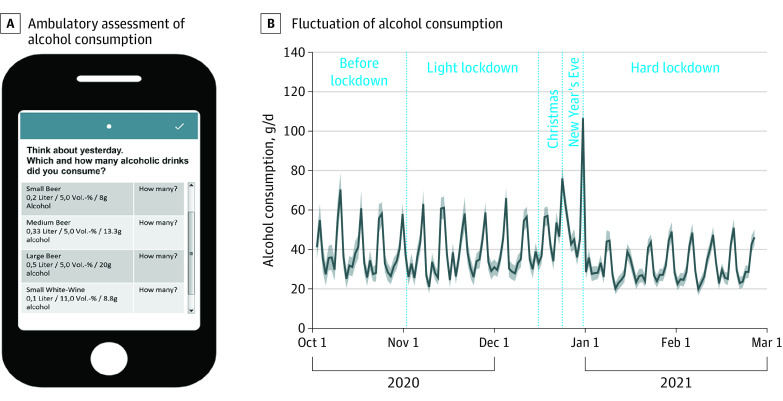
DESIGN, SETTING, AND PARTICIPANTS: This quantitative, intensive, longitudinal cohort study recruited 1743 participants from 3 sites from February 20, 2020, to February 28, 2021. Data were provided before and within the second lockdown of the COVID-19 pandemic in Germany: before lockdown (October 2 to November 1, 2020); light lockdown (November 2 to December 15, 2020); and hard lockdown (December 16, 2020, to February 28, 2021).
Daily ratings of AC (main outcome) captured during 3 lockdown phases (main variable) and temporal (weekends and holidays) and psychological (social isolation and drinking intention) correlates.
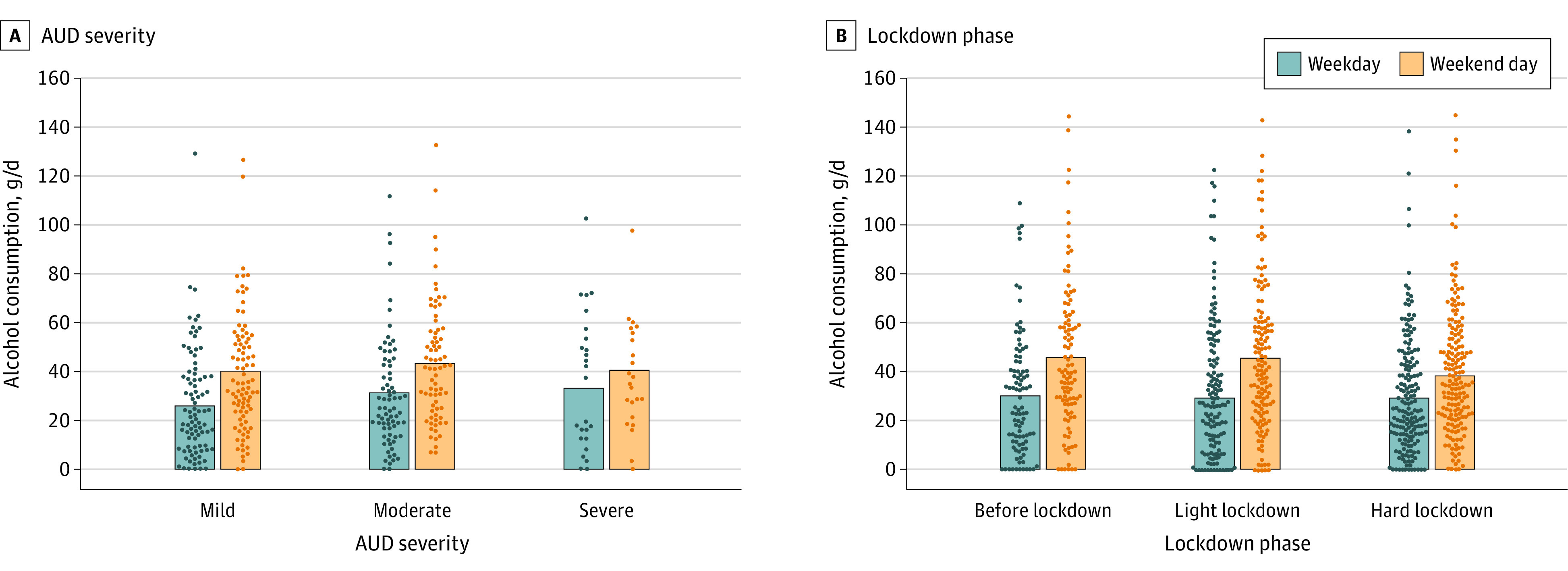
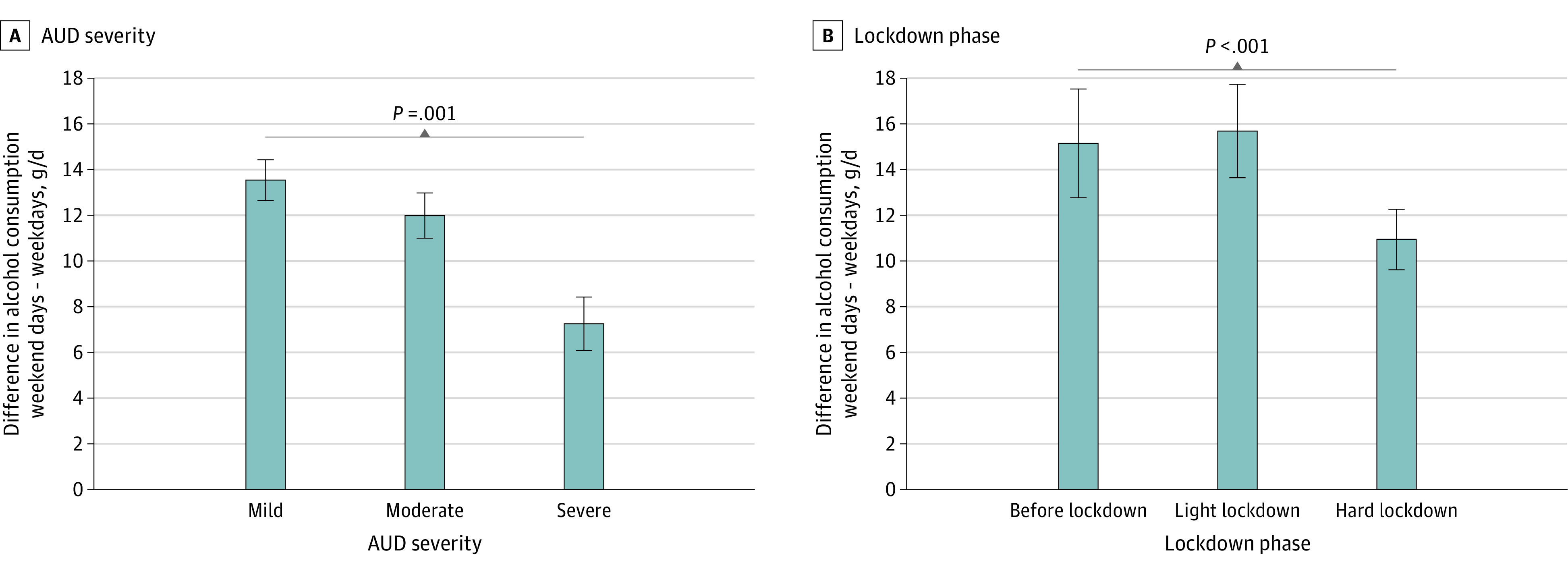
Of the 1743 screened participants, 189 (119 [63.0%] male; median [IQR] age, 37 [27.5-52.0] years) with at least 2 alcohol use disorder (AUD) criteria according to the Diagnostic and Statistical Manual of Mental Disorders (Fifth Edition) yet without the need for medically supervised alcohol withdrawal were included. These individuals provided 14 694 smartphone ratings from October 2020 through February 2021. Multilevel modeling revealed significantly higher AC (grams of alcohol per day) on weekend days vs weekdays (β = 11.39; 95% CI, 10.00-12.77; P < .001). Alcohol consumption was above the overall average on Christmas (β = 26.82; 95% CI, 21.87-31.77; P < .001) and New Year's Eve (β = 66.88; 95% CI, 59.22-74.54; P < .001). During the hard lockdown, perceived social isolation was significantly higher (β = 0.12; 95% CI, 0.06-0.15; P < .001), but AC was significantly lower (β = -5.45; 95% CI, -8.00 to -2.90; P = .001). Independent of lockdown, intention to drink less alcohol was associated with lower AC (β = -11.10; 95% CI, -13.63 to -8.58; P < .001). Notably, differences in AC between weekend and weekdays decreased both during the hard lockdown (β = -6.14; 95% CI, -9.96 to -2.31; P = .002) and in participants with severe AUD (β = -6.26; 95% CI, -10.18 to -2.34; P = .002).
This 5-month cohort study found no immediate negative associations of lockdown measures with overall AC. Rather, weekend-weekday and holiday AC patterns exceeded lockdown effects. Differences in AC between weekend days and weekdays evinced that weekend drinking cycles decreased as a function of AUD severity and lockdown measures, indicating a potential mechanism of losing and regaining control. This finding suggests that temporal patterns and drinking intention constitute promising targets for prevention and intervention, even in high-risk individuals.
饮酒(AC)在全球范围内导致死亡和残疾。需要根据真实世界的证据来讨论 COVID-19 大流行对 AC 可能产生的负面影响。
研究封锁措施是否与 AC 以及与消费相关的时间和心理内在机制有关。
设计、地点和参与者:这是一项定量、密集、纵向队列研究,从 2020 年 2 月 20 日至 28 日在德国的 3 个地点招募了 1743 名参与者。数据是在德国 COVID-19 大流行的第二次封锁之前和期间提供的:封锁前(2020 年 10 月 2 日至 11 月 1 日);轻度封锁(2020 年 11 月 2 日至 12 月 15 日);和严格封锁(2020 年 12 月 16 日至 2021 年 2 月 28 日)。
在 3 个封锁阶段(主要变量)期间,每天对 AC(主要结果)进行评分,并对时间(周末和节假日)和心理(社会隔离和饮酒意图)相关因素进行评估。
在筛选出的 1743 名参与者中,有 189 名(119 名男性[63.0%];中位数[IQR]年龄为 37 [27.5-52.0]岁)至少符合精神障碍诊断与统计手册(第五版)的 6 项酒精使用障碍(AUD)标准,但不需要医疗监督的酒精戒断。这些人在 2020 年 10 月至 2021 年 2 月期间通过智能手机提供了 14694 次评分。多层次模型显示,周末饮酒量(克酒精/天)显著高于工作日(β=11.39;95%CI,10.00-12.77;P<0.001)。圣诞节(β=26.82;95%CI,21.87-31.77;P<0.001)和新年前夜(β=66.88;95%CI,59.22-74.54;P<0.001)的酒精摄入量高于总体平均值。在严格封锁期间,感知到的社会隔离显著增加(β=0.12;95%CI,0.06-0.15;P<0.001),但酒精摄入量显著降低(β=-5.45;95%CI,-8.00 至-2.90;P=0.001)。独立于封锁,减少饮酒的意图与较低的 AC 相关(β=-11.10;95%CI,-13.63 至-8.58;P<0.001)。值得注意的是,周末和工作日之间的 AC 差异在严格封锁期间(β=-6.14;95%CI,-9.96 至-2.31;P=0.002)和 AUD 严重程度较高的参与者中(β=-6.26;95%CI,-10.18 至-2.34;P=0.002)都有所降低。
这项为期 5 个月的队列研究没有发现封锁措施与总体 AC 之间的直接负面关联。相反,周末-工作日和节假日的 AC 模式超过了封锁的影响。周末和工作日之间的 AC 差异表明,随着 AUD 严重程度和封锁措施的变化,周末饮酒周期减少,表明存在失去和重新获得控制的潜在机制。这一发现表明,时间模式和饮酒意图是预防和干预的有希望的目标,即使是在高危人群中。