Daigre Constanza, Palma-Álvarez Raul Felipe, Sorribes-Puertas Marta, Ortega-Hernández German, Perea-Ortueta Marta, Ros-Cucurull Elena, Segura Lidia, Colom Joan, Braquehais Maria Dolores, Ramos-Quiroga Josep Antoni, Grau-López Lara
Department of Psychiatry, Hospital Universitari Vall d'Hebron, Barcelona, Spain.
Department of Psychiatry and Forensic Medicine, Universitat Autònoma de Barcelona, Bellaterra, Spain.
Front Psychiatry. 2024 Feb 8;15:1339730. doi: 10.3389/fpsyt.2024.1339730. eCollection 2024.
The COVID-19 pandemic has impacted the mental health of patients with substance use disorder (SUD). However, few longitudinal studies have been done which examine associations between the pandemic, SUD patients' mental health and their drug use.
This study aimed to examine duration of abstinence according to psychiatric status among SUD outpatients followed-up for 18 months from the pandemic related lockdown.
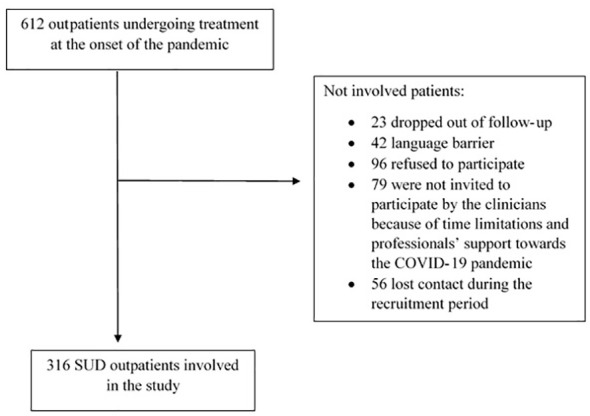
A follow-up study of 316 SUD outpatients was undertaken. Sociodemographic features, and clinical and consumption related variables were recorded. Pre, during and post lockdown information was evaluated. Abstinence/substance use was monitored at the patient's scheduled follow-up appointments, and psychiatric disorders and psychological variables were revaluated at 18 months.
Survival analyses were used to compare the duration of abstinence (in months) from the beginning of the lockdown. It was observed that 70% of patients consumed the main substance for which they were being treated at some point during the follow-up. Men, younger patients, those with more symptoms of anxiety and personality disorders, and patients who experienced increased craving during follow-up, showed shorter duration of abstinence. While patients who had previously maintained at least one year of abstinence, achieved better results.
During the first year and a half of the pandemic, SUD outpatients presented alterations in mental health, such us anxiety, depression and maladaptive personality traits and a high rate of relapse. For this reason, despite the health and social crisis and their restrictive measures, a comprehensive treatment should be ensured.
新冠疫情对物质使用障碍(SUD)患者的心理健康产生了影响。然而,很少有纵向研究探讨疫情、SUD患者的心理健康与其药物使用之间的关联。
本研究旨在根据疫情相关封锁措施实施18个月以来接受随访的SUD门诊患者的精神状态,研究其戒断持续时间。
对316名SUD门诊患者进行了一项随访研究。记录了社会人口学特征以及与临床和消费相关的变量。评估了封锁前、封锁期间和封锁后的信息。在患者预定的随访预约中监测戒断/物质使用情况,并在18个月时重新评估精神障碍和心理变量。
采用生存分析比较自封锁开始以来的戒断持续时间(以月为单位)。结果发现,70%的患者在随访期间的某个时间点使用了他们正在接受治疗的主要物质。男性、年轻患者、焦虑和人格障碍症状较多的患者以及随访期间渴望增加的患者,戒断持续时间较短。而之前保持至少一年戒断的患者取得了更好的结果。
在疫情的头一年半时间里,SUD门诊患者出现了心理健康方面的变化,如焦虑、抑郁和适应不良的人格特质,以及较高的复发率。因此,尽管面临健康和社会危机及其限制措施,仍应确保提供全面的治疗。