From the British Columbia Centre on Substance Use, Vancouver, BC, Canada (SL, MES, NF, KH, MJM); UCLA Cannabis Research Initiative, Jane and Terry Semel Institute for Neuroscience and Human Behavior, University of California, Los Angeles, Los Angeles, CA (SL, ZDC); Department of Psychiatry and Biobehavioral Sciences, University of California, Los Angeles, Los Angeles, CA (SL, ZDC); School of Population and Public Health, University of British Columbia, Vancouver, BC, Canada (JB); Department of Psychology, University of British Columbia, Kelowna, BC, Canada (ZW); Division of Social Medicine, Department of Medicine, University of British Columbia, St. Paul's Hospital, Vancouver, BC, Canada (MES, NF, MJM); and Faculty of Health Sciences, Simon Fraser University, Burnaby, BC, Canada (KH).
J Addict Med. 2023;17(1):e18-e26. doi: 10.1097/ADM.0000000000001032. Epub 2022 Aug 2.
Lower daily methadone dose is negatively associated with retention in methadone maintenance treatment (MMT). Cannabis use during MMT is common, with many patients reporting its use for opioid withdrawal mitigation. We sought to test whether the association between lower MMT dose and treatment retention differs by concurrent high-frequency cannabis use in a community sample of people on MMT.
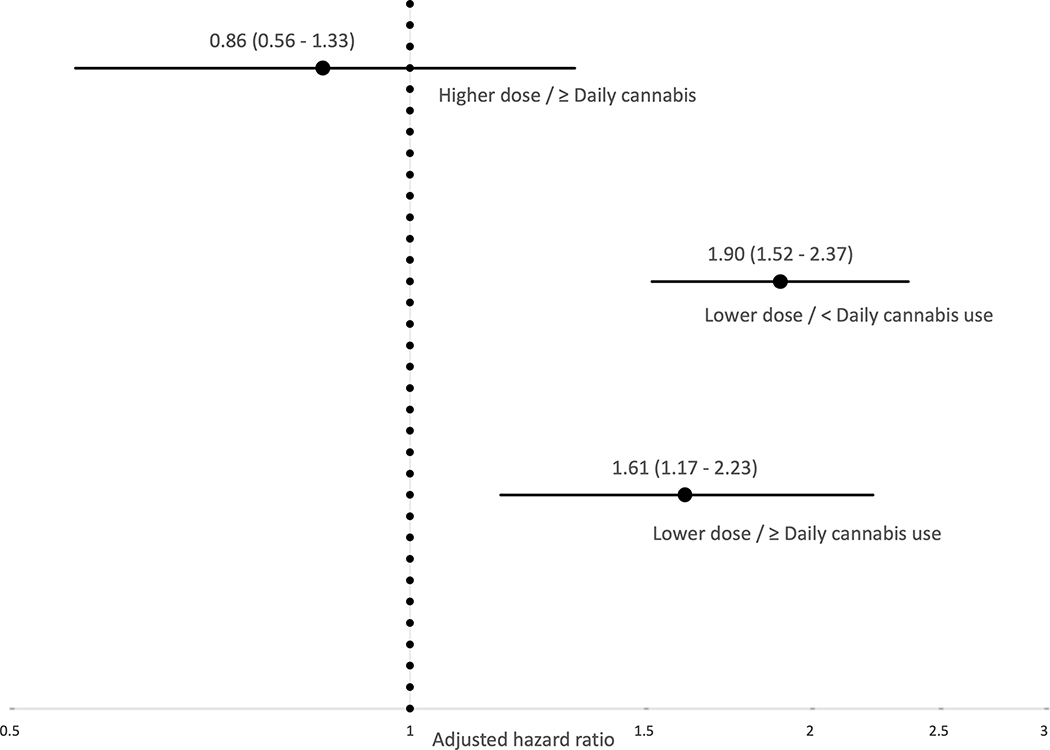
We obtained data from participants initiating MMT in 2 community-recruited prospective cohorts of people who use drugs in Vancouver, Canada. We built multivariable Cox frailty models to estimate the relationships between MMT dose (<90 mg/d vs ≥90 mg/d) and time to treatment discontinuation. We included an interaction term to test whether high-frequency (≥daily) cannabis use modified the measured effect of lower treatment dose on treatment retention.
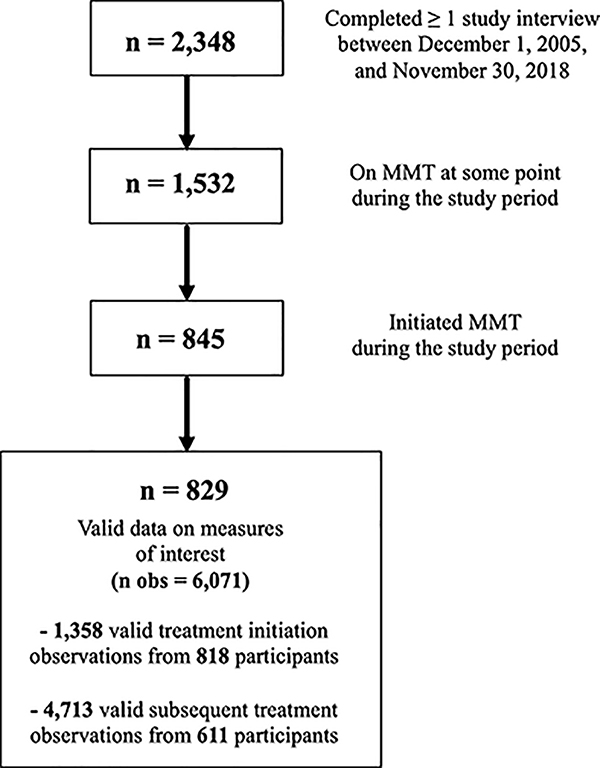
Between December 2005 and December 2018, 829 participants (54.1%) initiated at least 1 MMT episode and were included in the analysis. Lower MMT dose was strongly positively associated with treatment discontinuation regardless of concurrent high-frequency cannabis use (interaction P > 0.05). Structural factors including homelessness and incarceration were significantly and positively associated with treatment discontinuation.
Although we previously found the magnitude and strength of the relationship between lower MMT dose and high-frequency unregulated opioid use to be tempered during high-frequency cannabis use periods, this effect measure modification does not appear to translate to time retained in treatment. Cannabis-based interventions to promote retention in MMT are unlikely to produce long-term benefit without addressing external factors that place MMT patients at increased risk of treatment discontinuation.
每日美沙酮剂量较低与美沙酮维持治疗(MMT)的保留率呈负相关。在 MMT 期间使用大麻较为常见,许多患者报告称其用于缓解阿片类药物戒断。我们试图检验在一个接受 MMT 的社区人群样本中,MMT 剂量较低与治疗保留之间的关联是否因同时高频使用大麻而有所不同。
我们从加拿大温哥华两个社区招募的正在使用毒品的人群中,获取了开始 MMT 的参与者的数据。我们构建了多变量 Cox 脆弱性模型,以估计 MMT 剂量(<90mg/d 与 ≥90mg/d)与治疗终止时间之间的关系。我们纳入了一个交互项,以检验高频(≥每日)大麻使用是否改变了较低治疗剂量对治疗保留的测量效果。
2005 年 12 月至 2018 年 12 月期间,829 名参与者(54.1%)至少开始了 1 次 MMT 治疗,纳入了分析。无论是否同时高频使用大麻,较低的 MMT 剂量都与治疗中断呈强烈的正相关(交互 P > 0.05)。结构因素,包括无家可归和监禁,与治疗中断显著且呈正相关。
尽管我们之前发现,在高频大麻使用期间,较低 MMT 剂量与高频未受监管的阿片类药物使用之间的关系的幅度和强度有所减弱,但这种效果修正似乎不会转化为治疗保留的时间。如果不解决使 MMT 患者面临更高治疗中断风险的外部因素,基于大麻的干预措施不太可能对促进 MMT 保留产生长期益处。