Department of International Public Health, Liverpool School of Tropical Medicine, Liverpool, UK
Actions Transforming Lives, Monrovia, Liberia.
BMJ Open. 2022 Aug 1;12(8):e058626. doi: 10.1136/bmjopen-2021-058626.
COVID-19 has tested the resilience of health systems globally and exposed existing strengths and weaknesses. We sought to understand health systems COVID-19 adaptations and decision making in Liberia and Merseyside, UK.
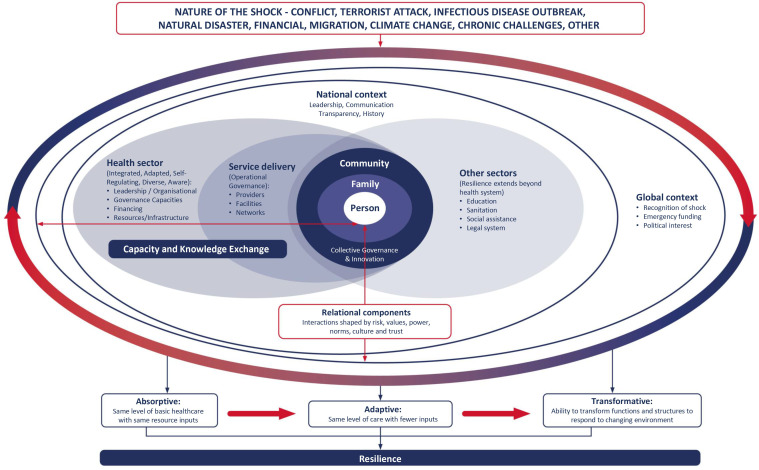
We used a people-centred approach to carry out qualitative interviews with 24 health decision-makers at national and county level in Liberia and 42 actors at county and hospital level in the UK (Merseyside). We explored health systems' decision-making processes and capacity to adapt and continue essential service delivery in response to COVID-19 in both contexts.
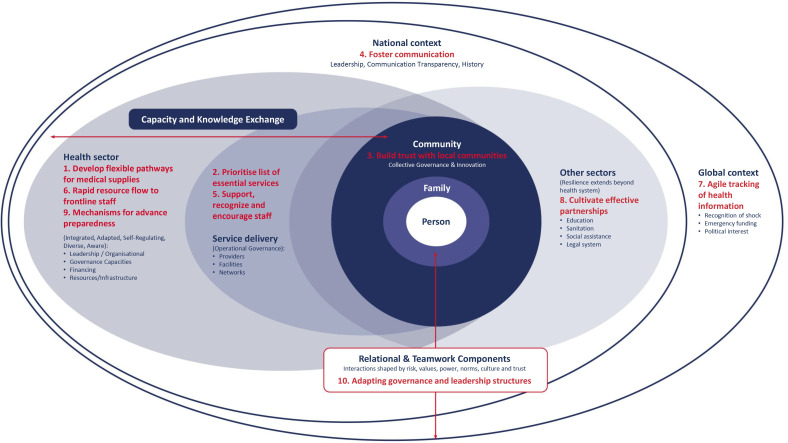
Study respondents in Liberia and Merseyside had similar experiences in responding to COVID-19, despite significant differences in health systems context, and there is an opportunity for multidirectional learning between the global south and north. The need for early preparedness; strong community engagement; clear communication within the health system and health service delivery adaptations for essential health services emerged strongly in both settings. We found the Foreign, Commonwealth and Development Office (FCDO) principles to have value as a framework for reviewing health systems changes, across settings, in response to a shock such as a pandemic. In addition to the eight original principles, we expanded to include two additional principles: (1) the need for functional structures and mechanisms for preparation and (2) adaptable governance and leadership structures to facilitate timely decision making and response coordination. We find the use of a people-centred approach also has value to prompt policy-makers to consider the acceptance of service adaptations by patients and health workers, and to continue the provision of 'routine services' for individuals during health systems shocks.
Our study highlights the importance of a people-centred approach, placing the person at the centre of the health system, and value in applying and adapting the FCDO principles across diverse settings.
COVID-19 对全球卫生系统的弹性进行了检验,暴露出了现有优势和劣势。我们试图了解利比里亚和英国默西塞德郡的卫生系统应对 COVID-19 的调整和决策。
我们采用以人为本的方法,在利比里亚的国家和县级层面与 24 名卫生决策者以及英国默西塞德郡(Merseyside)的县级和医院级别的 42 名参与者进行了定性访谈。我们探讨了卫生系统在这两个环境中应对 COVID-19 时的决策过程和适应能力,以及继续提供基本服务的能力。
尽管利比里亚和默西塞德郡的卫生系统背景存在显著差异,但应对 COVID-19 的研究受访者有类似的经历,因此南北双方之间存在相互学习的机会。在这两个地方都强烈需要早期的准备工作;强大的社区参与;卫生系统内部的明确沟通;对基本卫生服务的调整。我们发现,外交、联邦和发展办公室(FCDO)的原则具有作为审查卫生系统变化的框架的价值,这些变化是针对像大流行这样的冲击而做出的。除了最初的八项原则外,我们还扩展到包括另外两项原则:(1)需要有功能结构和机制来进行准备;(2)灵活的治理和领导结构,以促进及时的决策和协调。我们发现,采用以人为本的方法也具有价值,可以促使政策制定者考虑患者和卫生工作者对服务调整的接受程度,并在卫生系统受到冲击时继续为个人提供“常规服务”。
我们的研究强调了以人为本的方法的重要性,将人置于卫生系统的中心,以及在不同环境中应用和调整外交、联邦和发展办公室原则的价值。