Topp Stephanie M
College of Public Health, Medical and Veterinary Sciences, James Cook University, Townsville, QLD, Australia.
Int J Health Policy Manag. 2024;13:8606. doi: 10.34172/ijhpm.8606. Epub 2024 Aug 12.
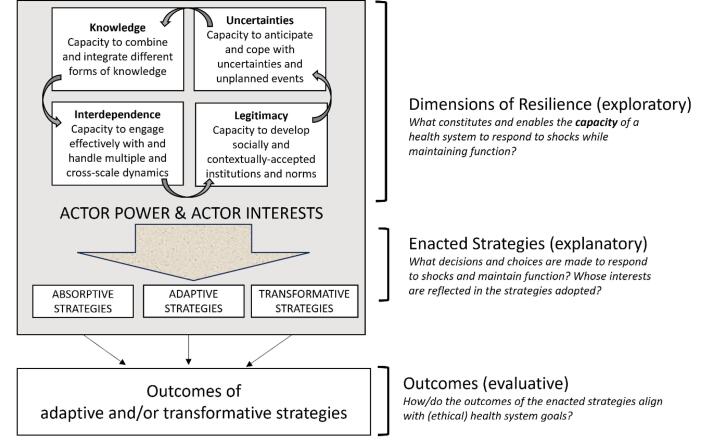
The concept of health system resilience has gained prominence in global health discourse, especially in response to the Ebola and COVID-19 pandemics. This commentary responds to Saulnier and colleagues' 2022 review, which used the Dimensions of Resilience Governance framework to synthesize of COVID-19 related health system resilience research and explore possible conceptual gaps. The review's findings reveal elements missing from the original framework which underscore the social nature of health systems. This commentary links the review's empirical findings to nascent theorization of health systems resilience to develop an adapted Framework for Exploratory Research on Health Systems Resilience. A key contribution of the adapted framework is to make explicit the role of actor power and highlight more clearly the distinctions between: () research focused on identifying the capacities needed to enable adaptation; () research focused on the actors whose interests and choices determine which adaptive strategies are used, and () research that assess the outcomes of such strategies.
卫生系统韧性的概念在全球卫生讨论中日益突出,尤其是在应对埃博拉疫情和新冠疫情方面。本评论回应了索尔nier及其同事2022年的综述,该综述使用韧性治理维度框架对与新冠疫情相关的卫生系统韧性研究进行了综合,并探讨了可能存在的概念空白。该综述的结果揭示了原始框架中缺失的要素,这些要素强调了卫生系统的社会性质。本评论将该综述的实证结果与卫生系统韧性的新兴理论联系起来,以开发一个适应性的卫生系统韧性探索性研究框架。适应性框架的一个关键贡献是明确行为者权力的作用,并更清晰地突出以下三者之间的区别:()专注于确定实现适应所需能力的研究;()专注于其利益和选择决定采用何种适应策略的行为者的研究;以及()评估此类策略结果的研究。