Division of Systems Neuroscience, Research Foundation for Mental Hygiene, Inc. (RFMH)/New York State Psychiatric Institute (NYSPI), Department of Psychiatry, Columbia University Irving Medical Center (CUIMC), New York, NY, 10032, USA.
Division of Translational Epidemiology, Research Foundation for Mental Hygiene, Inc. (RFMH)/New York State Psychiatric Institute (NYSPI), Department of Psychiatry, Columbia University Irving Medical Center (CUIMC), New York, NY, 10032, USA.
Transl Psychiatry. 2022 Aug 1;12(1):306. doi: 10.1038/s41398-022-02092-9.
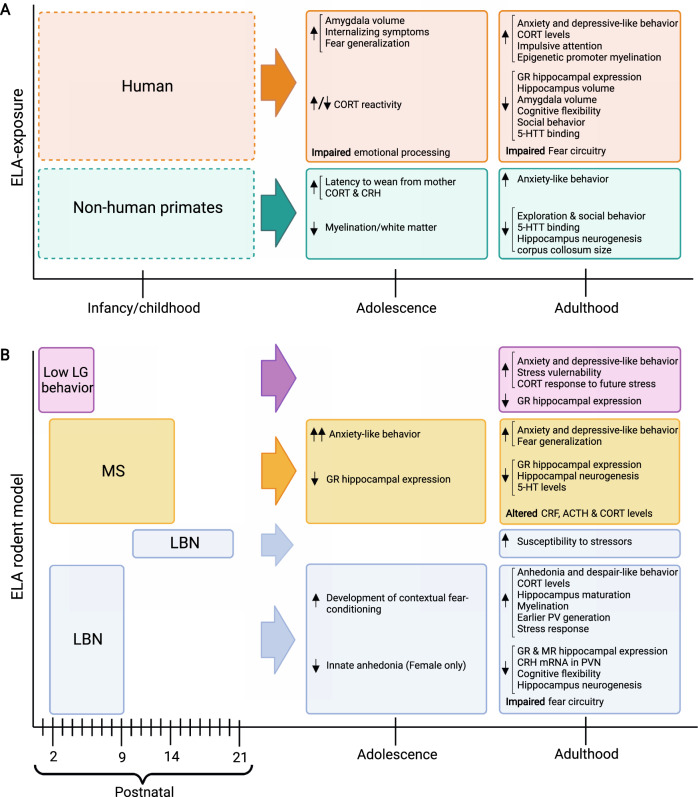
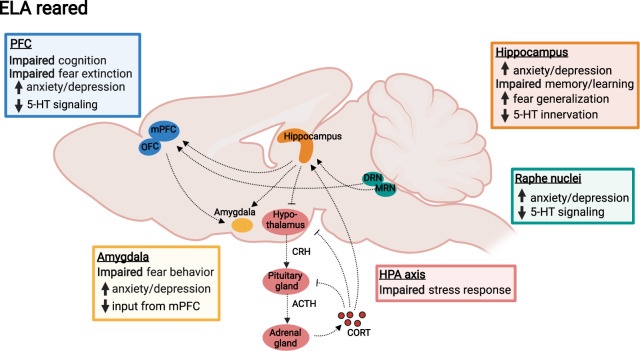
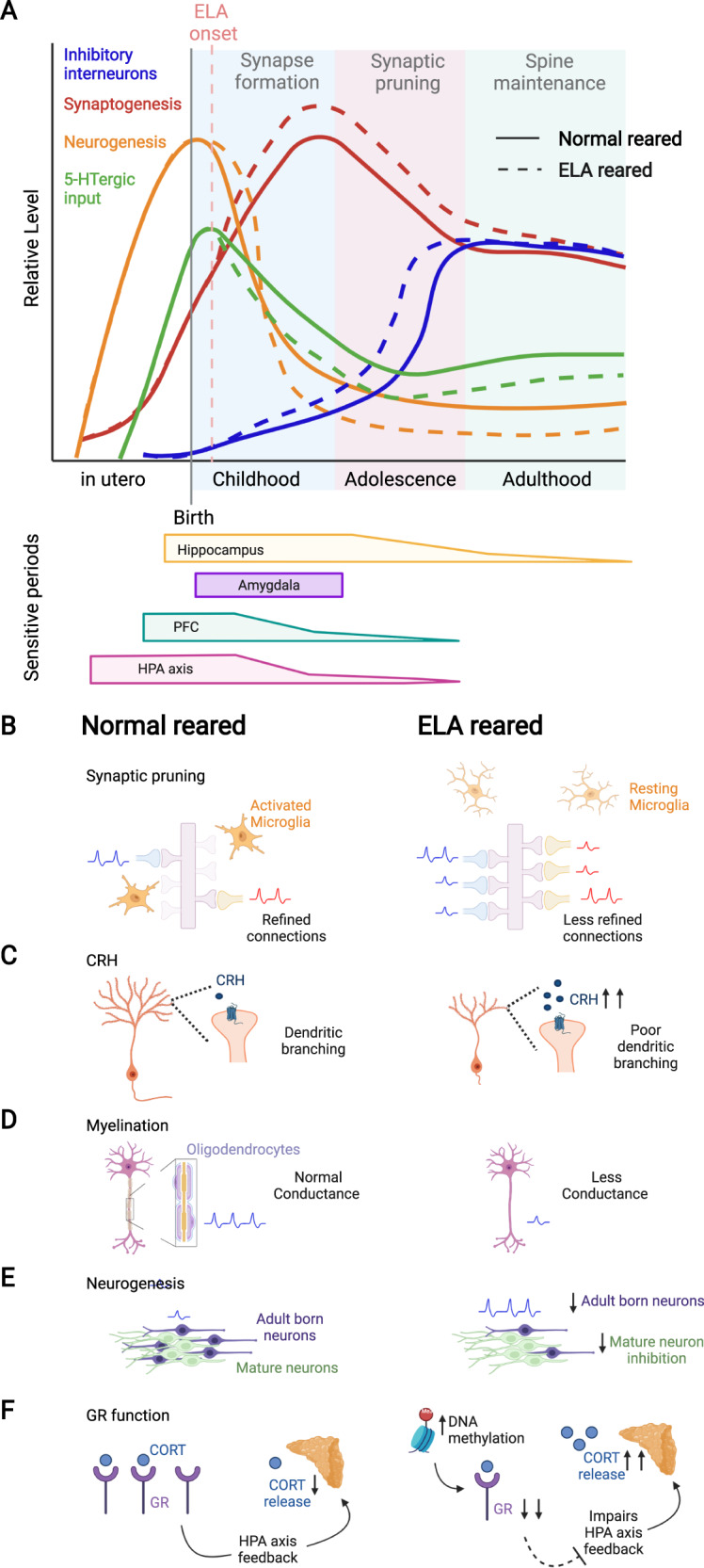
Early life adversity (ELA) is a major risk factor for mental illness, but the neurobiological mechanisms by which ELA increases the risk for future psychopathology are still poorly understood. Brain development is particularly malleable during prenatal and early postnatal life, when complex neural circuits are being formed and refined through an interplay of excitatory and inhibitory neural input, synaptogenesis, synaptic pruning, myelination, and neurogenesis. Adversity that influences these processes during sensitive periods of development can thus have long-lasting and pervasive effects on neural circuit maturation. In this review, we will discuss clinical and preclinical evidence for the impact of ELA on neural circuit formation with a focus on the early postnatal period, and how long-lasting impairments in these circuits can affect future behavior. We provide converging evidence from human and animal studies on how ELA alters the functional development of brain regions, neural circuits, and neurotransmitter systems that are crucial for cognition and affective behavior, including the hippocampus, the hypothalamus-pituitary-adrenal (HPA) axis, neural networks of fear responses and cognition, and the serotonin (5-HT) system. We also discuss how gene-by-environment (GxE) interactions can determine individual differences in susceptibility and resilience to ELA, as well as molecular pathways by which ELA regulates neural circuit development, for which we emphasize epigenetic mechanisms. Understanding the molecular and neurobiological mechanisms underlying ELA effects on brain function and psychopathology during early postnatal sensitive periods may have great potential to advance strategies to better treat or prevent psychiatric disorders that have their origin early in life.
早期生活逆境(ELA)是精神疾病的主要风险因素,但 ELA 增加未来精神病理学风险的神经生物学机制仍知之甚少。大脑在产前和产后早期发育期间特别具有可塑性,在此期间,通过兴奋性和抑制性神经输入、突触发生、突触修剪、髓鞘形成和神经发生的相互作用,复杂的神经回路正在形成和完善。因此,在发育敏感时期影响这些过程的逆境会对神经回路成熟产生持久而普遍的影响。在这篇综述中,我们将讨论临床和临床前证据,说明 ELA 对神经回路形成的影响,重点是产后早期,以及这些回路的持久损伤如何影响未来的行为。我们提供了来自人类和动物研究的综合证据,说明 ELA 如何改变大脑区域、神经回路和神经递质系统的功能发育,这些区域和神经递质系统对认知和情感行为至关重要,包括海马体、下丘脑-垂体-肾上腺(HPA)轴、恐惧反应和认知的神经网络以及 5-羟色胺(5-HT)系统。我们还讨论了基因-环境(GxE)相互作用如何决定个体对 ELA 的易感性和弹性差异,以及 ELA 调节神经回路发育的分子途径,我们强调了表观遗传机制。了解 ELA 对大脑功能和产后早期敏感时期精神病理学影响的分子和神经生物学机制,可能为推进治疗或预防起源于生命早期的精神障碍的策略提供巨大潜力。