Castle Biosciences, Inc., Friendswood, Texas, USA.
Melanoma Research Foundation, Washington, District of Columbia, USA.
Cancer Med. 2023 Jan;12(2):2008-2015. doi: 10.1002/cam4.5047. Epub 2022 Aug 1.
Although most patients diagnosed with early-stage cutaneous melanoma (CM) have excellent outcomes, because of the large number diagnosed each year, many will experience recurrence or death. Prognostic testing for CM using the 31-gene expression profile (31-GEP) test can benefit patients by helping guide risk-appropriate treatment and surveillance plans. We sought to evaluate patients' attitudes toward prognostic testing with the 31-GEP and assess whether patients experience decision regret about having 31-GEP testing.
A 43-question survey was distributed by the Melanoma Research Foundation in June-August 2021 to CM patients enrolled in their database. Patients were asked questions regarding their decision to undergo 31-GEP testing and the extent to which they experienced decision regret using a validated set of Decision Regret Scale questions.
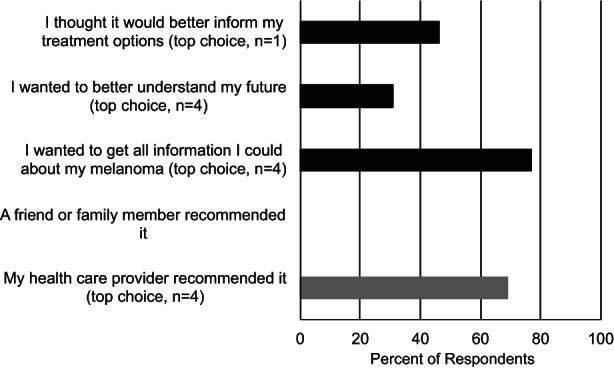
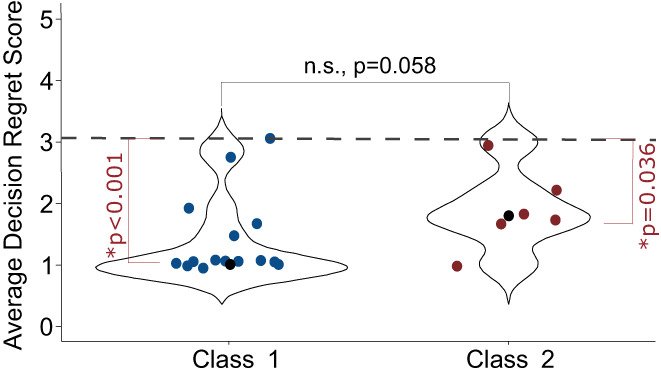
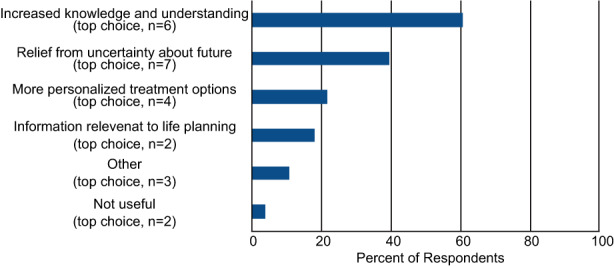
We analyzed responses from patients diagnosed in 2014 or later (n = 120). Of these, 28 had received 31-GEP testing. Most respondents (n = 108, 90%) desired prognostic information when diagnosed. Of those who received 31-GEP testing, most felt the results were useful (n = 22 out of 24) and had regret scores significantly less than neutral regret, regardless of their test results (Class 1: p < 0.001; Class 2: p = 0.036). Further, decision regret scores were not significantly different between patients who received a Class 1 31-GEP result and those who received a Class 2 result (mean Class 1 = 1.39 and mean Class 2 = 1.90, p = 0.058).
Most newly diagnosed CM patients desired prognostic information about their tumors. Patients who received 31-GEP testing felt it was useful and did not regret their decision to undergo 31-GEP testing.
尽管大多数早期皮肤黑色素瘤 (CM) 患者的预后良好,但由于每年诊断出的患者数量众多,许多患者仍会经历复发或死亡。使用 31 个基因表达谱 (31-GEP) 检测对 CM 进行预后检测,可以通过帮助指导风险适当的治疗和监测计划,使患者受益。我们旨在评估患者对 31-GEP 预后检测的态度,并评估患者是否对进行 31-GEP 检测感到决策后悔。
2021 年 6 月至 8 月,黑色素瘤研究基金会向其数据库中登记的 CM 患者分发了一份包含 43 个问题的调查问卷。患者被问及进行 31-GEP 检测的决定以及使用经过验证的决策后悔量表问题来评估他们经历决策后悔的程度。
我们分析了 2014 年或之后诊断的患者的回答(n = 120)。其中,28 人接受了 31-GEP 检测。大多数受访者(n = 108,90%)在诊断时希望获得预后信息。在接受 31-GEP 检测的患者中,大多数人认为检测结果有用(n = 22 例,占 24 例),无论检测结果如何,他们的后悔得分均明显低于中性后悔(Class 1:p < 0.001;Class 2:p = 0.036)。此外,接受 Class 1 31-GEP 检测结果和接受 Class 2 检测结果的患者之间的决策后悔得分没有显著差异(平均 Class 1 为 1.39,平均 Class 2 为 1.90,p = 0.058)。
大多数新诊断的 CM 患者希望获得有关其肿瘤的预后信息。接受 31-GEP 检测的患者认为该检测有用,并且不后悔接受 31-GEP 检测的决定。