Princess Máxima Center for Pediatric Oncology, Utrecht, The Netherlands.
Oncode Institute, Utrecht, The Netherlands.
EMBO Mol Med. 2022 Oct 10;14(10):e16001. doi: 10.15252/emmm.202216001. Epub 2022 Aug 2.
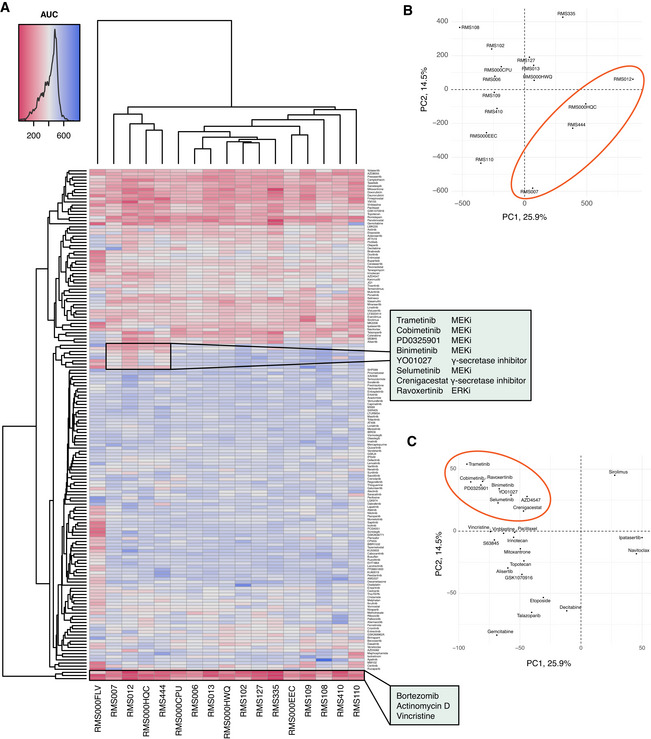
Rhabdomyosarcomas (RMS) are mesenchyme-derived tumors and the most common childhood soft tissue sarcomas. Treatment is intense, with a nevertheless poor prognosis for high-risk patients. Discovery of new therapies would benefit from additional preclinical models. Here, we describe the generation of a collection of 19 pediatric RMS tumor organoid (tumoroid) models (success rate of 41%) comprising all major subtypes. For aggressive tumors, tumoroid models can often be established within 4-8 weeks, indicating the feasibility of personalized drug screening. Molecular, genetic, and histological characterization show that the models closely resemble the original tumors, with genetic stability over extended culture periods of up to 6 months. Importantly, drug screening reflects established sensitivities and the models can be modified by CRISPR/Cas9 with TP53 knockout in an embryonal RMS model resulting in replicative stress drug sensitivity. Tumors of mesenchymal origin can therefore be used to generate organoid models, relevant for a variety of preclinical and clinical research questions.
横纹肌肉瘤(RMS)是间充质来源的肿瘤,也是儿童中最常见的软组织肉瘤。治疗强度大,但高危患者的预后仍然较差。新疗法的发现将受益于更多的临床前模型。在这里,我们描述了一组 19 种儿科 RMS 肿瘤类器官(肿瘤类器官)模型的生成(成功率为 41%),包括所有主要亚型。对于侵袭性肿瘤,肿瘤类器官模型通常可以在 4-8 周内建立,这表明个性化药物筛选的可行性。分子、遗传和组织学特征表明,这些模型与原始肿瘤非常相似,在长达 6 个月的延长培养期间遗传稳定性良好。重要的是,药物筛选反映了既定的敏感性,并且可以通过 CRISPR/Cas9 在胚胎 RMS 模型中进行基因编辑,敲除 TP53 导致复制应激药物敏感性。因此,可以使用源自间充质的肿瘤来生成与各种临床前和临床研究问题相关的类器官模型。