Earth System Analysis, Potsdam Institute for Climate Impact Research, Member of the Leibniz Association, 14473 Potsdam, Germany.
Institute of Physics and Astronomy, University of Potsdam, 14476 Potsdam, Germany.
Proc Natl Acad Sci U S A. 2022 Aug 9;119(32):e2120777119. doi: 10.1073/pnas.2120777119. Epub 2022 Aug 2.
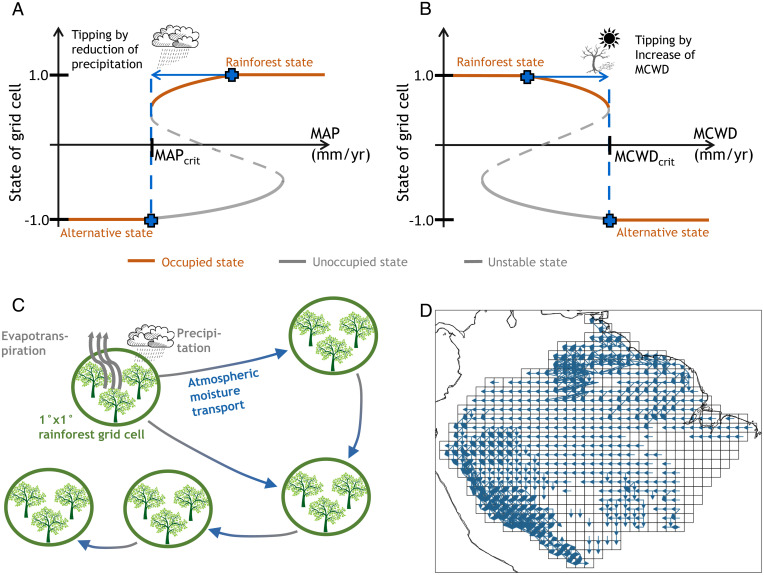
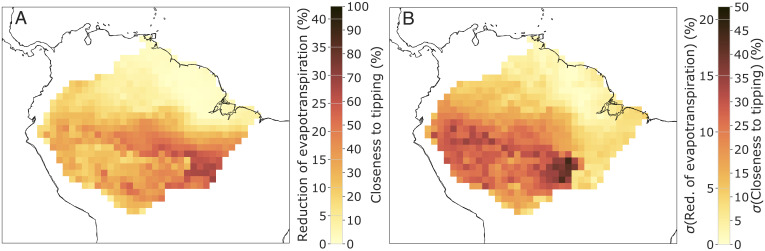
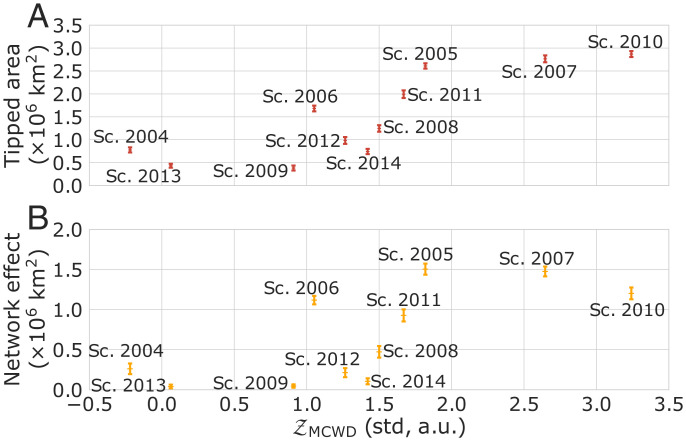
Tipping elements are nonlinear subsystems of the Earth system that have the potential to abruptly shift to another state if environmental change occurs close to a critical threshold with large consequences for human societies and ecosystems. Among these tipping elements may be the Amazon rainforest, which has been undergoing intensive anthropogenic activities and increasingly frequent droughts. Here, we assess how extreme deviations from climatological rainfall regimes may cause local forest collapse that cascades through the coupled forest-climate system. We develop a conceptual dynamic network model to isolate and uncover the role of atmospheric moisture recycling in such tipping cascades. We account for heterogeneity in critical thresholds of the forest caused by adaptation to local climatic conditions. Our results reveal that, despite this adaptation, a future climate characterized by permanent drought conditions could trigger a transition to an open canopy state particularly in the southern Amazon. The loss of atmospheric moisture recycling contributes to one-third of the tipping events. Thus, by exceeding local thresholds in forest adaptive capacity, local climate change impacts may propagate to other regions of the Amazon basin, causing a risk of forest shifts even in regions where critical thresholds have not been crossed locally.
tipping 元素是地球系统的非线性子系统,如果环境变化接近具有重大人类社会和生态系统后果的临界点,它们有可能突然转变为另一种状态。这些 tipping 元素可能包括亚马逊雨林,它一直在经历密集的人为活动和越来越频繁的干旱。在这里,我们评估极端偏离气候降雨模式如何可能导致局部森林崩溃,这种崩溃通过耦合的森林-气候系统级联。我们开发了一个概念性的动态网络模型,以隔离和揭示大气水分再循环在这种 tipping 级联中的作用。我们考虑了由于适应当地气候条件而导致的森林关键阈值的异质性。我们的结果表明,尽管存在这种适应,未来以永久干旱条件为特征的气候可能会引发向开阔树冠状态的转变,特别是在南亚马逊地区。大气水分再循环的损失促成了三分之一的 tipping 事件。因此,通过超过森林适应能力的本地阈值,当地气候变化的影响可能会传播到亚马逊盆地的其他地区,即使在局部没有超过关键阈值的地区,也会导致森林转变的风险。