Department of Clinical Laboratory, Daping Hospital, Third Military Medical University (Army Medical University), Chongqing, China.
Department of Clinical Laboratory and Pathology, The People's Liberation Army 77th Group Army Hospital, Leshan, Sichuan, China.
J Clin Lab Anal. 2022 Sep;36(9):e24627. doi: 10.1002/jcla.24627. Epub 2022 Aug 2.
Gestational diabetes mellitus (GDM) and gestational diabetic nephropathy (GDN) have become an increasingly serious problem worldwide, which can cause a large number of adverse pregnancy consequences for mothers and infants. However, the diagnosis of GDM and GDN remains a challenge due to the lack of optimal biomarkers, and the examination has high requirements for patient compliance. We aimed to establish a simple early diagnostic model for GDM and GDN.
We recruited 50 healthy pregnant (HP), 99 GDM patients, 99 GDN patients at Daping Hospital. Renal function indicators and blood cell indicators were collected for all patients.
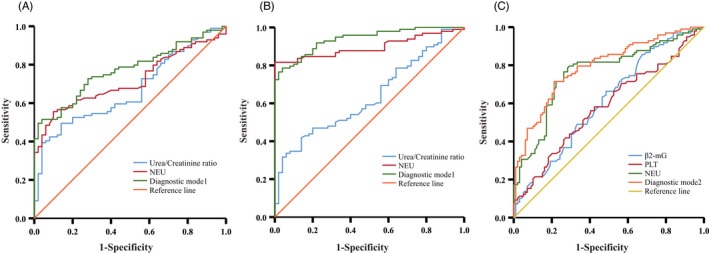
Compared with HP, GDM, and GDN patients exhibited significantly higher urea/creatinine ratio and NEU. The diagnostic model1 based on the combination of urea/creatinine ratio and NEU was built using logistic regression. Based on receiver operating characteristic curve analysis, the area under the curve (AUC) of the diagnostic model was 0.77 (0.7, 0.84) in distinguishing GDM from HP, and the AUC of the diagnostic model was 0.94 (0.9, 0.97) in distinguishing GDN from HP. Meanwhile, the diagnostic model2 based on the combination of β2-mG, PLT, and NEU in GDM and GDN patients was built using logistic regression, and the area under the ROC curve (AUC ROC) was 0.79 (0.73, 0.85), which was larger than the individual biomarker AUC.
Our study demonstrated that the diagnostic model established by the combination of renal function indicators and blood cell indicators could facilitate the differential diagnosis of GDM and GDN patients.
妊娠糖尿病(GDM)和妊娠糖尿病性肾病(GDN)已成为全球日益严重的问题,可导致母婴发生大量不良妊娠结局。然而,由于缺乏最佳生物标志物,GDM 和 GDN 的诊断仍然是一个挑战,并且检查对患者的依从性要求较高。我们旨在建立一种用于 GDM 和 GDN 的简单早期诊断模型。
我们招募了 50 名健康孕妇(HP)、99 名 GDM 患者和 99 名 GDN 患者。所有患者均采集肾功能指标和血细胞指标。
与 HP 相比,GDM 和 GDN 患者的尿素/肌酐比值和 NEU 明显升高。使用逻辑回归建立了基于尿素/肌酐比值和 NEU 组合的诊断模型 1。基于受试者工作特征曲线分析,诊断模型 1 区分 GDM 和 HP 的曲线下面积(AUC)为 0.77(0.7,0.84),诊断模型 1 区分 GDN 和 HP 的 AUC 为 0.94(0.9,0.97)。同时,使用逻辑回归建立了基于 GDM 和 GDN 患者β2-mG、PLT 和 NEU 组合的诊断模型 2,ROC 曲线下面积(AUC ROC)为 0.79(0.73,0.85),大于单个生物标志物 AUC。
我们的研究表明,通过联合肾功能指标和血细胞指标建立的诊断模型有助于鉴别诊断 GDM 和 GDN 患者。