Wang Yijue, Liu Yan, Gu Wenling, Cai Boyu, Lei Min, Luo Yingyu, Zhang Nannan
National Center for Birth Defect Monitoring, Key Laboratory of Birth Defects and Related Diseases of Women and Children, Ministry of Education, West China Second University Hospital, Sichuan University, Chengdu, Sichuan, China.
West China School of Stomatology, Sichuan University, Chengdu, Sichuan, China.
Front Endocrinol (Lausanne). 2025 Aug 18;16:1532682. doi: 10.3389/fendo.2025.1532682. eCollection 2025.
The significance of immune-inflammation indexes in diabetic nephropathy (DN) was assessed in this meta-analysis to offer guidance for clinical diagnosis and treatment for DN.
We performed a meta-analysis on the association between immune-inflammation indexes and the incidence and prognosis of DN, specifically focusing on the neutrophil-to-lymphocyte ratio (NLR), platelet-to-lymphocyte ratio (PLR), monocyte-to-lymphocyte ratio (MLR), systemic immune-inflammation index (SII), and systemic inflammation response index (SIRI). We thoroughly searched PubMed, Web of Science, Embase, and Cochrane from inception to September 2024. The statistical analysis was performed using R 4.2.3 software.
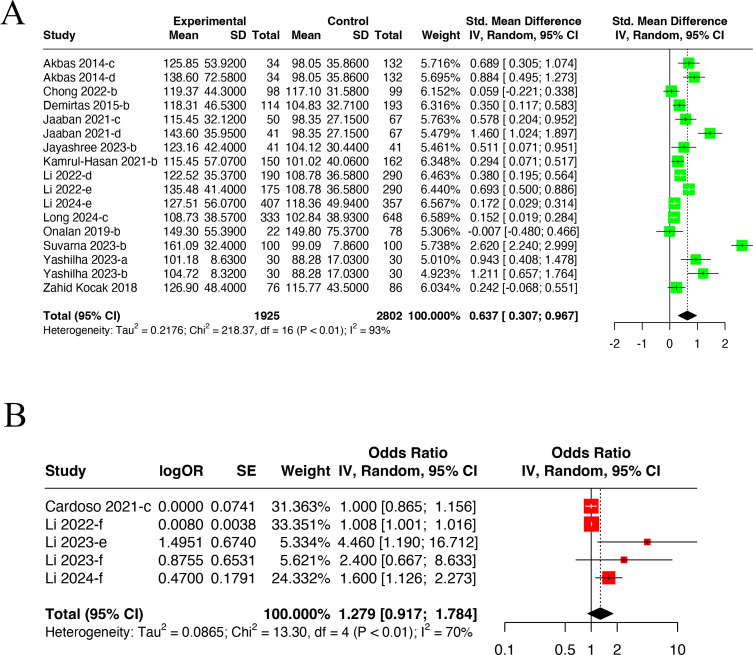
56 studies were ultimately included, comprising 50 that examined the association between DN incidence and immune-inflammation indexes and 8 that examined the association between DN prognosis and immune-inflammation indexes. The levels of NLR, MLR, PLR, and SII were significantly higher in DN patients than in non-DN ones. Besides, high NLR, MLR, SII, and SIRI were associated with elevated incidence of DN. Moreover, the high NLR group was more prone to a poor prognosis than the low NLR group (OR: 1.372, 95% CI: 1.160-1.624).
Immune-inflammation indexes can, to a certain extent, serve as a biomarker to predict the occurrence of DN. In addition, high NLR has a potential association with the occurrence of poor prognosis in DN.
本荟萃分析评估了免疫炎症指标在糖尿病肾病(DN)中的意义,为DN的临床诊断和治疗提供指导。
我们对免疫炎症指标与DN的发病率和预后之间的关联进行了荟萃分析,特别关注中性粒细胞与淋巴细胞比值(NLR)、血小板与淋巴细胞比值(PLR)、单核细胞与淋巴细胞比值(MLR)、全身免疫炎症指数(SII)和全身炎症反应指数(SIRI)。我们全面检索了从创刊到2024年9月的PubMed、Web of Science、Embase和Cochrane数据库。使用R 4.2.3软件进行统计分析。
最终纳入56项研究,其中50项研究了DN发病率与免疫炎症指标之间的关联,8项研究了DN预后与免疫炎症指标之间的关联。DN患者的NLR、MLR、PLR和SII水平显著高于非DN患者。此外,高NLR、MLR、SII和SIRI与DN发病率升高相关。而且,高NLR组比低NLR组更易出现不良预后(OR:1.372,95%CI:1.160 - 1.624)。
免疫炎症指标在一定程度上可作为预测DN发生的生物标志物。此外,高NLR与DN不良预后的发生可能存在关联。