Department of Diagnostic and Interventional Radiology, Hannover Medical School, Hannover, Germany.
Biomedical Research in Endstage and Obstructive Lung Disease Hannover (BREATH), German Center for Lung Research, Giessen, Germany.
Rofo. 2022 Dec;194(12):1333-1345. doi: 10.1055/a-1853-8291. Epub 2022 Aug 2.
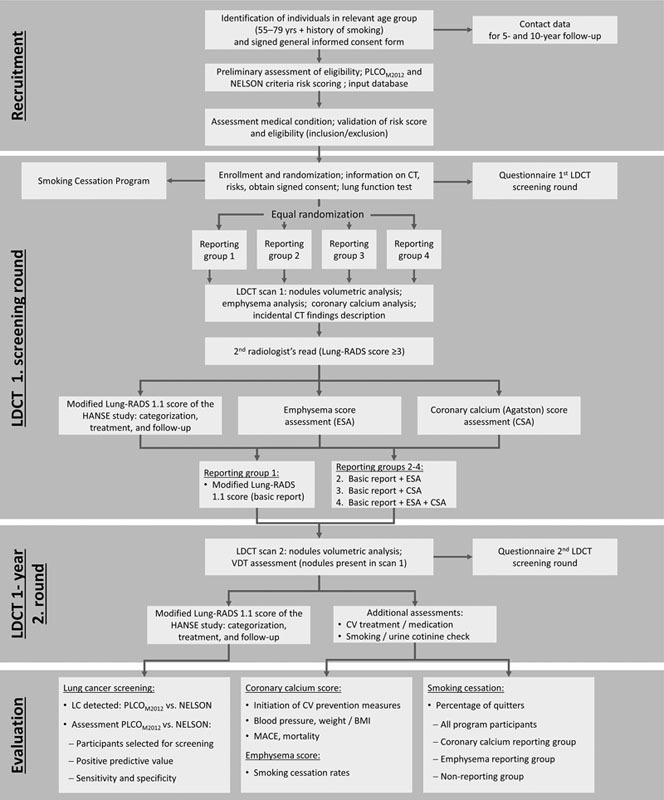
Despite the high prevalence and mortality of lung cancer and proven effectiveness of low-dose computed tomography (LDCT) to reduce mortality, Germany still lacks a national screening program. The German Institute for Quality and Efficiency in Health Care (IQWiG) and the Federal Office for Radiation Protection (BfS) both published positive scientific evaluations recommending a quality-controlled national screening program. IQWiG underlined the importance of a clear risk definition, integrated smoking cessation programs, and quality assurance, highlighting the necessity of procedural optimization.In the HANSE study, former and current smokers aged 55-79 years are assessed for their lung cancer risk by the NELSON and PLCO risk scores. 5000 high-risk participants, defined as PLCO 6-year risk ≥ 1.58 % or fulfilling NELSON risk inclusion criteria, will be screened by LDCT at baseline and after 12 months. Lung nodules are analyzed by a modified Lung-RADS 1.1 score of the HANSE study, and values of emphysema and coronary calcium are determined and randomly reported to the participants. 7100 low-risk participants serve as a control. All patients are followed-up for up to 10 years. The sensitivity and specificity of the two risk assessments and LDCT screening, effects of the randomized LDCT reporting, efficiency of lung nodule management, and several other factors are assessed to analyze the success and quality of the holistic screening program.The HANSE study is designed as a holistic lung cancer screening study in northern Germany to answer pressing questions for a successful implementation of an effective German lung cancer screening program. · HANSE is designed to address pressing questions for the implementation of lung cancer screening in Germany.. · HANSE compares NELSON and PLCOM2012 risk assessments for optimal definition of the high-risk group. . · HANSE integrates cardiac calcium and pulmonary emphysema scoring in a holistic screening approach.. CITATION FORMAT: · Vogel-Claussen J, Lasch F, Bollmann B et al. Design and Rationale of the HANSE Study: A Holistic German Lung Cancer Screening Trial Using Low-Dose Computed Tomography. Fortschr Röntgenstr 2022; 194: 1333 - 1345.
尽管肺癌的患病率和死亡率很高,低剂量计算机断层扫描(LDCT)降低死亡率的效果也已得到证实,但德国仍缺乏全国性的筛查计划。德国质量与效率研究所(IQWiG)和联邦辐射防护办公室(BfS)均发表了积极的科学评估报告,建议开展有质量控制的全国性筛查计划。IQWiG 强调了明确风险定义、综合戒烟计划和质量保证的重要性,突出了程序优化的必要性。
在 HANSE 研究中,年龄在 55-79 岁的前吸烟者和现吸烟者通过 NELSON 和 PLCO 风险评分评估肺癌风险。5000 名高危参与者,定义为 PLCO 6 年风险≥1.58%或符合 NELSON 风险纳入标准,将在基线和 12 个月时通过 LDCT 进行筛查。肺结节通过 HANSE 研究的改良 Lung-RADS 1.1 评分进行分析,并确定肺气肿和冠状动脉钙的值,并随机报告给参与者。7100 名低危参与者作为对照。所有患者的随访时间最长为 10 年。该研究评估了两种风险评估和 LDCT 筛查的敏感性和特异性、随机 LDCT 报告的效果、肺结节管理的效率以及其他一些因素,以分析整体筛查计划的成功和质量。
HANSE 研究是在德国北部进行的一项综合性肺癌筛查研究,旨在回答有效实施德国肺癌筛查计划的紧迫问题。
· HANSE 旨在为德国的肺癌筛查实施解决紧迫问题。
· HANSE 比较了 NELSON 和 PLCOM2012 风险评估,以最佳定义高危人群。
· HANSE 将心脏钙和肺肺气肿评分纳入整体筛查方法。