Yang Xiaoyan, Liu Min, Duan Jianghui, Sun Haishuang, An Jing, Benkert Thomas, Dai Huaping, Wang Chen
Department of Pulmonary and Critical Care Medicine, China-Japan Friendship Hospital, Capital Medical University, Beijing, China.
National Center for Respiratory Medicine, Institute of Respiratory Medicine, Chinese Academy of Medical Sciences, National Clinical Research Center for Respiratory Diseases, Beijing, China.
Quant Imaging Med Surg. 2022 Aug;12(8):4176-4189. doi: 10.21037/qims-21-1133.
We aimed to evaluate the image quality, feasibility, and diagnostic performance of three-dimensional ultrashort echo time magnetic resonance imaging (3D UTE-MRI) to assess idiopathic pulmonary fibrosis (IPF) compared with high-resolution computed tomography (HRCT) and half-Fourier single-shot turbo spin-echo (HASTE) MRI.
A total of 36 patients with IPF (34 men; mean age: 62±8 years, age range: 43 to 78 years) were prospectively included and underwent HRCT and chest MRI on the same day. Chest MRI was performed with a free-breathing 3D spiral UTE pulse sequence and HASTE sequence on a 1.5 T MRI. Two radiologists independently evaluated the image quality of the HRCT, HASTE, and 3D UTE-MRI. They assessed the representative imaging features of IPF, including honeycombing, reticulation, traction bronchiectasis, and ground-glass opacities. Image quality of the 3D UTE-MRI, HASTE, and HRCT were assessed using a 5-point visual scoring method. Kappa and weighted kappa analysis were used to measure intra- and inter-observer and inter-method agreements. Sensitivity (SE), specificity (SP), and accuracy (AC) were used to assess the performance of 3D UTE-MRI for detecting image features of IPF and monitoring the extent of pulmonary fibrosis. Linear regressions and Bland-Altman plots were generated to assess the correlation and agreement between the assessment of the extent of pulmonary fibrosis made by the 2 observers.
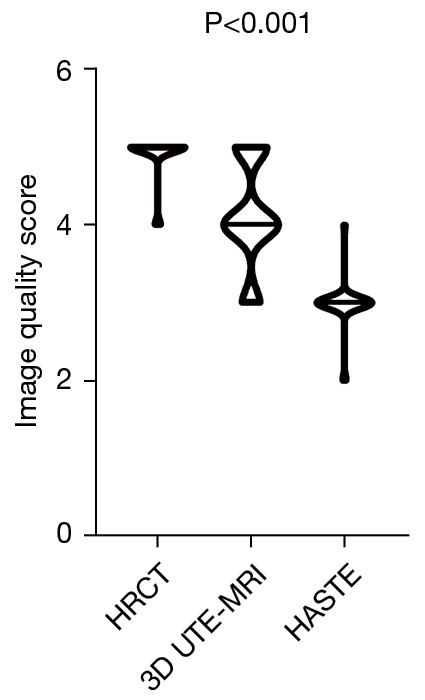
The image quality of HRCT was higher than that of HASTE and UTE-MRI (HRCT UTE-MRI HASTE: 4.9±0.3 4.1±0.7 3.0±0.3; P<0.001). Interobserver agreement of HRCT, HASTE, and 3D UTE-MRI when assessing pulmonary fibrosis was substantial and excellent (HRCT: 0.727≤ κ ≤1, P<0.001; HASTE: 0.654≤ κ ≤1, P<0.001; 3D UTE-MRI: 0.719≤ κ ≤0.824, P<0.001). In addition, reticulation (SE: 97.1%; SP: 100%; AC: 97.2%; κ =0.654), honeycombing (SE: 83.3%; SP: 100%; AC: 86.1%; κ =0.625) patterns, and traction bronchiectasis (SE: 94.1%; SP: 100%; AC: 94.4%, κ =0.640) were also well-visualized on 3D UTE-MRI, which was significantly superior to HASTE. Compared with HRCT, the sensitivity of 3D UTE-MRI to detect signs of pulmonary fibrosis (n=35) was 97.2%. The interobserver agreement in elevation of the extent of pulmonary fibrosis with HRCT and 3D UTE-MRI was R=0.84 (P<0.001) and R=0.84 (P<0.001), respectively. The extent of pulmonary fibrosis assessed with 3D UTE-MRI [median =9, interquartile range (IQR): 6.25 to 10.00] was lower than that from HRCT (median =12, IQR: 9.25 to 13.00; U=320.00, P<0.001); however, they had a positive correlation (R=0.72, P<0.001).
As a radiation-free non-contrast enhanced imaging method, although the image quality of 3D UTE-MRI is inferior to that of HRCT, it has high reproducibility to identify the imaging features of IPF and evaluate the extent of pulmonary fibrosis.
我们旨在评估三维超短回波时间磁共振成像(3D UTE-MRI)在评估特发性肺纤维化(IPF)方面的图像质量、可行性和诊断性能,并与高分辨率计算机断层扫描(HRCT)和半傅里叶单次激发快速自旋回波(HASTE)MRI进行比较。
前瞻性纳入36例IPF患者(34例男性;平均年龄:62±8岁,年龄范围:43至78岁),并于同一天接受HRCT和胸部MRI检查。在1.5T MRI上使用自由呼吸的3D螺旋UTE脉冲序列和HASTE序列进行胸部MRI检查。两名放射科医生独立评估HRCT、HASTE和3D UTE-MRI的图像质量。他们评估了IPF的代表性影像学特征,包括蜂窝状改变、网状改变、牵拉性支气管扩张和磨玻璃影。使用5分视觉评分法评估3D UTE-MRI、HASTE和HRCT的图像质量。使用Kappa和加权Kappa分析来测量观察者内和观察者间以及方法间的一致性。使用敏感性(SE)、特异性(SP)和准确性(AC)来评估3D UTE-MRI检测IPF图像特征和监测肺纤维化程度的性能。生成线性回归和Bland-Altman图以评估两名观察者对肺纤维化程度评估之间的相关性和一致性。
HRCT的图像质量高于HASTE和UTE-MRI(HRCT>UTE-MRI>HASTE:4.9±0.3>4.1±0.7>3.0±0.3;P<0.001)。HRCT、HASTE和3D UTE-MRI在评估肺纤维化时观察者间一致性良好且优秀(HRCT:0.727≤κ≤1,P<0.001;HASTE:0.654≤κ≤1,P<0.001;3D UTE-MRI:0.719≤κ≤0.824,P<0.001)。此外,网状改变(SE:97.1%;SP:100%;AC:97.2%;κ =0.654)、蜂窝状改变(SE:83.3%;SP:100%;AC:86.1%;κ =0.625)和牵拉性支气管扩张(SE:94.1%;SP:100%;AC:94.4%,κ =0.640)在3D UTE-MRI上也显示良好,明显优于HASTE。与HRCT相比,3D UTE-MRI检测肺纤维化征象(n = 35)的敏感性为97.2%。HRCT和3D UTE-MRI在肺纤维化程度升高方面的观察者间一致性分别为R = 0.84(P<0.001)和R = 0.84(P<0.001)。3D UTE-MRI评估的肺纤维化程度[中位数 = 9,四分位间距(IQR):6.25至10.00]低于HRCT(中位数 = 12,IQR:9.25至13.00;U = 320.00,P<0.001);然而,它们具有正相关性(R = 0.72,P<0.001)。
作为一种无辐射的非对比增强成像方法,尽管3D UTE-MRI的图像质量不如HRCT,但它在识别IPF的影像学特征和评估肺纤维化程度方面具有较高的可重复性。