Ouédraogo Jean Claude Romaric Pingdwindé, Jatta Joseph W, Tabiri Dennis, Nitiema Mathieu, Belemlilga Mohamed Bonewendé
School of Public Health, University of Ghana, Legon, Ghana.
Département de médecine et pharmacopée traditionnelles, harmacie (MEPHATRA-Ph), Institut de recherche en sciences de la santé (IRSS), Ouagadougou, Burkina Faso.
Med Trop Sante Int. 2022 May 27;2(2). doi: 10.48327/mtsi.v2i2.2022.236. eCollection 2022 Jun 30.
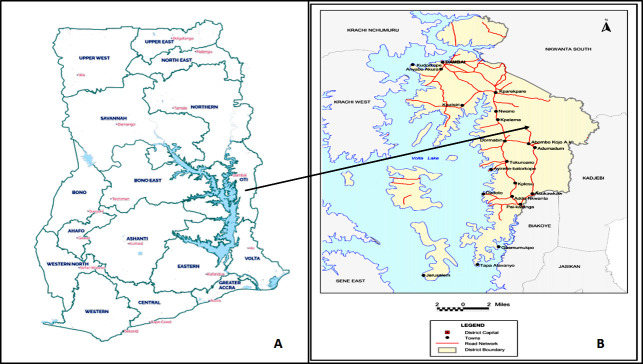
The Ghana Neglected Tropical Diseases control program aimed to raise population awareness on soil-transmitted helminth (STH) infections and achieve a 100% coverage of preventive chemotherapy (PCT) by 2020. This study aims at determining the factors associated with the knowledge of school-age children and describing their perceptions at Krachi East Municipal in Ghana.
It was a cross-sectional study. Children and their caregivers were selected from 8 communities following a two-stage stratified sampling. Descriptive statistics and binary logistic regression were performed at a 5% significance level.
352 children and their caregivers were surveyed, mainly from Dambai (66.48%). The median age was 11 (IQR: 9-12) years and the children aged 7-14 years. About half of the children were males (53.13%) and most caregivers were females (66.48%). Most children perceived a benefit associated with PCT (94.89%). The proportion of children perceiving a health risk did not differ significantly from those not perceiving a risk (49.72% vs 50.28%; p=0.8802). In general, children had poor knowledge (91.19% vs 8.81%; p<0.0001). Good knowledge was associated with ethnic group [Guan: aOR=3.96 95%CI 1.11-14.12; p=0.034], child age [(11-12 years: aOR=6.05 95%CI 1.21-30.22; p=0.026); (13-14 years: aOR=8.19 95%CI 1.64-40.89; p=0.010)] and caregivers' sex (Female: aOR=2.97 95%CI 1.02-8.66; p=0.046) in the adjusted model.
Younger children and male caregivers seem to have low knowledge of intestinal worms and PCT. Therefore, they must get more attention regarding health education.
加纳被忽视热带病控制项目旨在提高民众对土壤传播蠕虫(STH)感染的认识,并在2020年前实现预防性化疗(PCT)100%的覆盖率。本研究旨在确定加纳克拉奇东部市学龄儿童知识水平的相关因素,并描述他们的认知情况。
这是一项横断面研究。采用两阶段分层抽样从8个社区选取儿童及其照料者。在5%的显著性水平下进行描述性统计和二元逻辑回归分析。
共对352名儿童及其照料者进行了调查,主要来自丹拜(66.48%)。年龄中位数为11岁(四分位间距:9 - 12岁),儿童年龄在7 - 14岁之间。约一半儿童为男性(53.13%),大多数照料者为女性(66.48%)。大多数儿童认为PCT有好处(94.89%)。认为存在健康风险的儿童比例与不认为有风险的儿童比例无显著差异(49.72%对50.28%;p = 0.8802)。总体而言,儿童知识水平较差(91.19%对8.81%;p < 0.0001)。在调整模型中,知识水平良好与种族[关族:调整后比值比(aOR)= 3.96,95%置信区间(CI)1.11 - 14.12;p = 0.034]、儿童年龄[(11 - 12岁:aOR = 6.05,95%CI 1.21 - 30.22;p = 0.026);(13 - 14岁:aOR = 8.19,95%CI 1.64 - 40.89;p = 0.010)]以及照料者性别(女性:aOR = 2.97,95%CI 1.02 - 8.66;p = 0.046)相关。
年龄较小的儿童和男性照料者似乎对肠道蠕虫和PCT的知识了解较少。因此,在健康教育方面必须给予他们更多关注。