Department of Biostatistics and Epidemiology, Makerere University School of Public Health, Kampala, Uganda.
Department of Health Policy Planning and Management, Makerere University School of Public Health, Kampala, Uganda.
BMC Infect Dis. 2018 Aug 17;18(1):408. doi: 10.1186/s12879-018-3289-0.
Over 80% of morbidity due to soil-transmitted helminthiasis (STH) occurs in low-income countries. Children under 5 account for 20-30% of the burden in endemic areas. This study assessed the prevalence, intensity and factors associated with STH infections among preschool-age children (PSAC) in Hoima district, Uganda. The PSAC are particularly vulnerable because the chronicity of this condition usually affects their physical and mental growth and development.
A cross-sectional study was carried out among 562 PSAC (1-5 years old) in 6 counties of Hoima district using Expanded Program on Immunization (EPI) method. Stool samples from children were examined using the formol ether concentration technique for STH egg detection. Egg counts were represented as egg per gram (EPG). A structured questionnaire was used to collect information on factors associated with STH infection. Generalized linear models were used to analyze relationships between STH infection and associated factors.
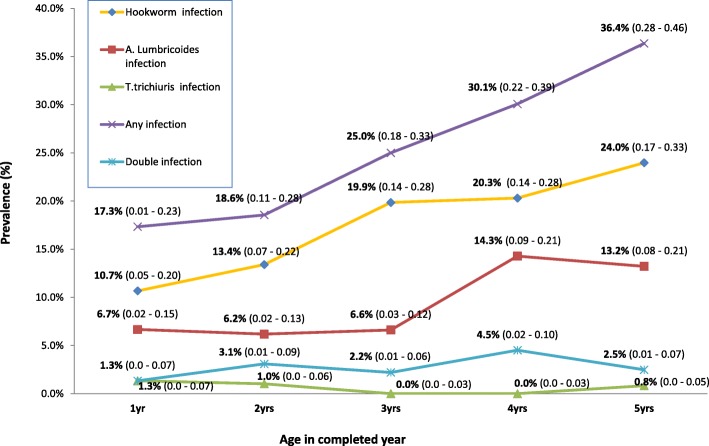
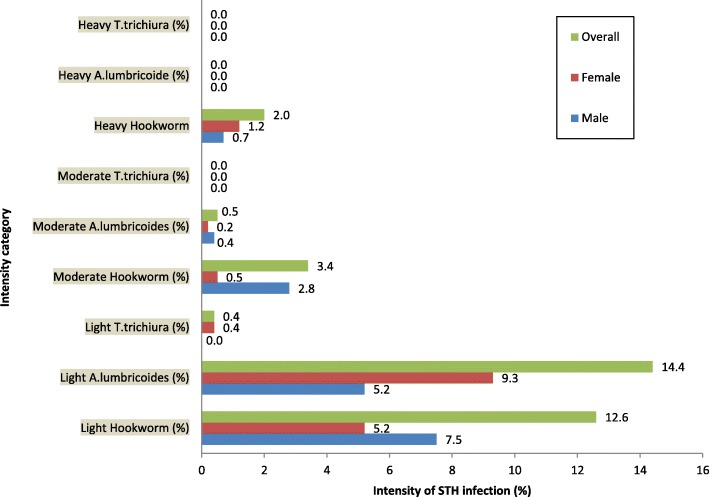
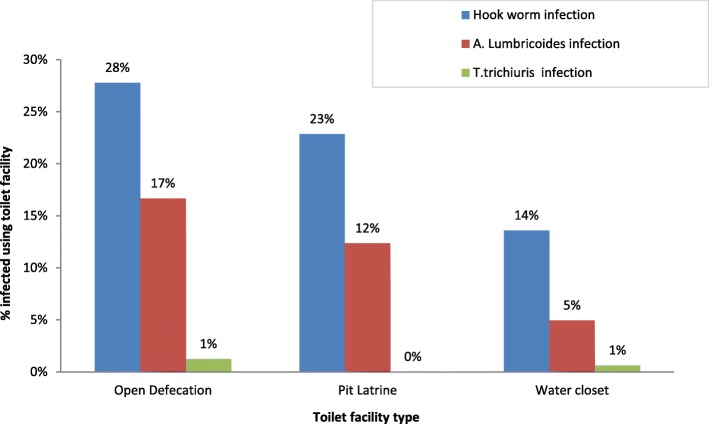
Overall STH prevalence was 26.5%. Hookworm infection was the most prevalent (18.5%), followed by A.lumbricoides (9.8%) and T.trichiura (0.5%). Prevalence of STH infection was significantly higher in children aged 5 years (Pearson chi-square test, p = 0.009) than in children aged 1 year. The general geometric mean (GM) counts for Hookworm infection was (696.1 EPG; range (530.3-913.8)) with girls having a higher GM (789.8 EPG; range (120-13,200)) than boys. Eating uncooked or unwashed vegetables (adj. Prevalence Ratio (PR) = 1.9, 95% CI: 1.3-2.7) and fruits (adj.PR = 1.8, 95% CI: 1.1-2.8), indiscriminate disposal of young children's faeces (adj.PR = 1.5, 95% CI: 1.1-2.0); not washing hands after defecation (adj.PR = 2.6, 95% CI: 1.9-3.6); and not deworming children regularly (adj.PR = 1.4, 95% CI: 1.1-1.8) were significantly associated with STH infection.
The prevalence of Soil transmitted helminths infection among preschool-age children in Hoima district significantly increased with age. Poor hygiene, inadequate sanitation and irregular deworming were associated with STH infections among PSAC in the study area. Intense health education on the importance of hygienic practices, improved sanitation and regular deworming of PSAC should be integrated into prevention and control programs.
超过 80%的土壤传播性蠕虫病(STH)发病率发生在低收入国家。在流行地区,5 岁以下儿童占负担的 20-30%。本研究评估了乌干达霍伊马地区学龄前儿童(PSAC)的 STH 感染的流行率、强度和相关因素。由于这种情况的慢性通常会影响他们的身体和精神成长和发育,因此这些儿童特别容易受到影响。
使用扩大免疫规划(EPI)方法,在霍伊马区的 6 个县对 562 名 PSAC(1-5 岁)进行了横断面研究。使用福尔马林乙醚浓缩技术检测儿童粪便样本中的 STH 卵。卵计数表示为每克卵(EPG)。使用结构化问卷收集与 STH 感染相关的因素信息。使用广义线性模型分析 STH 感染与相关因素之间的关系。
总体 STH 流行率为 26.5%。钩虫感染最为普遍(18.5%),紧随其后的是 A.lumbricoides(9.8%)和 T.trichiura(0.5%)。5 岁儿童的 STH 感染率明显高于 1 岁儿童(皮尔逊卡方检验,p=0.009)。钩虫感染的总几何平均(GM)计数为(696.1 EPG;范围(530.3-913.8)),女孩的 GM 计数(789.8 EPG;范围(120-13200))高于男孩。食用未煮熟或未清洗的蔬菜(adj. 患病率比(PR)=1.9,95%CI:1.3-2.7)和水果(adj.PR=1.8,95%CI:1.1-2.8)、不分青红皂白地处理幼儿粪便(adj.PR=1.5,95%CI:1.1-2.0)、大便后不洗手(adj.PR=2.6,95%CI:1.9-3.6)和不定期给儿童驱虫(adj.PR=1.4,95%CI:1.1-1.8)与 STH 感染显著相关。
霍伊马地区学龄前儿童的土壤传播性蠕虫感染率随年龄增长而显著增加。不良卫生习惯、卫生设施不足和不定期驱虫与研究地区 PSAC 的 STH 感染有关。应将针对卫生习惯重要性的强化卫生教育、改善卫生设施和定期给 PSAC 驱虫纳入预防和控制计划。