Department of Cognitive and Neuropsychology, Institute of Psychology, University of Szeged, Szeged, Hungary.
Institute of Cognitive Neuroscience and Psychology, Research Centre for Natural Sciences, Budapest, Hungary.
Sci Rep. 2022 Aug 3;12(1):13312. doi: 10.1038/s41598-022-17049-7.
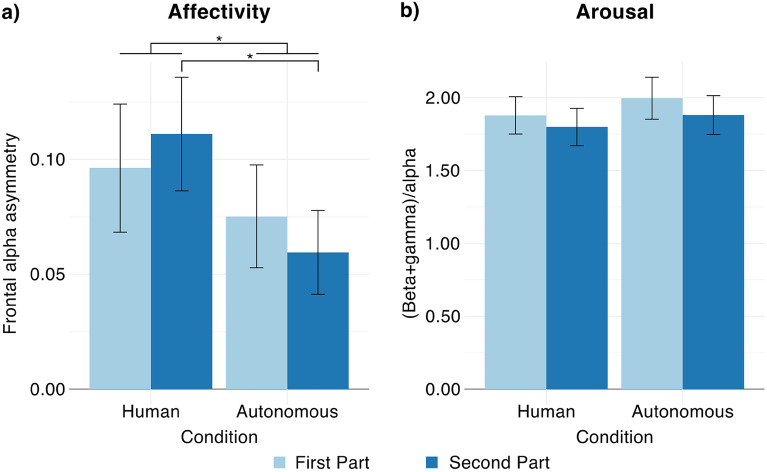
The goal of the present study is to examine the cognitive/affective physiological correlates of passenger travel experience in autonomously driven transportation systems. We investigated the social acceptance and cognitive aspects of self-driving technology by measuring physiological responses in real-world experimental settings using eye-tracking and EEG measures simultaneously on 38 volunteers. A typical test run included human-driven (Human) and Autonomous conditions in the same vehicle, in a safe environment. In the spectrum analysis of the eye-tracking data we found significant differences in the complex patterns of eye movements: the structure of movements of different magnitudes were less variable in the Autonomous drive condition. EEG data revealed less positive affectivity in the Autonomous condition compared to the human-driven condition while arousal did not differ between the two conditions. These preliminary findings reinforced our initial hypothesis that passenger experience in human and machine navigated conditions entail different physiological and psychological correlates, and those differences are accessible using state of the art in-world measurements. These useful dimensions of passenger experience may serve as a source of information both for the improvement and design of self-navigating technology and for market-related concerns.
本研究旨在探讨自主驾驶交通系统中乘客旅行体验的认知/情感生理相关性。我们通过在真实实验环境中同时使用眼动追踪和 EEG 测量来测量生理反应,研究了自动驾驶技术的社会接受度和认知方面,共有 38 名志愿者参与了测试。在典型的测试运行中,同一辆车内包括人类驾驶(Human)和自动驾驶(Autonomous)两种模式,且处于安全环境中。在眼动追踪数据的频谱分析中,我们发现眼球运动的复杂模式存在显著差异:在自动驾驶模式下,不同幅度运动的结构变化较小。与人类驾驶模式相比,自动驾驶模式下的 EEG 数据显示出较低的积极情感,而两种模式下的唤醒程度没有差异。这些初步发现证实了我们的初始假设,即人类和机器导航条件下的乘客体验涉及不同的生理和心理相关性,并且可以使用最新的现场测量技术来获取这些差异。这些有用的乘客体验维度可以为自动驾驶技术的改进和设计以及市场相关问题提供信息来源。