Meng Hong-Fang, Jin Jide, Wang Hua, Wang Li-Sheng, Wu Chu-Tse
School of Chemical Engineering and Technology, Tianjin University, Tianjin, China.
Beijing Key Laboratory for Radiobiology, Beijing Institute of Radiation Medicine, Beijing, China.
J Cell Mol Med. 2022 Sep;26(18):4745-4755. doi: 10.1111/jcmm.17497. Epub 2022 Aug 3.
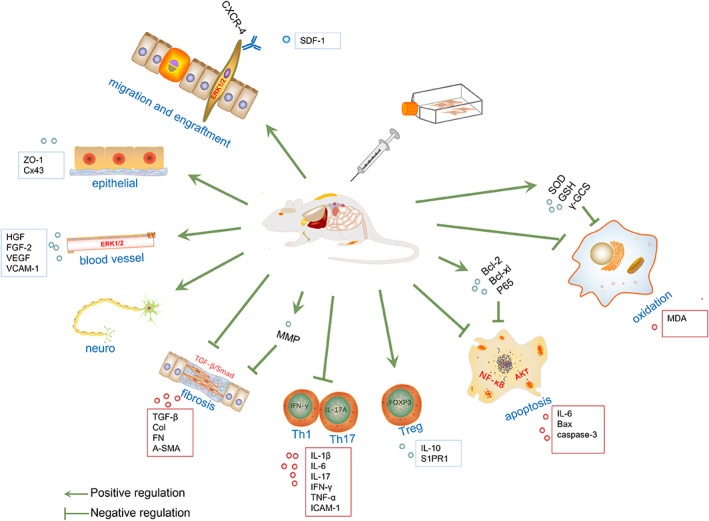
Mesenchymal stem cell (MSC) therapy is considered a new treatment for a wide range of diseases and injuries, but challenges remain, such as poor survival, homing and engraftment rates, thus limiting the therapeutic efficacy of the transplanted MSCs. Many strategies have been developed to enhance the therapeutic efficacy of MSCs, such as preconditioning, co-transplantation with graft materials and gene modification. Hepatocyte growth factor (HGF) is secreted by MSCs, which plays an important role in MSC therapy. It has been reported that the modification of the HGF gene is beneficial to the therapeutic efficacy of MSCs, including diseases of the heart, lung, liver, urinary system, bone and skin, lower limb ischaemia and immune-related diseases. This review focused on studies involving HGF/MSCs both in vitro and in vivo. The characteristics of HGF/MSCs were summarized, and the mechanisms of their improved therapeutic efficacy were analysed. Furthermore, some insights are provided for HGF/MSCs' clinical application based on our understanding of the HGF gene and MSC therapy.
间充质干细胞(MSC)疗法被认为是治疗多种疾病和损伤的一种新方法,但仍存在一些挑战,如存活率低、归巢和植入率低,从而限制了移植的间充质干细胞的治疗效果。人们已经开发了许多策略来提高间充质干细胞的治疗效果,如预处理、与移植材料共移植和基因修饰。肝细胞生长因子(HGF)由间充质干细胞分泌,在间充质干细胞治疗中起重要作用。据报道,HGF基因的修饰有利于间充质干细胞的治疗效果,包括心脏、肺、肝、泌尿系统、骨骼和皮肤疾病、下肢缺血和免疫相关疾病。本综述聚焦于涉及HGF/间充质干细胞的体外和体内研究。总结了HGF/间充质干细胞的特征,并分析了其改善治疗效果的机制。此外,基于我们对HGF基因和间充质干细胞治疗的理解,为HGF/间充质干细胞的临床应用提供了一些见解。