Shen Yuying, Turner Carlene Buchanan, Perkins Robert K, Moore Ami
Department of Sociology, Norfolk State University, Norfolk, VA, USA.
Department of Rehabilitation and Health Services, University of North Texas, Denton, TX, USA.
J Public Health Res. 2022 Jul 29;11(3):22799036221102492. doi: 10.1177/22799036221102492. eCollection 2022 Jul.
This study advances health disparities research by documenting the racial/ethnic disparities in children's health insurance coverage and health insurance adequacy under the implementation and revisions of the Affordable Care Act between 2016 and 2018 in America.
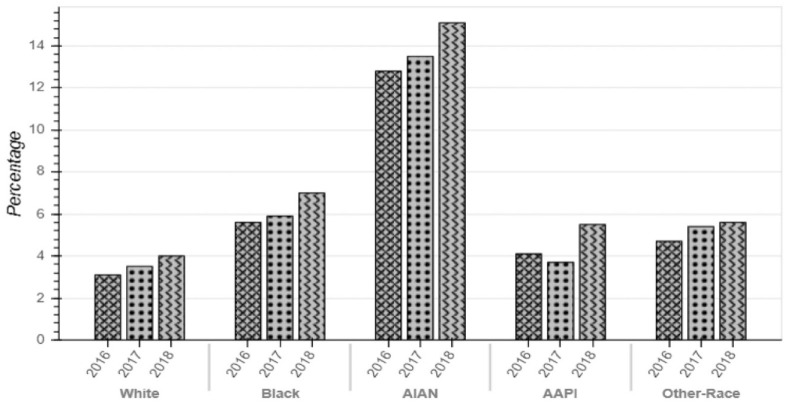
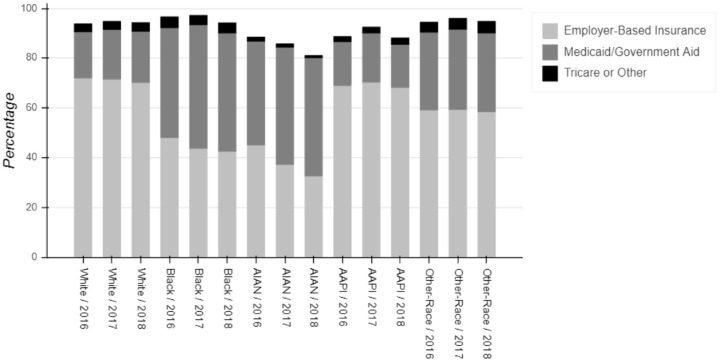
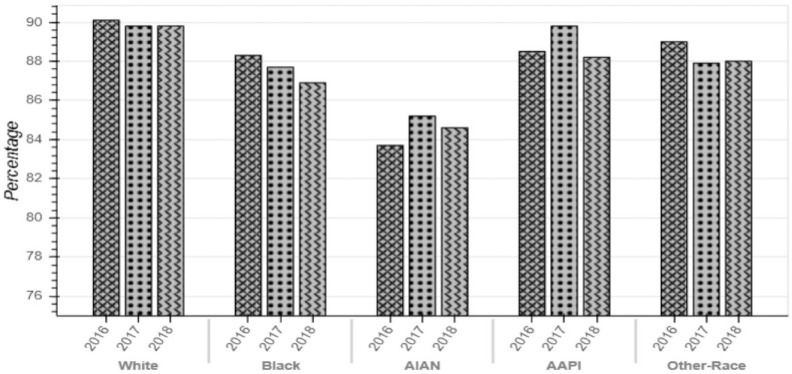
Combining the nation-wide repeated cross-sectional data from 2016 to 2018 Children's Health National Survey (NSCH), we examined the changes and trends of health insurance coverage and health insurance adequacy among children age 0-17 across different racial/ethnic groups from 2016 to 2018. Multivariate logistic regression models stratified by race-ethnicity were further analyzed to examine the association between children's health insurance adequacy, their health insurance coverage, and their socio-demographic background factors.
Our analyses indicate that generally children's enrollment in Medicaid or other government aided health care programs had been increasing whereas children's enrollment in the employer-based had been decreasing from 2016 to 2018. At the same time, the number of children who said that they always had adequate health insurance to meet their health care needs has slightly dropped from 2016 to 2018, except for AIAN children. Our analyses further revealed that the risk of inadequate health insurance appears to be stronger for children in disadvantaged situation, socially and economically.
The ACA has contributed to expanding childhood health insurance coverage. But racial/ethnic disparities continue to exist in children's health insurance coverage and health insurance adequacy. To achieve equity in childhood health care, more outreach and appropriate programs are needed for children who are socially and economically disadvantaged.
本研究通过记录2016年至2018年美国《平价医疗法案》实施和修订期间儿童医疗保险覆盖范围及医疗保险充足性方面的种族/族裔差异,推进了健康差异研究。
结合2016年至2018年儿童健康全国调查(NSCH)的全国性重复横断面数据,我们研究了2016年至2018年不同种族/族裔群体中0至17岁儿童医疗保险覆盖范围及医疗保险充足性的变化和趋势。进一步分析按种族-族裔分层的多变量逻辑回归模型,以研究儿童医疗保险充足性、医疗保险覆盖范围及其社会人口背景因素之间的关联。
我们的分析表明,总体而言,2016年至2018年期间,儿童参加医疗补助或其他政府资助医疗保健项目的人数一直在增加,而参加雇主提供保险的儿童人数一直在减少。与此同时,除了美洲印第安人和阿拉斯加原住民(AIAN)儿童外,2016年至2018年期间表示自己始终有足够医疗保险满足医疗需求的儿童数量略有下降。我们的分析还进一步显示,对于社会和经济处于不利地位的儿童,医疗保险不足的风险似乎更大。
《平价医疗法案》有助于扩大儿童医疗保险覆盖范围。但在儿童医疗保险覆盖范围及医疗保险充足性方面,种族/族裔差异仍然存在。为实现儿童医疗保健公平,需要为社会和经济处于不利地位的儿童开展更多宣传推广活动并制定适当项目。