Singh Swati, Banavath Hemanth Naick, Godara Priya, Naik Biswajit, Srivastava Varshita, Prusty Dhaneswar
Department of Biochemistry, School of Life Sciences, Central University of Rajasthan, NH-8, Bandarsindri, Kishangarh, Ajmer, Rajasthan 305817 India.
Department of Sports, Bio-Science, Central University of Rajasthan, Ajmer, Rajasthan India.
3 Biotech. 2022 Sep;12(9):198. doi: 10.1007/s13205-022-03258-4. Epub 2022 Aug 1.
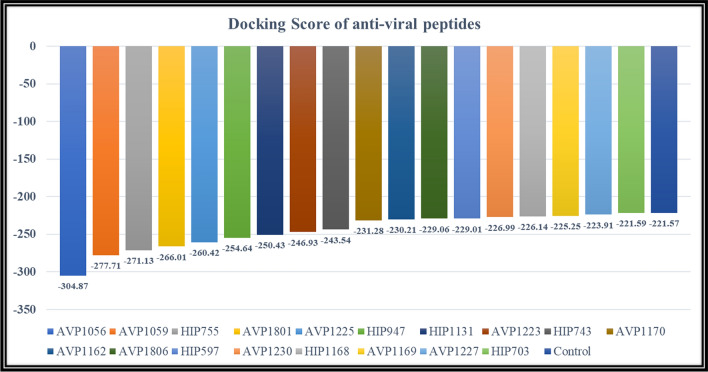
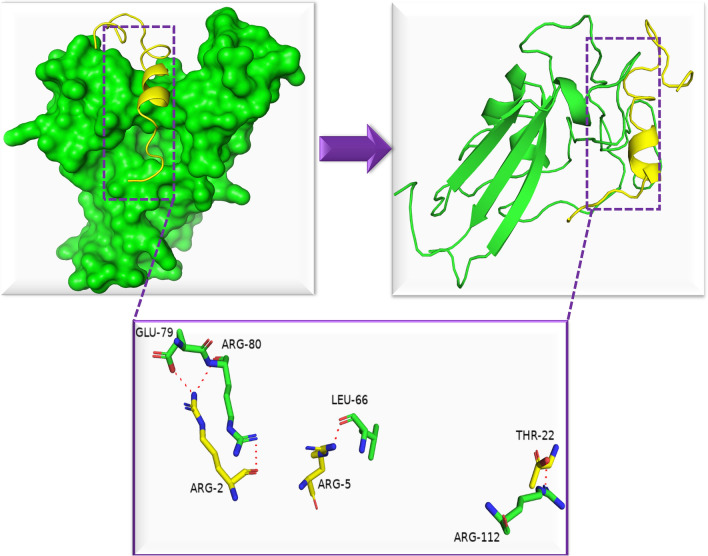
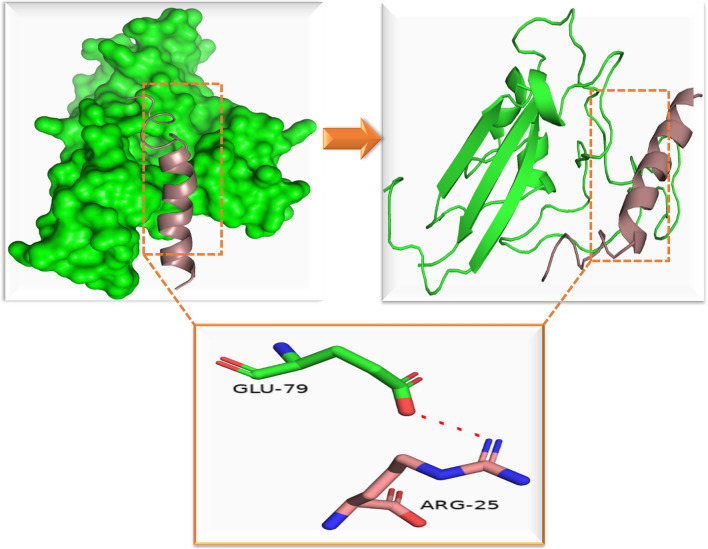
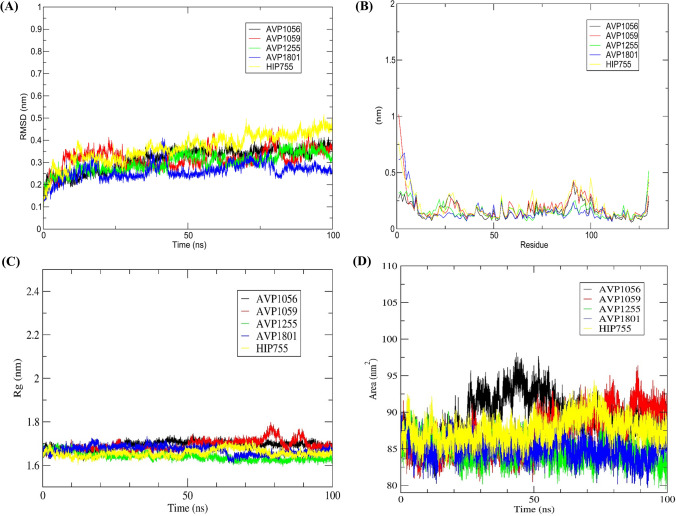
Omicron, a variant of concern (VOC) of SARS-CoV-2, emerged in South Africa in November 2021. Omicron has been continuously acquiring a series of new mutations, especially in the spike (S) protein that led to high infectivity and transmissibility. Peptides targeting the receptor-binding domain (RBD) of the spike protein by which omicron and its variants attach to the host receptor, angiotensin-converting enzyme (ACE2) can block the viral infection at the first step. This study aims to identify antiviral peptides from the Antiviral peptide database (AVPdb) and HIV-inhibitory peptide database (HIPdb) against the RBD of omicron by using a molecular docking approach. The lead RBD binder peptides obtained through molecular docking were screened for allergenicity and physicochemical criteria (isoelectric point (pI) and net charge) required for peptide-based drugs. The binding affinity of the best five peptide inhibitors with the RBD of omicron was validated further by molecular dynamics (MD) simulation. Our result introduces five antiviral peptides, including AVP1056, AVP1059, AVP1225, AVP1801, and HIP755, that may effectively hinder omicron-host interactions. It is worth mentioning that all the three major sub-variants of omicron, BA.1 (B.1.1.529.1), BA.2 (B.1.1.529.2), and BA.3 (B.1.1.529.3), exhibits conserved ACE-2 interacting residues. Hence, the screened antiviral peptides with similar affinity can also interrupt the RBD-mediated invasion of different major sub-variants of omicron. Altogether, these peptides can be considered in the peptide-based therapeutics development for omicron treatment after further experimentation.
The online version contains supplementary material available at 10.1007/s13205-022-03258-4.
奥密克戎是严重急性呼吸综合征冠状病毒2(SARS-CoV-2)的一种值得关注的变异株(VOC),于2021年11月在南非出现。奥密克戎一直在不断获得一系列新的突变,特别是在刺突(S)蛋白中,这导致了高传染性和传播性。靶向刺突蛋白受体结合域(RBD)的肽,奥密克戎及其变体通过该域附着于宿主受体血管紧张素转换酶(ACE2),可以在第一步阻断病毒感染。本研究旨在通过分子对接方法从抗病毒肽数据库(AVPdb)和HIV抑制肽数据库(HIPdb)中鉴定针对奥密克戎RBD的抗病毒肽。对通过分子对接获得的主要RBD结合肽进行基于肽的药物所需的致敏性和物理化学标准(等电点(pI)和净电荷)筛选。通过分子动力学(MD)模拟进一步验证了最佳的五种肽抑制剂与奥密克戎RBD的结合亲和力。我们的结果引入了五种抗病毒肽,包括AVP1056、AVP1059、AVP1225、AVP1801和HIP755,它们可能有效地阻碍奥密克戎与宿主的相互作用。值得一提的是,奥密克戎的所有三个主要亚变体,BA.1(B.1.1.529.1)、BA.2(B.1.1.529.2)和BA.3(B.1.1.529.3),都表现出保守的ACE-2相互作用残基。因此,筛选出的具有相似亲和力的抗病毒肽也可以阻断奥密克戎不同主要亚变体的RBD介导的入侵。总之,在进一步实验后,这些肽可用于基于肽的治疗奥密克戎的疗法开发。
在线版本包含可在10.1007/s13205-022-03258-4获取的补充材料。