Structural Bioinformatics Lab, CSIR-Institute of Himalayan Bioresource Technology (CSIR-IHBT), Palampur, HP, 176061, India; Biotechnology Division, CSIR-IHBT, Palampur, HP, 176061, India.
Structural Bioinformatics Lab, CSIR-Institute of Himalayan Bioresource Technology (CSIR-IHBT), Palampur, HP, 176061, India; Biotechnology Division, CSIR-IHBT, Palampur, HP, 176061, India; Academy of Scientific & Innovative Research (AcSIR), Ghaziabad-201002, India.
Comput Biol Med. 2021 Dec;139:104965. doi: 10.1016/j.compbiomed.2021.104965. Epub 2021 Oct 22.
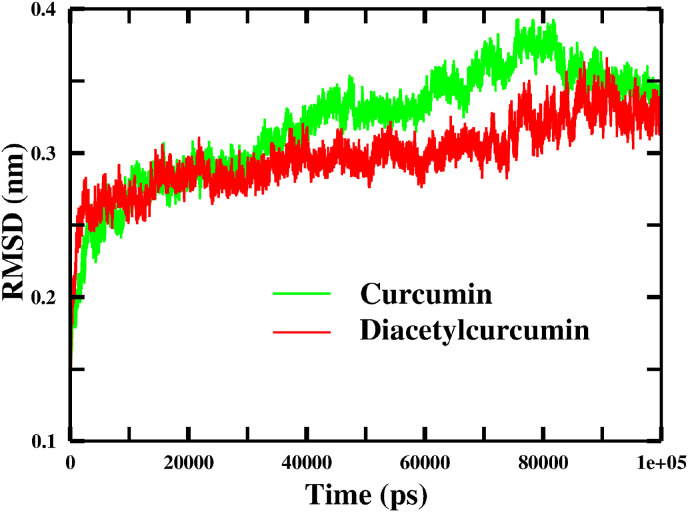
The Severe Acute Respiratory Syndrome Coronavirus 2 (SARS-CoV-2) is the causative agent of the COVID-19 pandemic. Currently, there are no particular antivirals available to battle with COVID-19. The RNA-dependent RNA polymerase (RdRp) has emerged as a novel drug target due to its essential role in virus replication. In this study, turmeric-derived compounds were chosen and subjected to in-silico analysis to evaluate their binding affinity against the RdRp-RNA complex of SARS-CoV-2. Our in-silico approach included the analysis of protein-ligand interactions by molecular docking and molecular dynamics simulations, followed by free energy calculations by molecular mechanics Poisson-Boltzmann surface area analysis. Curcumin and diacetylcurcumin showed stability and good binding affinity at the active site of the SARS-CoV-2 RdRp-RNA complex. Furthermore, to validate the potency of selected compounds, we compared them with Favipiravir and Remdesivir antiviral drugs from our previous analysis on targeting tea bioactive molecules to inhibit RdRp-RNA complex. The comparative analysis revealed that the selected compounds showed higher potential to be developed as RdRp-RNA inhibitors than antiviral medicines Remdesivir and Favipiravir. However, these compounds need to be further validated by in-vitro and in-vivo investigations.
严重急性呼吸综合征冠状病毒 2 (SARS-CoV-2) 是 COVID-19 大流行的病原体。目前,尚无专门用于对抗 COVID-19 的抗病毒药物。RNA 依赖性 RNA 聚合酶 (RdRp) 因其在病毒复制中的重要作用而成为新的药物靶点。在这项研究中,选择了姜黄衍生的化合物,并进行了计算机模拟分析,以评估它们对 SARS-CoV-2 RdRp-RNA 复合物的结合亲和力。我们的计算机模拟方法包括通过分子对接和分子动力学模拟分析蛋白质-配体相互作用,然后通过分子力学泊松-玻尔兹曼表面积分析计算自由能。姜黄素和二乙酰基姜黄素在 SARS-CoV-2 RdRp-RNA 复合物的活性位点表现出稳定性和良好的结合亲和力。此外,为了验证所选化合物的效力,我们将它们与我们之前针对茶叶生物活性分子抑制 RdRp-RNA 复合物的靶向分析中选择的抗病毒药物法匹拉韦和瑞德西韦进行了比较。比较分析表明,与抗病毒药物瑞德西韦和法匹拉韦相比,所选化合物在开发 RdRp-RNA 抑制剂方面具有更高的潜力。然而,这些化合物需要通过体外和体内研究进一步验证。