Martins Mauricio de Jesus Dias, Baumard Nicolas
Institut Jean Nicod, Département d'Etudes Cognitives, ENS, EHESS, CNRS, PSL Research University, Paris, France.
Front Psychol. 2022 Jul 18;13:786229. doi: 10.3389/fpsyg.2022.786229. eCollection 2022.
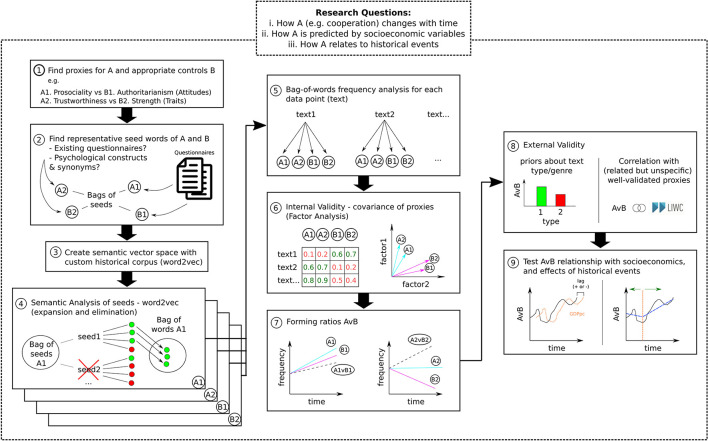
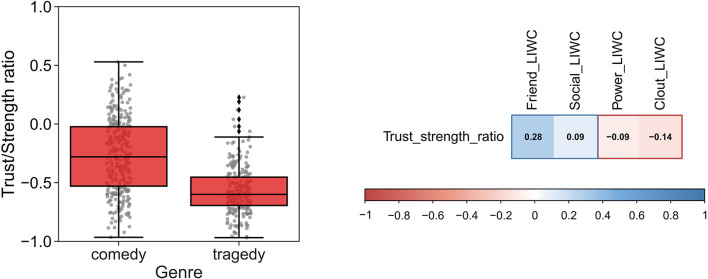
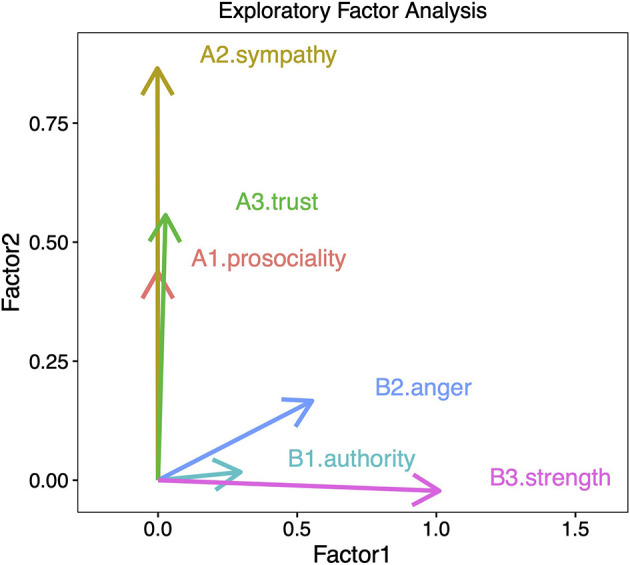
While we cannot directly measure the psychological preferences of individuals, and the moral, emotional, and cognitive tendencies of people from the past, we can use cultural artifacts as a window to the zeitgeist of societies in particular historical periods. At present, an increasing number of digitized texts spanning several centuries is available for a computerized analysis. In addition, developments form historical economics have enabled increasingly precise estimations of sociodemographic realities from the past. Crossing these datasets offer a powerful tool to test how the environment changes psychology and . However, designing the appropriate proxies of relevant psychological constructs is not trivial. The gold standard to measure psychological constructs in modern texts - Linguistic Inquiry and Word Count (LIWC) - has been validated by psychometric experimentation with modern participants. However, as a tool to investigate the psychology of the past, the LIWC is limited in two main aspects: (1) it does not cover the entire range of relevant psychological dimensions and (2) the meaning, spelling, and pragmatic use of certain words depend on the historical period from which the fiction work is sampled. These LIWC limitations make the design of custom tools inevitable. However, without psychometric validation, there is uncertainty regarding what exactly is being measured. To overcome these pitfalls, we suggest several internal and external validation procedures, to be conducted prior to diachronic analyses. First, the semantic adequacy of search terms in bags-of-words approaches should be verified by training semantic vector spaces with the historical text corpus using tools like word2vec. Second, we propose factor analyses to evaluate the internal consistency between distinct bag-of-words proxying the same underlying psychological construct. Third, these proxies can be externally validated using prior knowledge on the differences between genres or other literary dimensions. Finally, while LIWC is limited in the analysis of historical documents, it can be used as a sanity check for external validation of custom measures. This procedure allows a robust estimation of psychological constructs and how they change throughout history. Together with historical economics, it also increases our power in testing the relationship between environmental change and the expression of psychological traits from the past.
虽然我们无法直接测量个体的心理偏好以及过去人们的道德、情感和认知倾向,但我们可以将文化产物作为了解特定历史时期社会思潮的窗口。目前,越来越多跨越几个世纪的数字化文本可供进行计算机分析。此外,历史经济学的发展使得对过去社会人口现实的估计越来越精确。将这些数据集交叉使用提供了一个强大的工具,可用于测试环境如何改变心理以及……。然而,设计相关心理结构的合适代理并非易事。现代文本中测量心理结构的黄金标准——语言查询与字数统计(LIWC)——已通过对现代参与者的心理测量实验得到验证。然而,作为一种研究过去心理的工具,LIWC在两个主要方面存在局限性:(1)它没有涵盖所有相关的心理维度;(2)某些词汇的含义、拼写和语用用法取决于所采样小说作品的历史时期。这些LIWC的局限性使得设计定制工具成为必然。然而,未经心理测量验证,所测量的具体内容存在不确定性。为了克服这些缺陷,我们建议在进行历时分析之前进行若干内部和外部验证程序。首先,应通过使用word2vec等工具对历史文本语料库进行语义向量空间训练,来验证词袋法中搜索词的语义充分性。其次,我们建议进行因子分析,以评估代表相同潜在心理结构的不同词袋之间的内部一致性。第三,可以利用关于体裁或其他文学维度差异的先验知识对这些代理进行外部验证。最后,虽然LIWC在历史文献分析中存在局限性,但它可用于对定制测量的外部验证进行合理性检查。这一程序能够对心理结构及其在历史进程中的变化进行可靠估计。与历史经济学一起,它还增强了我们检验环境变化与过去心理特征表达之间关系的能力。