Al-Hussaini Abdulrahman, Abanemai Mohammed, Alhebbi Homoud, Saadah Omar, Bader Razan, Al Sarkhy Ahmed, Alhatlani Maher, Halabi Hana, Aladsani Ahmed, AlEdreesi Mohammed, Wali Sami, Alguofi Talal, Al-Drees Khalid, Arain Zahid, Al Saleem Badr, Asery Ali, Holdar Sinan, Alrashidi Sami, Alsayed Fahad, Aldhalan Sulaiman, NasserAllah Amira, Alghamdi Rawabi, Alhaffaf Faisal, AlAwfi Ahmed, AlSweed Abdulrahman, Alshamrani Ali, AlShaikh Manal, Saeed Anjum, Assiri Heba, Bashir Muhammed Salman
Division of Pediatric Gastroenterology, Children's Specialized Hospital, King Fahad Medical City, Riyadh, Saudi Arabia.
College of Medicine, Alfaisal University, Riyadh, Saudi Arabia.
Front Pediatr. 2022 Jul 18;10:921948. doi: 10.3389/fped.2022.921948. eCollection 2022.
The epidemiology and outcomes of biliary atresia (BA) have been well-documented in national cohorts from two main ethnicities, namely, the Asian Orientals and Caucasians, with incidence ranging from 1 in 5,000 to 1 in 9,000 live births in East Asia and 1 in 15,000 to 19,000 live births in Europe and North America.
We report the first nationwide BA study outside North America, Europe, and East Asia to describe the epidemiology and outcomes of BA in Saudi Arabia.
A national database of BA cases diagnosed between 2000 and 2018 was analyzed. We assessed clearance of jaundice (bilirubin <20 μmol/L) in all cases that underwent Kasai portoenterostomy (KPE). We then estimated survival using the Kaplan-Meier method with endpoints of liver transplantation (LT), death, or survival with native liver (SNL).
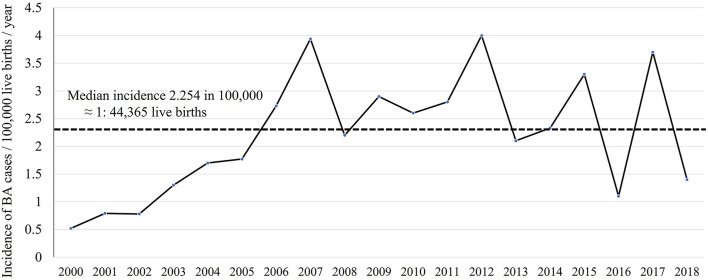
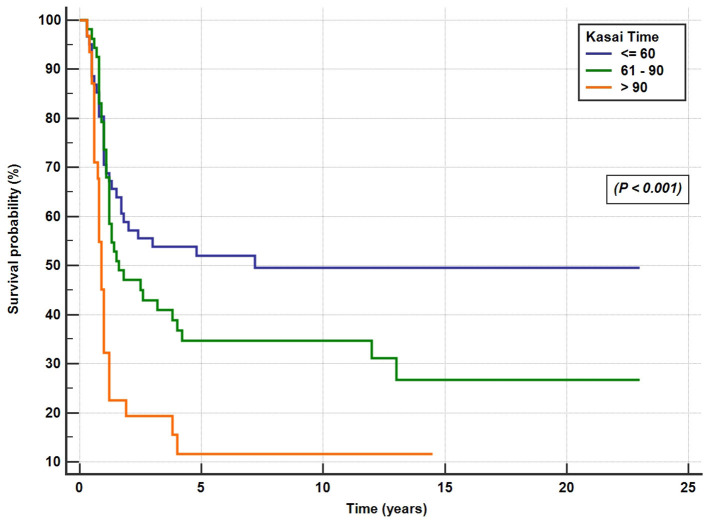
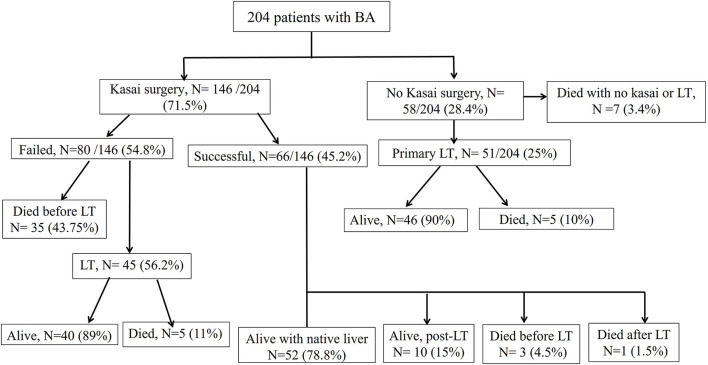
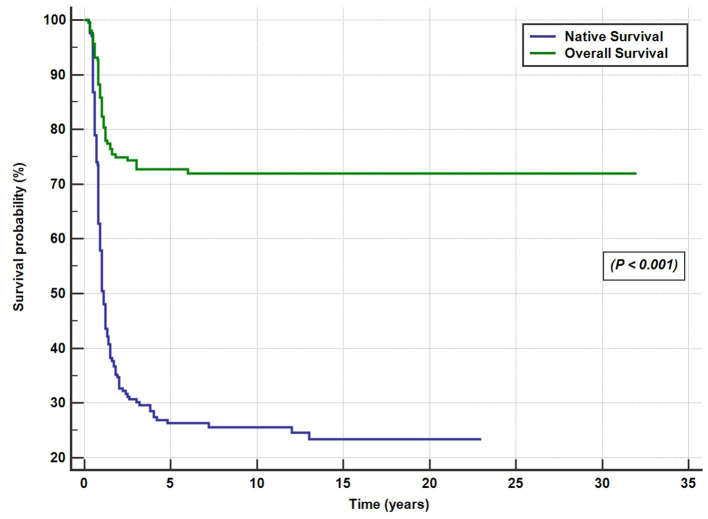
BA was diagnosed in 204 infants (106 females; 10% pre-term). The incidence of BA was 1 in 44,365, or 2.254 in 100,000 live births (range, 0.5-4 in 100,000). Polysplenia was diagnosed in 22 cases (11%). The median age at referral was 65 days. A total of 146 children (71.5%) underwent KPE at a median age of 70 days. Clearance of jaundice was achieved in 66 of the 146 (45%) infants. The 10-year SNL after KPE was 25.5%, and the overall 10-year estimated survival was 72.5%. The Kaplan-Meier survival curves for patients undergoing KPE at the age of <60, 61-90, and >90 days showed a SNL rate at 51.6, 33, and 12.5%, respectively, at 5 years ( < 0.001). The 2-, 5-, and 10-year post-LT survival rates were 92.5, 90.6, and 90%, respectively. Undergoing an initial KPE did not impact negatively on the overall LT survival rate when compared to BA cases that underwent primary LT ( = 0.88).
The incidence rate of BA in Saudi Arabia is lower than the incidence reported elsewhere. Late referral of BA cases remains a problem in Saudi Arabia; as a result, the SNL rate was lower than reported by other national registries. Hence, national policies devoted to timely referral and earlier age at KPE are needed.
胆道闭锁(BA)的流行病学和转归情况在两个主要种族群体(即亚洲东方人和高加索人)的全国队列研究中已有充分记录,东亚地区活产儿中BA发病率为1/5000至1/9000,欧洲和北美地区为1/15000至1/19000。
我们报告了北美、欧洲和东亚以外地区的第一项全国性BA研究,以描述沙特阿拉伯BA的流行病学和转归情况。
分析了一个包含2000年至2018年期间诊断的BA病例的全国数据库。我们评估了所有接受Kasai肝门空肠吻合术(KPE)的病例中黄疸的清除情况(胆红素<20μmol/L)。然后我们使用Kaplan-Meier方法估计生存率,终点为肝移植(LT)、死亡或自体肝存活(SNL)。
共诊断出204例BA婴儿(106例女性;10%为早产儿)。BA发病率为1/44365,即每100000例活产儿中有2.254例(范围为每100000例中有0.5 - 4例)。22例(11%)诊断为多脾症。转诊时的中位年龄为65天。共有146名儿童(71.5%)在中位年龄70天时接受了KPE。146例婴儿中有66例(45%)黄疸清除。KPE后10年的SNL率为25.5%,总体10年估计生存率为72.5%。年龄<60天、61 - 90天和>90天接受KPE的患者的Kaplan-Meier生存曲线显示,5年时SNL率分别为51.6%、33%和12.5%(P<0.001)。肝移植后2年、5年和10年的生存率分别为92.5%、90.6%和90%。与直接接受肝移植的BA病例相比,最初接受KPE对总体肝移植生存率没有负面影响(P = 0.88)。
沙特阿拉伯BA的发病率低于其他地区报告的发病率。BA病例转诊延迟在沙特阿拉伯仍然是一个问题;因此,SNL率低于其他国家登记处报告的水平。因此,需要制定致力于及时转诊和更早进行KPE的国家政策。