Sozzi Stefania, Ghai Shashank, Schieppati Marco
Istituti Clinici Scientifici Maugeri IRCCS, Centro Studi Attività Motorie (CSAM), Pavia, Italy.
Department of Physical Therapy, Rsgbiogen, New Delhi, India.
Front Neurol. 2022 Jul 18;13:929132. doi: 10.3389/fneur.2022.929132. eCollection 2022.
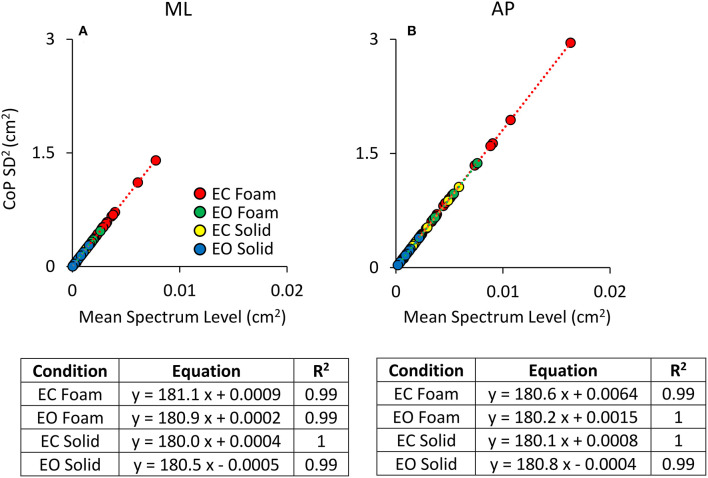
Different measurements of body oscillations in the time or frequency domain are being employed as markers of gait and balance abnormalities. This study investigates basic relationships within and between geometric and spectral measures in a population of young adult subjects. Twenty healthy subjects stood with parallel feet on a force platform with and without a foam pad. Adaptation effects to prolonged stance were assessed by comparing the first and last of a series of eight successive trials. Centre of Foot Pressure (CoP) excursions were recorded with Eyes Closed (EC) and Open (EO) for 90s. Geometric measures (Sway Area, Path Length), standard deviation (SD) of the excursions, and spectral measure (mean power Spectrum Level and Median Frequency), along the medio-lateral (ML) and antero-posterior (AP) direction were computed. Sway Area was more strongly associated than Path Length with CoP SD and, consequently, with mean Spectrum Level for both ML and AP, and both visual and surface conditions. The squared-SD directly specified the mean power Spectrum Level of CoP excursions (ML and AP) in all conditions. Median Frequency was hardly related to Spectrum Level. Adaptation had a confounding effect, whereby equal values of Sway Area, Path Length, and Spectrum Level corresponded to different Median Frequency values. Mean Spectrum Level and SDs of the time series of CoP ML and AP excursions convey the same meaning and bear an acceptable correspondence with Sway Area values. Shifts in Median Frequency values represent important indications of neuromuscular control of stance and of the effects of vision, support conditions, and adaptation. The Romberg Quotient EC/EO for a given variable is contingent on the compliance of the base of support and adaptation, and different between Sway Area and Path Length, but similar between Sway Area and Spectrum Level (AP and ML). These measures must be taken with caution in clinical studies, and considered together in order to get a reliable indication of overall body sway, of modifications by sensory and standing condition, and of changes with ageing, medical conditions and rehabilitation treatment. However, distinct measures shed light on the discrete mechanisms and complex processes underpinning the maintenance of stance.
在时域或频域中对身体振荡进行的不同测量正被用作步态和平衡异常的标志物。本研究调查了年轻成年受试者群体中几何测量和频谱测量内部及之间的基本关系。20名健康受试者双脚平行站立在有和没有泡沫垫的测力平台上。通过比较一系列连续八次试验中的第一次和最后一次来评估对长时间站立的适应效果。闭眼(EC)和睁眼(EO)状态下记录90秒的足底压力中心(CoP)偏移。计算了沿内外侧(ML)和前后方向的几何测量值(摆动面积、路径长度)、偏移的标准差(SD)以及频谱测量值(平均功率谱水平和中位数频率)。对于ML和AP方向,以及视觉和表面条件,摆动面积比路径长度与CoP SD的相关性更强,因此与平均频谱水平的相关性也更强。在所有条件下,SD的平方直接指定了CoP偏移(ML和AP)的平均功率谱水平。中位数频率与频谱水平几乎没有关系。适应具有混杂效应,即摆动面积、路径长度和频谱水平的相等值对应不同的中位数频率值。CoP ML和AP偏移时间序列的平均频谱水平和SDs传达相同的含义,并且与摆动面积值具有可接受的对应关系。中位数频率值反映了姿势神经肌肉控制以及视觉、支撑条件和适应效果的重要指标。给定变量的闭目/睁眼状态下的罗姆伯格商取决于支撑基础的顺应性和适应性,在摆动面积和路径长度之间不同,但在摆动面积和频谱水平(AP和ML)之间相似。在临床研究中必须谨慎采用这些测量方法,并综合考虑,以便可靠地指示全身摆动情况、感觉和站立条件引起的变化以及衰老、医疗状况和康复治疗导致的变化。然而,不同的测量方法有助于揭示维持姿势背后的离散机制和复杂过程。