Lu Yining, Pareek Ayoosh, Lavoie-Gagne Ophelie Z, Forlenza Enrico M, Patel Bhavik H, Reinholz Anna K, Forsythe Brian, Camp Christopher L
Department of Orthopedic Surgery, Mayo Clinic, Rochester, Minnesota, USA.
Harvard Combined Orthopaedic Surgery Program, Harvard Medical School, Boston, Massachusetts, USA.
Orthop J Sports Med. 2022 Jul 26;10(7):23259671221111742. doi: 10.1177/23259671221111742. eCollection 2022 Jul.
In professional sports, injuries resulting in loss of playing time have serious implications for both the athlete and the organization. Efforts to quantify injury probability utilizing machine learning have been met with renewed interest, and the development of effective models has the potential to supplement the decision-making process of team physicians.
PURPOSE/HYPOTHESIS: The purpose of this study was to (1) characterize the epidemiology of time-loss lower extremity muscle strains (LEMSs) in the National Basketball Association (NBA) from 1999 to 2019 and (2) determine the validity of a machine-learning model in predicting injury risk. It was hypothesized that time-loss LEMSs would be infrequent in this cohort and that a machine-learning model would outperform conventional methods in the prediction of injury risk.
Case-control study; Level of evidence, 3.
Performance data and rates of the 4 major muscle strain injury types (hamstring, quadriceps, calf, and groin) were compiled from the 1999 to 2019 NBA seasons. Injuries included all publicly reported injuries that resulted in lost playing time. Models to predict the occurrence of a LEMS were generated using random forest, extreme gradient boosting (XGBoost), neural network, support vector machines, elastic net penalized logistic regression, and generalized logistic regression. Performance was compared utilizing discrimination, calibration, decision curve analysis, and the Brier score.
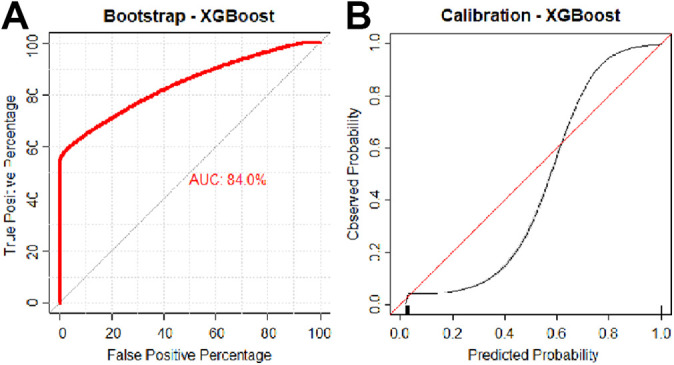
A total of 736 LEMSs resulting in lost playing time occurred among 2103 athletes. Important variables for predicting LEMS included previous number of lower extremity injuries; age; recent history of injuries to the ankle, hamstring, or groin; and recent history of concussion as well as 3-point attempt rate and free throw attempt rate. The XGBoost machine achieved the best performance based on discrimination assessed via internal validation (area under the receiver operating characteristic curve, 0.840), calibration, and decision curve analysis.
Machine learning algorithms such as XGBoost outperformed logistic regression in the prediction of a LEMS that will result in lost time. Several variables increased the risk of LEMS, including a history of various lower extremity injuries, recent concussion, and total number of previous injuries.
在职业体育中,导致比赛时间损失的伤病对运动员和组织都有严重影响。利用机器学习量化受伤概率的努力重新引起了人们的兴趣,开发有效的模型有可能辅助团队医生的决策过程。
目的/假设:本研究的目的是:(1)描述1999年至2019年美国职业篮球联赛(NBA)中导致比赛时间损失的下肢肌肉拉伤(LEMS)的流行病学特征;(2)确定机器学习模型在预测受伤风险方面的有效性。研究假设是,在这个队列中导致比赛时间损失的LEMS并不常见,并且机器学习模型在预测受伤风险方面将优于传统方法。
病例对照研究;证据等级,3级。
收集了1999年至2019年NBA赛季4种主要肌肉拉伤类型(腘绳肌、股四头肌、小腿和腹股沟)的表现数据和发生率。伤病包括所有公开报道的导致比赛时间损失的伤病。使用随机森林、极端梯度提升(XGBoost)、神经网络、支持向量机、弹性网惩罚逻辑回归和广义逻辑回归生成预测LEMS发生的模型。利用判别、校准、决策曲线分析和Brier评分比较模型性能。
2103名运动员中共有736例导致比赛时间损失的LEMS。预测LEMS的重要变量包括先前下肢受伤次数、年龄、近期脚踝、腘绳肌或腹股沟受伤史、近期脑震荡史以及三分球命中率和罚球命中率。基于通过内部验证评估的判别(受试者工作特征曲线下面积,0.840)、校准和决策曲线分析,XGBoost机器表现最佳。
在预测会导致比赛时间损失的LEMS方面,诸如XGBoost之类的机器学习算法优于逻辑回归。几个变量增加了LEMS的风险,包括各种下肢受伤史、近期脑震荡以及先前受伤总数。