Gantasala Elizabeth, Bhat Sevitha, Saralaya Vishwas, Jayaram Madhumitha, Udayalaxmi Jeppu
Kasturba Medical College, Mangalore, Manipal Academy of Higher Education, Manipal, Karnataka, India.
Department of Microbiology, Kasturba Medical College, Mangalore, Manipal Academy of Higher Education, Manipal, Karnataka, 576104, India.
Infect Drug Resist. 2022 Jul 26;15:3991-3999. doi: 10.2147/IDR.S362445. eCollection 2022.
To determine the antibiotic resistance patterns, detection of carbapenemase genes in uropathogenic bacilli belonging to the Enterobacteriaceae family and to correlate it with clinical data.
Identification and antibiotic sensitivity testing of the uropathogenic Enterobacteriaceae was done by using VITEK2 Compact (C) system. Multiplex PCR was used to detect , and genes.
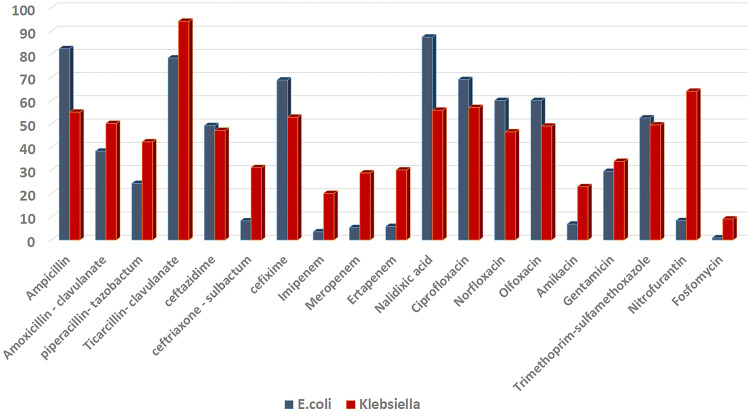
Out of 1602 urine samples, 417 (26%) showed significant growth, and in these 311 (74.6%) belonged to the family. showed a relatively low rate of resistance to nitrofurantoin (17/205; 8.3%), with the majority of the isolates showing a MIC value of ≤16 µg/mL when compared to spp. (55/86; 64%), with MIC values for the majority of isolates being 128 µg/mL. spp. showed a relatively low rate of resistance to nalidixic acid (48/86; 55.8%) when compared with isolates (179/205; 87.3%). Out of 145 isolates tested, we found in 11 (7.58%), in 8 (5.51%), in 4 (2.75%), in one (0.6%) and in none of the isolates. Of these 3 isolates were carbapenem sensitive, the rest were resistant.
Most of the isolates were sensitive to fosfomycin, carbapenems and resistant to cephalosporins and nalidixic acid. We detected carbapenemase genes in 13 (59%) out of 22 carbapenem resistant isolates and 3 (2.4%) out of 123 carbapenem sensitive isolates.
确定肠杆菌科尿路致病性杆菌的抗生素耐药模式,检测碳青霉烯酶基因,并将其与临床数据相关联。
采用VITEK2 Compact(C)系统对尿路致病性肠杆菌科细菌进行鉴定和抗生素敏感性测试。使用多重聚合酶链反应检测 、 和 基因。
在1602份尿液样本中,417份(26%)显示有显著生长,其中311份(74.6%)属于 科。 对呋喃妥因的耐药率相对较低(17/205;8.3%),与 属细菌(55/86;64%)相比,大多数分离株的最低抑菌浓度(MIC)值≤16μg/mL,而大多数 属细菌分离株的MIC值为128μg/mL。与 分离株(179/205;87.3%)相比, 属细菌对萘啶酸的耐药率相对较低(48/86;55.8%)。在145份测试分离株中,我们在11份(7.58%)中发现了 ,在8份(5.51%)中发现了 ,在4份(2.75%)中发现了 ,在1份(0.6%)中发现了 ,在所有分离株中均未发现 。其中3株对碳青霉烯类敏感,其余耐药。
大多数分离株对磷霉素、碳青霉烯类敏感,对头孢菌素和萘啶酸耐药。我们在22株碳青霉烯类耐药分离株中的13株(59%)和123株碳青霉烯类敏感分离株中的3株(2.4%)中检测到碳青霉烯酶基因。