Department of Biomechanics and Movement Science Program, University of Delaware, Newark, DE, USA.
Department of Biostatistics Core Facility, University of Delaware, Newark, DE, USA.
Neurorehabil Neural Repair. 2022 Aug;36(8):535-544. doi: 10.1177/15459683221115409. Epub 2022 Aug 4.
Social and physical environmental factors affect real-world walking activity in individuals with stroke. However, environmental factors are often non-modifiable, presenting a challenge for clinicians working with individuals with stroke whose real-world walking is limited due to environmental barriers.
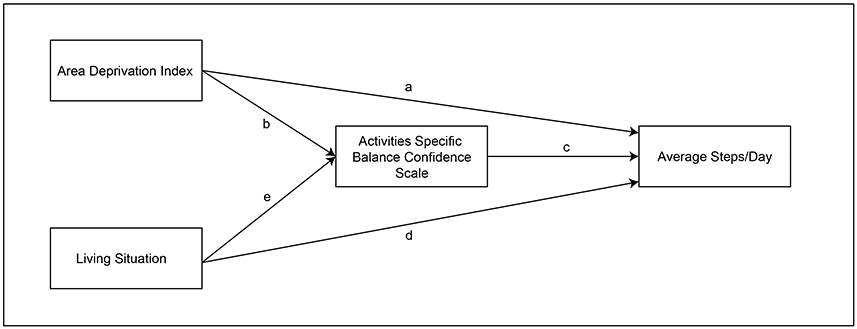
The purpose of this work was to test a model hypothesizing the relationships among environmental factors (specifically, living situation and area deprivation), modifiable factors, and real-world walking activity to understand opportunities for intervention. We hypothesized that balance self-efficacy would mediate the relationship between the environment and real-world walking and that physical capacity would moderate this mediation.
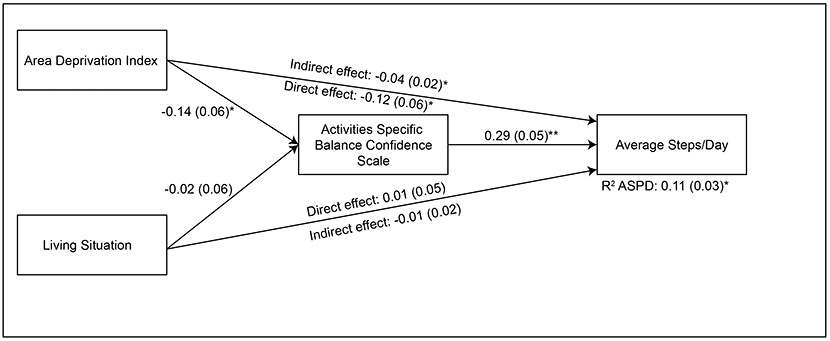
This was a cross-sectional study of 282 individuals with chronic (≥6 months) stroke. We tested the indirect effect to determine if mediation was present. Multiple group structural equation modeling was used to test if physical capacity moderated this mediation. A difference test was used to compare the moderation model against the null (no moderation) model.
Balance self-efficacy mediated the relationship between area deprivation and real-world walking (indirect effect: = -0.04, = .04). Both the moderation and null models fit the data equally well statistically (χ(5) = 6.9, = .23). We therefore accepted the simpler (null) model and concluded that the mediation was not moderated.
Targeting balance self-efficacy may be an effective approach to improving real-world walking in persons with stroke who experience barriers within the physical environment. A stroke survivor's physical capacity may not impact this approach. Future work should consider utilizing more specific measures of the social and physical environment to better understand their influences on real-world walking activity in individuals with stroke. However, the results of this work provide excellent targets for future longitudinal studies targeting real-world walking activity in stroke.
社会和物理环境因素会影响脑卒中患者的真实世界步行活动。然而,环境因素通常是不可改变的,这对于那些由于环境障碍而导致真实世界步行能力受限的脑卒中患者的临床医生来说是一个挑战。
本研究旨在测试一个假设模型,该模型假设环境因素(具体为居住情况和地区贫困程度)、可改变因素与真实世界步行活动之间的关系,以了解干预的机会。我们假设平衡自我效能感将在环境和真实世界步行之间的关系中起中介作用,而身体能力将调节这种中介作用。
这是一项对 282 名慢性(≥6 个月)脑卒中患者的横断面研究。我们测试了间接效应,以确定是否存在中介作用。使用多组结构方程模型来检验身体能力是否调节了这种中介作用。差异检验用于比较调节模型与零(无调节)模型。
平衡自我效能感在地区贫困程度和真实世界步行之间的关系中起中介作用(间接效应: = -0.04, =.04)。调节和零模型在统计学上都很好地拟合了数据(χ(5) = 6.9, =.23)。因此,我们接受了更简单的(零)模型,并得出结论,中介作用不受调节。
针对平衡自我效能感可能是改善脑卒中患者在身体环境中遇到障碍时真实世界步行能力的有效方法。脑卒中患者的身体能力可能不会影响这种方法。未来的工作应该考虑使用更具体的社会和物理环境措施来更好地理解它们对脑卒中患者真实世界步行活动的影响。然而,这项工作的结果为未来针对脑卒中患者真实世界步行活动的纵向研究提供了极好的目标。