Physiotherapy, School of Health and Rehabilitation Sciences, University of Queensland, Brisbane, Australia.
Physiotherapy, School of Allied Health, Faculty of Health Sciences, Australian Catholic University, Brisbane, Australia.
Clin Rehabil. 2024 Oct;38(10):1393-1403. doi: 10.1177/02692155241261698. Epub 2024 Jul 25.
This study aimed to identify factors at hospital discharge that predict physical activity and walking outcomes in the first 6 months after stroke.
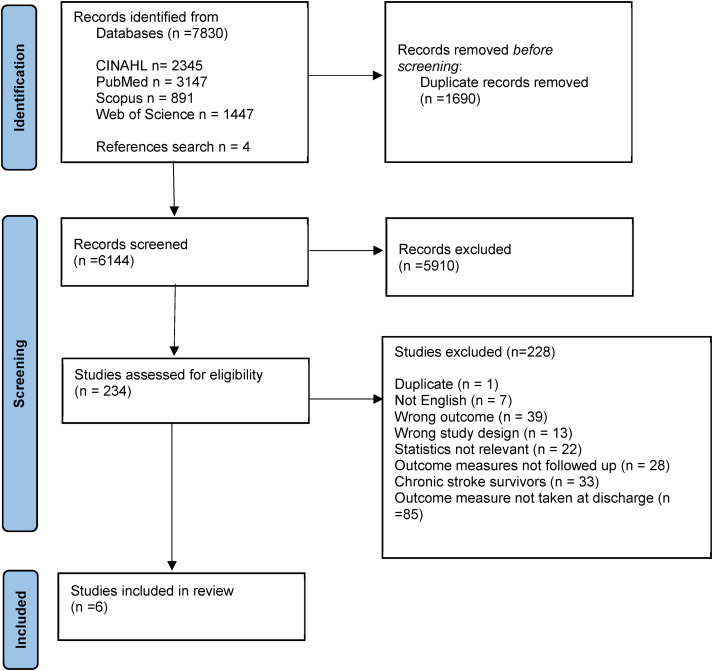
Searches were conducted in CINAHL (EBSCO), Web of Science, PubMed and Scopus from inception to 30 April 2024. Reference lists of included articles were manually screened to identify additional studies.
Studies of adults with stroke reporting predictors at hospital discharge and outcomes of physical activity or walking across the first 6 months after hospital discharge were included. Two reviewers independently screened titles, abstracts and reviewed full texts. Quality of included studies was assessed with Quality in Prognostic Studies screening tool. A narrative synthesis was undertaken.
The search strategy retrieved 7834 studies, from which 6 eligible studies were identified, including a total of 1433 participants. Overall, studies had a low risk of bias. Age, balance, walking speed and walking distance at hospital discharge predicted physical activity outcomes after stroke ( = 2 studies). Cognition, lower limb cycling rhythm and self-efficacy for walking at hospital discharge predicted walking outcomes after stroke ( = 4 studies).
A range of factors predicted physical activity and walking outcomes 6 months after stroke. Physical capabilities at discharge appear to be a predictor of these outcomes; however, this needs to be interpreted with caution. Diverse measures and time points were used across studies to characterise physical activity and walking outcomes, highlighting the need for consistency in measurement and longitudinal studies in stroke research.
本研究旨在确定出院时的相关因素,以预测卒中后 6 个月内的身体活动和行走能力。
从建库至 2024 年 4 月 30 日,在 CINAHL(EBSCO)、Web of Science、PubMed 和 Scopus 中进行了检索。手工筛选纳入文章的参考文献,以确定其他研究。
纳入了报告出院时预测因素以及出院后 6 个月内身体活动或行走能力结局的成人卒中研究。两名审查员独立筛选标题、摘要和全文。使用预后研究质量筛查工具评估纳入研究的质量。采用叙述性综合方法。
检索策略共检索到 7834 篇研究,其中有 6 项符合纳入标准,共纳入 1433 名参与者。总体而言,这些研究的偏倚风险较低。出院时的年龄、平衡、行走速度和行走距离预测卒中后身体活动能力的结局( = 2 项研究)。出院时的认知、下肢踏车节律和行走自我效能预测卒中后行走能力的结局( = 4 项研究)。
一系列因素可预测卒中后 6 个月的身体活动和行走能力。出院时的身体能力似乎是这些结局的预测因素,但需要谨慎解释。各项研究使用了不同的测量方法和时间点来描述身体活动和行走能力结局,这突出表明需要在卒中研究中统一测量方法和开展纵向研究。