Department of Internal Medicine, Ewha Womans University Seoul Hospital, Ewha Womans University College of Medicine, Seoul, Korea.
Department of Internal Medicine, Dongguk University Ilsan Hospital, Goyang, Korea.
PLoS One. 2022 Aug 4;17(8):e0272495. doi: 10.1371/journal.pone.0272495. eCollection 2022.
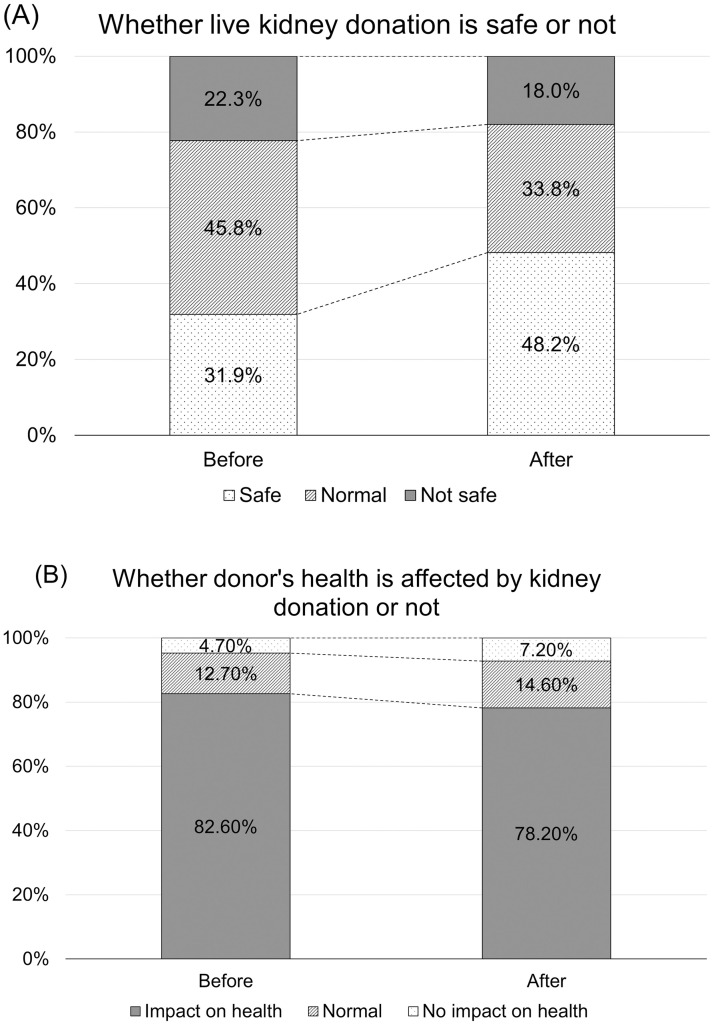
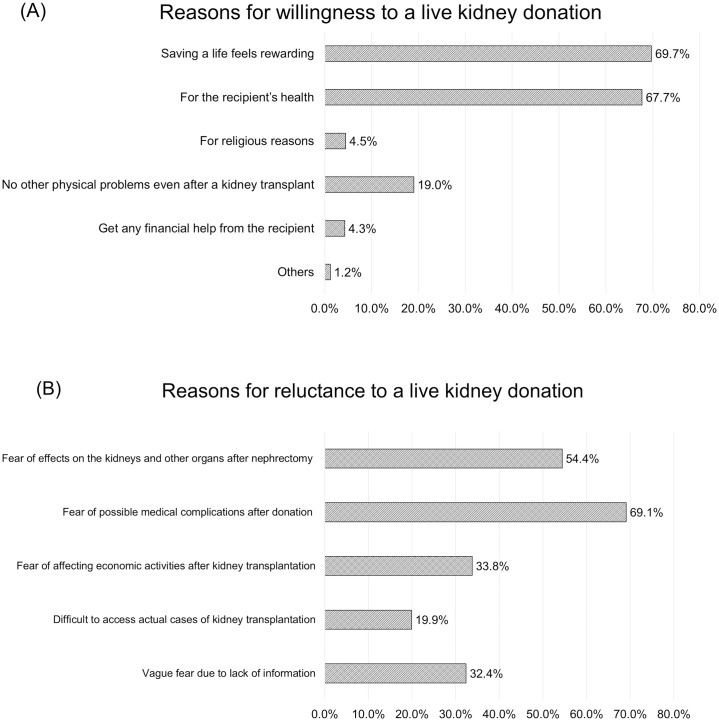
This study aimed to know how the general population recognizes live kidney donation in Korea. Participants were randomly selected from the general population after proportional allocation by region, sex, and age. Selected participants received a questionnaire that included demographic information, socioeconomic and marital statuses, prior recognition of live donor kidney transplantation, expected changes after donation, and the need for support after donor nephrectomy. Among the 1,000 participants from the web-based survey, 83.8% answered they fully understood living donor kidney transplantation, 81.1% knew about them, and 51.1% were willing to donate. Various complications after nephrectomy and deterioration in health after donation were the most significant reasons for those reluctant to donate. Most agreed that the government should provide social and economic support to living kidney donors, especially after exposure to the description of donor nephrectomy. Financial support, including surgery and regular medical check-up costs, was the most preferred government support. The Korean general population seemed aware of the value and safety of kidney donation, although only half of them were willing to donate due to concerns about possible complications. Most participants agreed on social and economic support for living kidney donors, especially surgery-related costs.
本研究旨在了解韩国普通民众对活体肾脏捐赠的认知。参与者是通过地区、性别和年龄的比例分配,从普通人群中随机选择的。选定的参与者收到了一份问卷,其中包括人口统计学信息、社会经济和婚姻状况、对活体供肾移植的预先认知、捐赠后的预期变化以及供肾切除术后的支持需求。在这项基于网络的调查的 1000 名参与者中,83.8%的人表示他们完全理解活体供肾移植,81.1%的人知道活体供肾移植,51.1%的人愿意捐赠。各种术后并发症和捐赠后健康状况恶化是那些不愿意捐赠的人最主要的原因。大多数人认为政府应该为活体肾脏捐赠者提供社会和经济支持,尤其是在接触到描述供肾切除术后。经济支持,包括手术和定期医疗检查费用,是最受欢迎的政府支持形式。韩国普通民众似乎意识到肾脏捐赠的价值和安全性,尽管由于担心可能出现的并发症,只有一半人愿意捐赠。大多数参与者同意为活体肾脏捐赠者提供社会和经济支持,特别是与手术相关的费用。