Max Planck Institute of Molecular Cell Biology and Genetics, Pfotenhauerstraße 108, 01307 Dresden, Germany.
Max Planck Institute of Molecular Cell Biology and Genetics, Pfotenhauerstraße 108, 01307 Dresden, Germany; B CUBE - Center for Molecular Bioengineering, Technische Universität Dresden, Tatzberg 41, 01307 Dresden, Germany; Cluster of Excellence Physics of Life, Technische Universität Dresden, 01062 Dresden, Germany.
Curr Biol. 2022 Sep 26;32(18):4071-4078.e4. doi: 10.1016/j.cub.2022.07.033. Epub 2022 Aug 3.
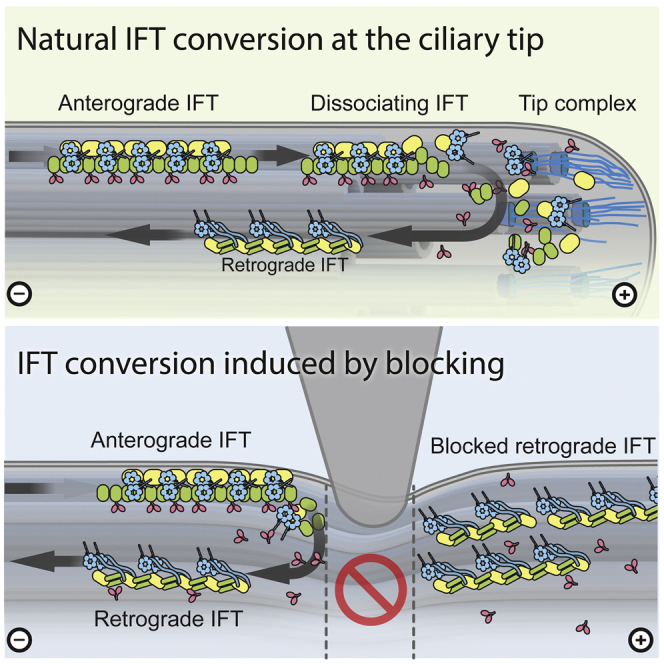
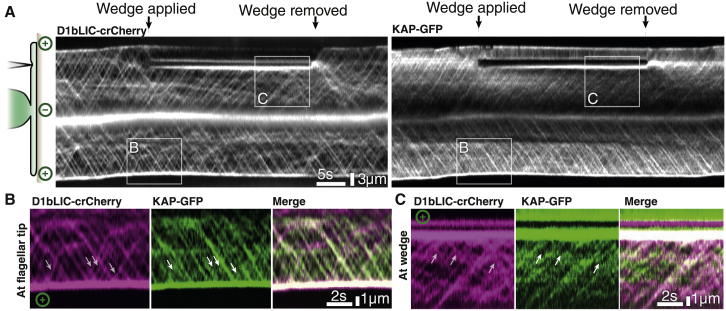
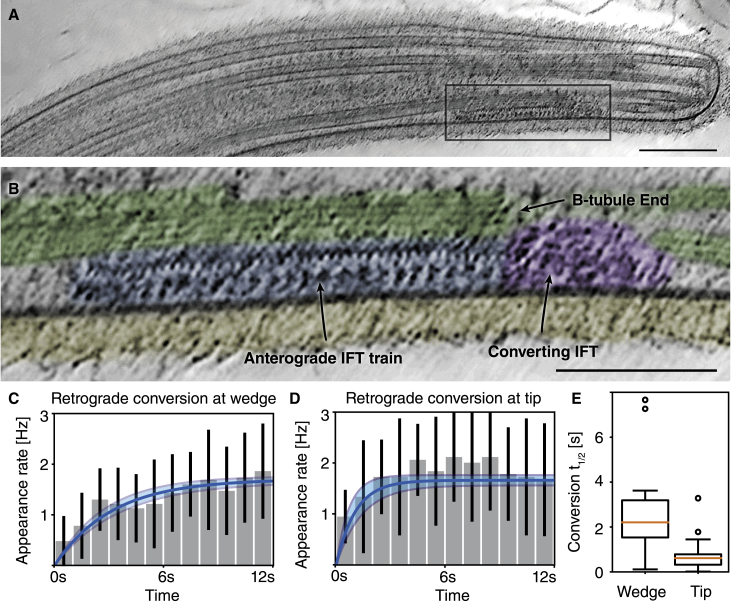
Cilia or eukaryotic flagella are microtubule-based organelles found across the eukaryotic tree of life. Their very high aspect ratio and crowded interior are unfavorable to diffusive transport of most components required for their assembly and maintenance. Instead, a system of intraflagellar transport (IFT) trains moves cargo rapidly up and down the cilium (Figure 1A). Anterograde IFT, from the cell body to the ciliary tip, is driven by kinesin-II motors, whereas retrograde IFT is powered by cytoplasmic dynein-1b motors. Both motors are associated with long chains of IFT protein complexes, known as IFT trains, and their cargoes. The conversion from anterograde to retrograde motility at the ciliary tip involves (1) the dissociation of kinesin motors from trains, (2) a fundamental restructuring of the train from the anterograde to the retrograde architecture, (3) the unloading and reloading of cargo, and (4) the activation of the dynein motors. A prominent hypothesis is that there is dedicated calcium-dependent protein-based machinery at the ciliary tip to mediate these processes. However, the mechanisms of IFT turnaround have remained elusive. In this study, we use mechanical and chemical methods to block IFT at intermediate positions along the cilia of the green algae Chlamydomonas reinhardtii, in normal and calcium-depleted conditions. We show that IFT turnaround, kinesin dissociation, and dynein-1b activation can consistently be induced at arbitrary distances from the ciliary tip, with no stationary tip machinery being required. Instead, we demonstrate that the anterograde-to-retrograde conversion is a calcium-independent intrinsic ability of IFT.
纤毛或真核鞭毛是一种基于微管的细胞器,存在于真核生物的生命树中。它们的高长径比和拥挤的内部不利于大多数组装和维持所需的组件的扩散运输。相反,内鞭毛运输(IFT)列车系统快速地将货物沿纤毛上下运输(图 1A)。从细胞体到纤毛尖端的正向 IFT 由驱动蛋白-II 马达驱动,而逆行 IFT 由细胞质动力蛋白-1b 马达驱动。这两种马达都与IFT 蛋白复合物的长链相关联,称为 IFT 列车及其货物。在纤毛尖端从正向到逆行运动的转换涉及 (1) 动蛋白马达从列车上解离,(2) 列车从正向到逆行结构的基本重构,(3) 货物的卸载和重新加载,以及 (4) 动力蛋白马达的激活。一个突出的假设是,在纤毛尖端有专门的依赖钙的蛋白基础机制来介导这些过程。然而,IFT 反转的机制仍然难以捉摸。在这项研究中,我们使用机械和化学方法在正常和钙耗尽条件下阻断绿藻衣藻纤毛中间位置的 IFT。我们表明,IFT 反转、动蛋白解离和动力蛋白-1b 的激活可以在距纤毛尖端任意距离处一致地诱导,而不需要静止的尖端机制。相反,我们证明了从正向到逆行的转换是 IFT 的一种独立的钙非依赖性内在能力。