Huggins Ashley A, McTeague Lisa M, Davis Megan M, Bustos Nicholas, Crum Kathleen I, Polcyn Rachel, Adams Zachary W, Carpenter Laura A, Hajcak Greg, Halliday Colleen A, Joseph Jane E, Danielson Carla Kmett
Duke-UNC Brain Imaging and Analysis Center (AAH), Duke University, Durham; Department of Psychology (MMD), University of North Carolina at Chapel Hill, Chapel Hill, North Carolina; Departments of Psychiatry (LMM, RP, CAH, CKD), Neuroscience (NB, JEJ), and Pediatrics (LAC), Medical University of South Carolina, Charleston, South Carolina; Department of Psychiatry (KIC, ZWA), Indiana University School of Medicine, Indianapolis, Indiana; and the Department of Biomedical Sciences (GH), Florida State University, Tallahassee, Florida.
Biol Psychiatry Glob Open Sci. 2022 Jul;2(3):242-252. doi: 10.1016/j.bpsgos.2022.03.006. Epub 2022 Mar 17.
Childhood socioeconomic disadvantage is a form of adversity associated with alterations in critical frontolimbic circuits involved in the pathophysiology of psychiatric disorders. Most work has focused on individual-level socioeconomic position, yet individuals living in deprived communities typically encounter additional environmental stressors that have unique effects on the brain and health outcomes. Notably, chronic and unpredictable stressors experienced in the everyday lives of youth living in disadvantaged neighborhoods may impact neural responsivity to uncertain threat.
A community sample of children ( = 254) ages 8 to 15 years (mean = 12.15) completed a picture anticipation task during a functional magnetic resonance imaging scan, during which neutral and negatively valenced photos were presented in a temporally predictable or unpredictable manner. Area Deprivation Index (ADI) scores were derived from participants' home addresses as an index of relative neighborhood disadvantage. Voxelwise analyses examined interactions of ADI, valence, and predictability on neural response to picture presentation.
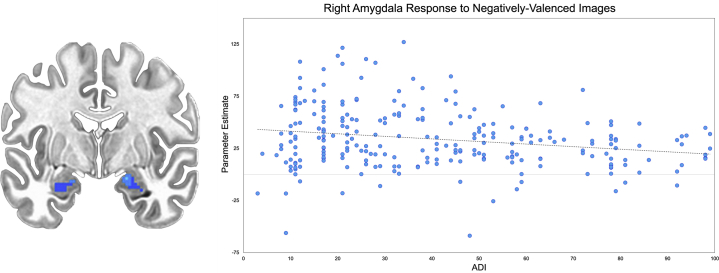
There was a significant ADI × valence interaction in the middle temporal gyrus, anterior cingulate cortex, hippocampus, and amygdala. Higher ADI was associated with less amygdala activation to negatively valenced images. ADI also interacted with predictability. Higher ADI was associated with greater activation of lingual and calcarine gyri for unpredictably presented stimuli. There was no three-way interaction of ADI, valence, and predictability.
Neighborhood disadvantage may impact how the brain perceives and responds to potential threats. Future longitudinal work is critical for delineating how such effects may persist across the life span and how health outcomes may be modifiable with community-based interventions and policies.
儿童期社会经济劣势是一种逆境形式,与精神疾病病理生理学中关键的额颞叶回路改变有关。大多数研究都集中在个体层面的社会经济地位上,然而生活在贫困社区的个体通常会遇到额外的环境压力源,这些压力源对大脑和健康结果有独特的影响。值得注意的是,生活在弱势社区的青少年在日常生活中经历的慢性和不可预测的压力源可能会影响神经对不确定威胁的反应。
一个由254名8至15岁儿童(平均年龄 = 12.15岁)组成的社区样本在功能磁共振成像扫描期间完成了一项图片预期任务,在此期间,中性和负性情绪的照片以时间上可预测或不可预测的方式呈现。区域剥夺指数(ADI)得分从参与者的家庭住址得出,作为相对社区劣势的指标。体素分析检查了ADI、效价和可预测性对图片呈现神经反应的相互作用。
在颞中回、前扣带回皮质、海马体和杏仁核中存在显著的ADI×效价相互作用。较高的ADI与杏仁核对负性情绪图像的激活减少有关。ADI也与可预测性相互作用。较高的ADI与舌回和距状回对不可预测呈现刺激的更大激活有关。不存在ADI、效价和可预测性的三向相互作用。
社区劣势可能会影响大脑对潜在威胁的感知和反应方式。未来的纵向研究对于描绘这些影响如何在整个生命周期中持续存在,以及健康结果如何通过基于社区的干预措施和政策进行改善至关重要。