Hematology Department, Catalan Institute of Oncology, University of Barcelona, IDIBELL, Barcelona, Spain.
Front Immunol. 2022 Jul 19;13:909008. doi: 10.3389/fimmu.2022.909008. eCollection 2022.
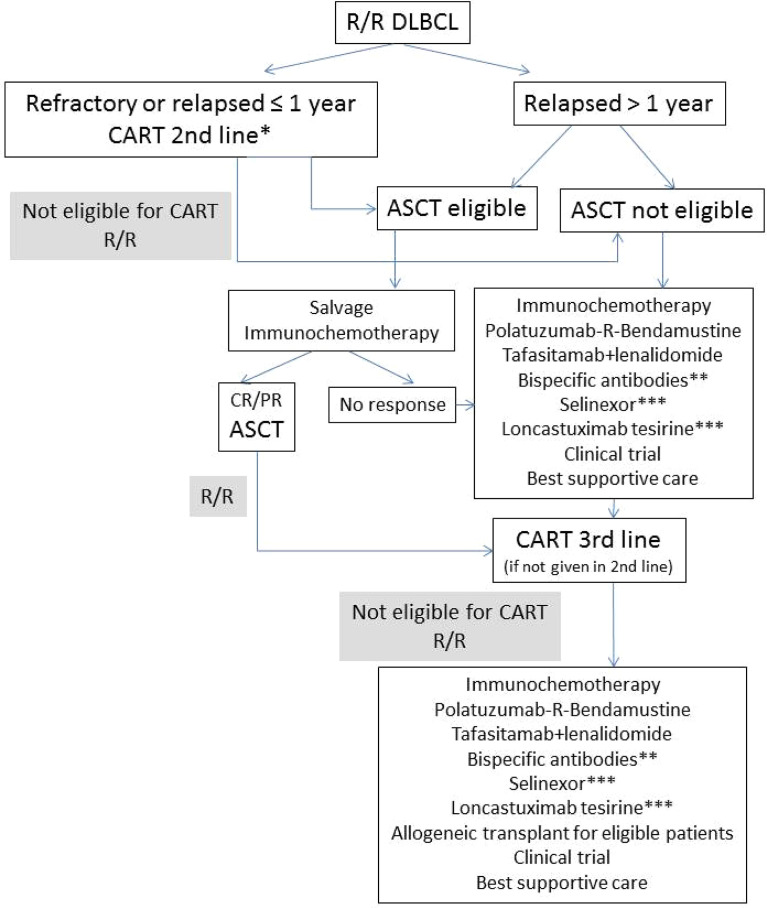
Diffuse large B-cell lymphoma is an aggressive and biologically heterogeneous disease. R-CHOP is the standard first line therapy and cures more than 60% of patients. Salvage high-dose chemotherapy with autologous stem cell transplant remains the standard second-line treatment for relapsed or refractory patients, and recently, three CD19 chimeric antigen receptor T cells (CART) cell products have been approved beyond 2 prior lines of systemic therapy. Nevertheless, some patients are not eligible for transplant or CARTs, or progress after these treatments. In this context, IgG-like bispecific antibodies (BsAbs) have been designed to treat B-cell lymphomas. They combine two different monospecific antigen-binding regions that target CD20 on B cells and engage T cells CD3 in a 1:1 or 2:1 CD20:CD3 antigen binding fragment (Fab) format. The results of different phase 1 trials with BsAbs, including mosunetuzumab, glofitamab, epcoritamab and odeonextamab, have been recently published. They are infused intravenously or subcutaneously, and have a favorable toxicity profile, with reduced cytokine release syndrome and neurological toxicity. Moreover, these BsAbs have demonstrated very promising efficacy in B-cell lymphomas, including in aggressive lymphomas. New trials are currently ongoing to confirm BsAbs efficacy and tolerability, as well as to explore its efficacy in different lines of therapy or in combination with other drugs.
弥漫性大 B 细胞淋巴瘤是一种侵袭性和生物学异质性疾病。R-CHOP 是标准的一线治疗方法,可治愈超过 60%的患者。挽救性高剂量化疗联合自体干细胞移植仍然是复发或难治性患者的标准二线治疗方法,最近,三种 CD19 嵌合抗原受体 T 细胞(CART)细胞产品已被批准用于超过 2 线系统治疗。然而,有些患者不符合移植或 CART 的条件,或在这些治疗后进展。在这种情况下,设计了 IgG 样双特异性抗体(BsAbs)来治疗 B 细胞淋巴瘤。它们结合了两种不同的单特异性抗原结合区,靶向 B 细胞上的 CD20,并以 1:1 或 2:1 的 CD20:CD3 抗原结合片段(Fab)形式与 T 细胞 CD3 结合。最近发表了不同 BsAbs 的 1 期临床试验结果,包括 mosunetuzumab、glofitamab、epcoritamab 和 odeonextamab。它们通过静脉或皮下输注,具有良好的毒性特征,减少细胞因子释放综合征和神经毒性。此外,这些 BsAbs 在 B 细胞淋巴瘤中显示出非常有希望的疗效,包括侵袭性淋巴瘤。目前正在进行新的试验以确认 BsAbs 的疗效和耐受性,并探索其在不同治疗线或与其他药物联合治疗中的疗效。