Division of Cardiology and Sports Cardiology BC University of British Columbia Vancouver British Columbia Canada.
Division of Cardiology Massachusetts General Hospital Boston MA.
J Am Heart Assoc. 2022 Aug 16;11(16):e025369. doi: 10.1161/JAHA.122.025369. Epub 2022 Aug 5.
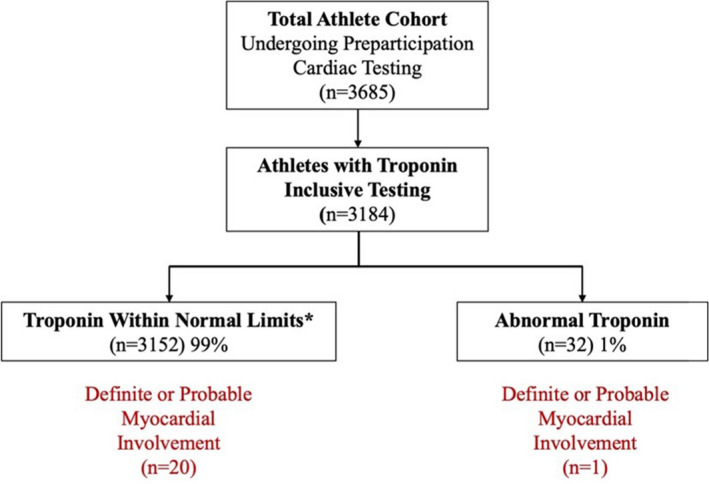
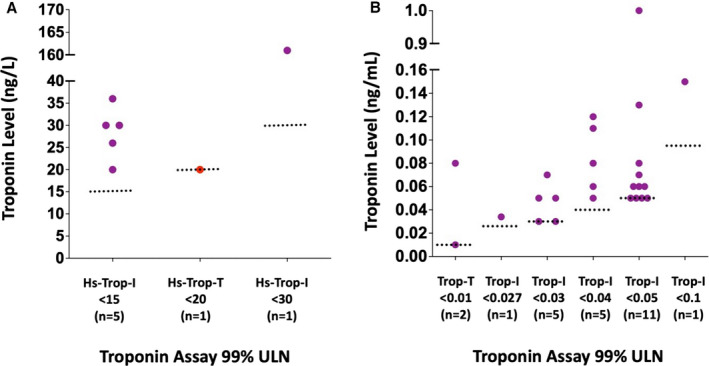
Background Initial protocols for return to play cardiac testing in young competitive athletes following SARS-CoV-2 infection recommended cardiac troponin (cTn) to screen for cardiac involvement. This study aimed to define the diagnostic yield of cTn in athletes undergoing cardiovascular testing following SARS-CoV-2 infection. Methods and Results This prospective, observational cohort study from ORCCA (Outcomes Registry for Cardiac Conditions in Athletes) included collegiate athletes who underwent cTn testing as a component of return to play protocols following SARS-CoV-2 infection. The cTn values were stratified as undetectable, detectable but within normal limits, and abnormal (>99% percentile). The presence of probable or definite SARS-CoV-2 myocardial involvement was compared between those with normal versus abnormal cTn levels. A total of 3184/3685 (86%) athletes in the ORCCA database met the inclusion criteria for this study (age 20±1 years, 32% female athletes, 28% Black race). The median time from SARS-CoV-2 diagnosis to cTn testing was 13 days (interquartile range, 11, 18 days). The cTn levels were undetectable in 2942 athletes (92%), detectable but within normal limits in 210 athletes (7%), and abnormal in 32 athletes (1%). Of the 32 athletes with abnormal cTn testing, 19/32 (59%) underwent cardiac magnetic resonance imaging, 30/32 (94%) underwent transthoracic echocardiography, and 1/32 (3%) did not have cardiac imaging. One athlete with abnormal troponin met the criteria for definite or probable SARS-CoV-2 myocardial involvement. In the total cohort, 21/3184 (0.7%) had SARS-CoV-2 myocardial involvement, among whom 20/21 (95%) had normal troponin testing. Conclusions Abnormal cTn during routine return to play cardiac screening among competitive athletes following SARS-CoV-2 infection appears to have limited diagnostic utility.
在 SARS-CoV-2 感染后,年轻竞技运动员重返赛场的初始心脏检测方案建议使用肌钙蛋白(cTn)筛查心脏受累情况。本研究旨在确定 SARS-CoV-2 感染后接受心血管检测的运动员中 cTn 的诊断效果。
这项来自 ORCCA(运动员心脏疾病结果登记处)的前瞻性观察队列研究纳入了接受 SARS-CoV-2 感染后重返赛场检测方案并进行 cTn 检测的大学生运动员。将 cTn 值分为不可检测、可检测但在正常范围内和异常(>99%分位数)。比较 cTn 水平正常与异常的患者中是否存在可能或明确的 SARS-CoV-2 心肌受累。在 ORCCA 数据库中,共有 3184/3685(86%)名运动员符合本研究纳入标准(年龄 20±1 岁,32%为女性运动员,28%为黑人)。从 SARS-CoV-2 诊断到 cTn 检测的中位时间为 13 天(四分位距,11,18 天)。2942 名运动员(92%)的 cTn 水平不可检测,210 名运动员(7%)的 cTn 水平可检测但在正常范围内,32 名运动员(1%)的 cTn 水平异常。在 32 名 cTn 检测异常的运动员中,19/32(59%)进行了心脏磁共振成像,30/32(94%)进行了经胸超声心动图检查,1/32(3%)未进行心脏成像。1 名 cTn 异常的运动员符合明确或可能的 SARS-CoV-2 心肌受累标准。在总队列中,3184 名运动员中有 21 名(0.7%)发生 SARS-CoV-2 心肌受累,其中 20 名(95%)的肌钙蛋白检测正常。
在 SARS-CoV-2 感染后竞技运动员常规重返赛场心脏筛查中,cTn 异常似乎诊断效果有限。