Michigan Neuroscience Institute, University of Michigan, Ann Arbor, MI 48109.
Department of Human Genetics, University of Michigan, Ann Arbor, MI 48109.
Proc Natl Acad Sci U S A. 2022 Aug 9;119(32):e2116956119. doi: 10.1073/pnas.2116956119. Epub 2022 Aug 5.
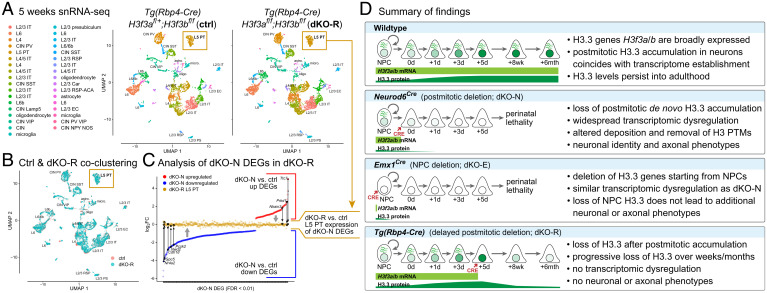
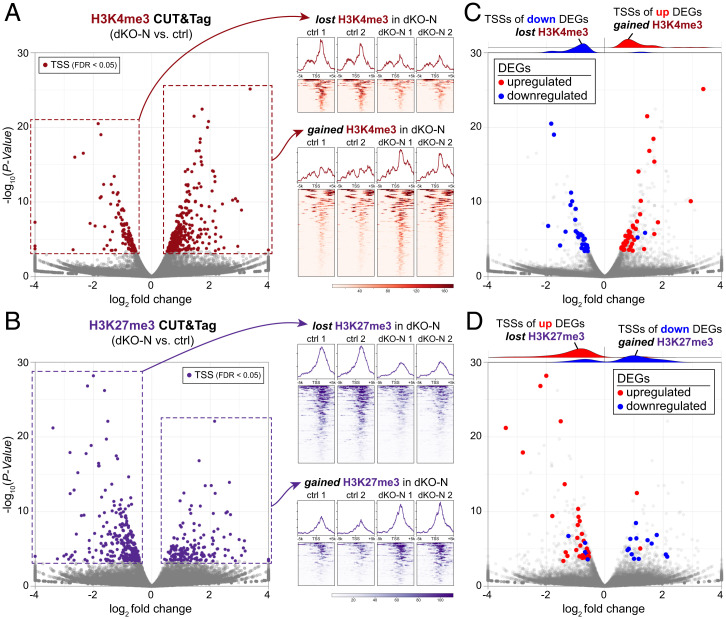
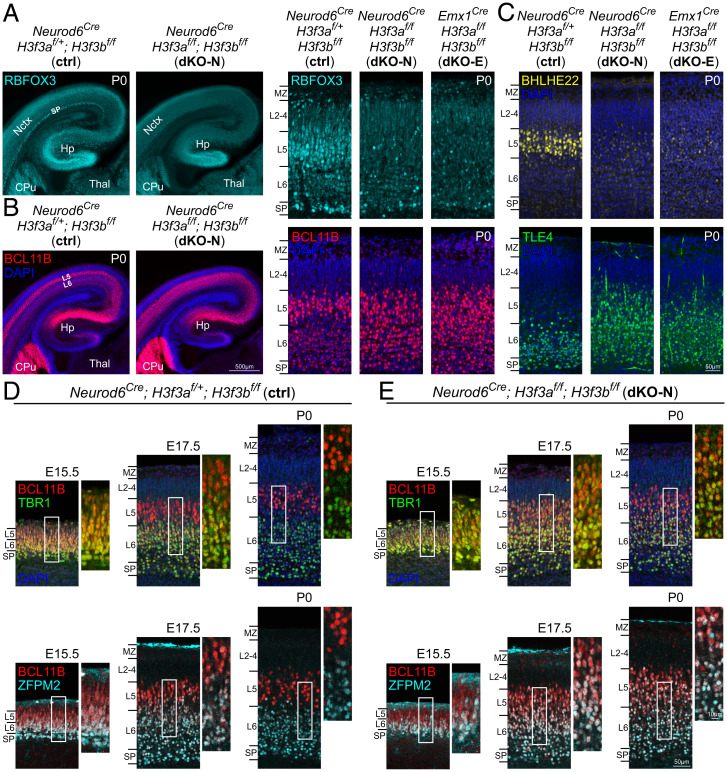
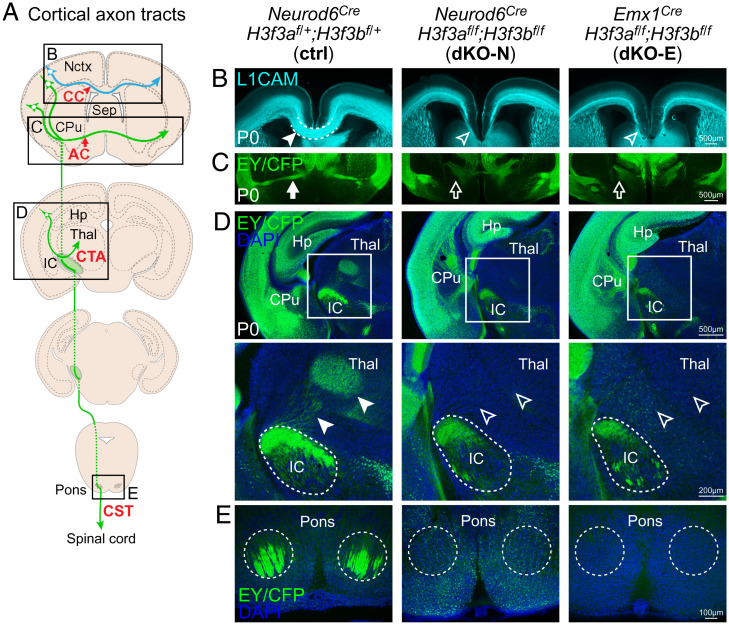
Histone variants, which can be expressed outside of S-phase and deposited DNA synthesis-independently, provide long-term histone replacement in postmitotic cells, including neurons. Beyond replenishment, histone variants also play active roles in gene regulation by modulating chromatin states or enabling nucleosome turnover. Here, we uncover crucial roles for the histone H3 variant H3.3 in neuronal development. We find that newborn cortical excitatory neurons, which have only just completed replication-coupled deposition of canonical H3.1 and H3.2, substantially accumulate H3.3 immediately postmitosis. Codeletion of H3.3-encoding genes and from newly postmitotic neurons abrogates H3.3 accumulation, markedly alters the histone posttranslational modification landscape, and causes widespread disruptions to the establishment of the neuronal transcriptome. These changes coincide with developmental phenotypes in neuronal identities and axon projections. Thus, preexisting, replication-dependent histones are insufficient for establishing neuronal chromatin and transcriptome; de novo H3.3 is required. Stage-dependent deletion of and from 1) cycling neural progenitor cells, 2) neurons immediately postmitosis, or 3) several days later, reveals the first postmitotic days to be a critical window for de novo H3.3. After H3.3 accumulation within this developmental window, codeletion of and does not lead to immediate H3.3 loss, but causes progressive H3.3 depletion over several months without widespread transcriptional disruptions or cellular phenotypes. Our study thus uncovers key developmental roles for de novo H3.3 in establishing neuronal chromatin, transcriptome, identity, and connectivity immediately postmitosis that are distinct from its role in maintaining total histone H3 levels over the neuronal lifespan.
组蛋白变体可以在 S 期外表达,并在 DNA 合成独立的情况下进行沉积,为有丝分裂后细胞(包括神经元)提供长期的组蛋白替代。除了补充外,组蛋白变体还通过调节染色质状态或促进核小体周转,在基因调控中发挥积极作用。在这里,我们揭示了组蛋白 H3.3 变体在神经元发育中的关键作用。我们发现,新皮质兴奋性神经元在刚刚完成与复制偶联的经典 H3.1 和 H3.2 沉积后,在有丝分裂后立即大量积累 H3.3。从新有丝分裂后的神经元中缺失编码 H3.3 的基因 和 ,会消除 H3.3 的积累,显著改变组蛋白翻译后修饰的景观,并导致广泛的神经元转录组建立的破坏。这些变化与神经元身份和轴突投射的发育表型一致。因此,现有的、依赖复制的组蛋白不足以建立神经元染色质和转录组;需要从头合成 H3.3。从 1)循环神经祖细胞、2)有丝分裂后立即的神经元、或 3)几天后,对 和 进行阶段依赖性缺失,揭示了第一个有丝分裂后的日子是从头合成 H3.3 的关键窗口。在这个发育窗口内 H3.3 积累后,从 1)循环神经祖细胞、2)有丝分裂后立即的神经元、或 3)几天后,对 和 进行阶段依赖性缺失,揭示了第一个有丝分裂后的日子是从头合成 H3.3 的关键窗口。在这个发育窗口内 H3.3 积累后,缺失 和 不会立即导致 H3.3 丢失,但会导致在几个月内逐渐耗尽 H3.3,而不会导致广泛的转录中断或细胞表型。因此,我们的研究揭示了新合成的 H3.3 在有丝分裂后立即建立神经元染色质、转录组、身份和连接方面的关键发育作用,这与它在维持神经元寿命内总组蛋白 H3 水平方面的作用不同。