Hypoxia Biology Laboratory, Francis Crick Institute, London, NW1 1AT, United Kingdom.
Ludwig Institute for Cancer Research, Nuffield Department of Clinical Medicine, University of Oxford, Oxford, OX3 7DQ, United Kingdom.
Proc Natl Acad Sci U S A. 2022 Aug 9;119(32):e2201483119. doi: 10.1073/pnas.2201483119. Epub 2022 Aug 5.
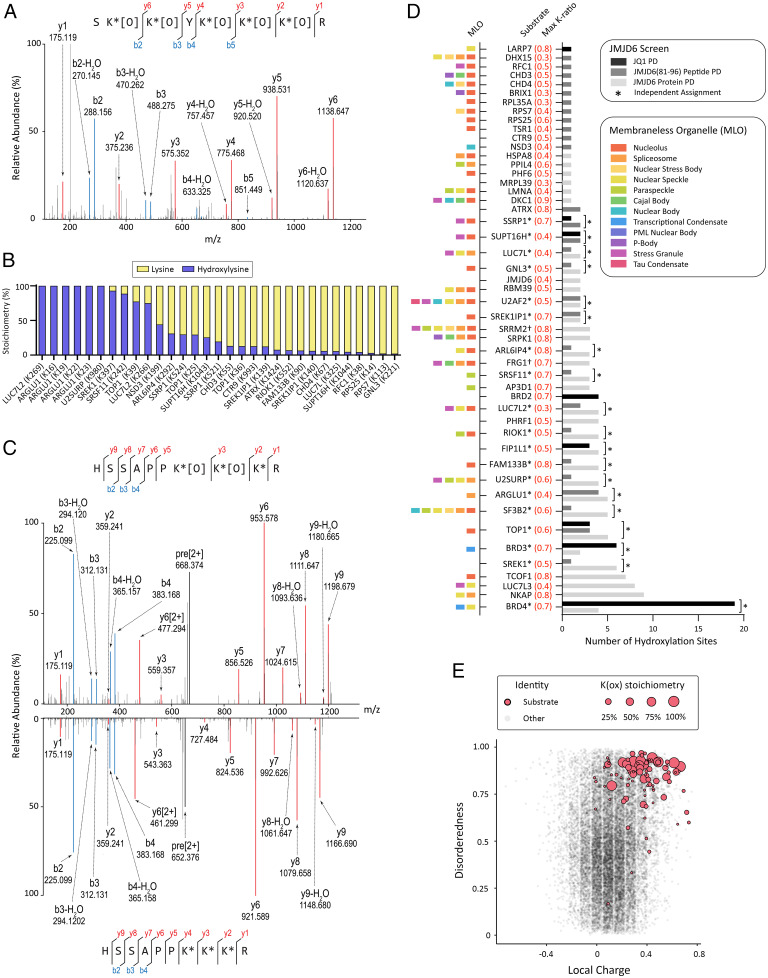
The Jumonji domain-containing protein JMJD6 is a 2-oxoglutarate-dependent dioxygenase associated with a broad range of biological functions. Cellular studies have implicated the enzyme in chromatin biology, transcription, DNA repair, mRNA splicing, and cotranscriptional processing. Although not all studies agree, JMJD6 has been reported to catalyze both hydroxylation of lysine residues and demethylation of arginine residues. However, despite extensive study and indirect evidence for JMJD6 catalysis in many cellular processes, direct assignment of JMJD6 catalytic substrates has been limited. Examination of a reported site of proline hydroxylation within a lysine-rich region of the tandem bromodomain protein BRD4 led us to conclude that hydroxylation was in fact on lysine and catalyzed by JMJD6. This prompted a wider search for JMJD6-catalyzed protein modifications deploying mass spectrometric methods designed to improve the analysis of such lysine-rich regions. Using lysine derivatization with propionic anhydride to improve the analysis of tryptic peptides and nontryptic proteolysis, we report 150 sites of JMJD6-catalyzed lysine hydroxylation on 48 protein substrates, including 19 sites of hydroxylation on BRD4. Most hydroxylations were within lysine-rich regions that are predicted to be unstructured; in some, multiple modifications were observed on adjacent lysine residues. Almost all of the JMJD6 substrates defined in these studies have been associated with membraneless organelle formation. Given the reported roles of lysine-rich regions in subcellular partitioning by liquid-liquid phase separation, our findings raise the possibility that JMJD6 may play a role in regulating such processes in response to stresses, including hypoxia.
Jumonji 结构域包含蛋白 JMJD6 是一种依赖 2-氧戊二酸的双加氧酶,与广泛的生物学功能有关。细胞研究表明,该酶参与染色质生物学、转录、DNA 修复、mRNA 剪接和共转录加工。尽管并非所有研究都一致,但据报道,JMJD6 既能催化赖氨酸残基的羟化,也能催化精氨酸残基的去甲基化。然而,尽管 JMJD6 在许多细胞过程中的催化作用进行了广泛的研究和间接证据,但 JMJD6 催化底物的直接分配一直受到限制。对串联溴结构域蛋白 BRD4 赖氨酸丰富区域中报道的脯氨酸羟化位点的检查使我们得出结论,羟化实际上发生在赖氨酸上,由 JMJD6 催化。这促使我们更广泛地寻找 JMJD6 催化的蛋白质修饰,采用质谱方法来改善对这种富含赖氨酸区域的分析。使用丙酸酐对赖氨酸进行衍生化以改善胰蛋白酶肽的分析和非胰蛋白酶蛋白水解,我们报告了 48 种蛋白质底物上由 JMJD6 催化的赖氨酸羟化的 150 个位点,包括 BRD4 上的 19 个羟化位点。大多数羟化发生在预测无结构的赖氨酸丰富区域内;在一些区域中,相邻赖氨酸残基上观察到多个修饰。在这些研究中定义的几乎所有 JMJD6 底物都与无膜细胞器的形成有关。鉴于赖氨酸丰富区域在通过液-液相分离进行亚细胞分区中的报道作用,我们的发现提出了这样一种可能性,即 JMJD6 可能在响应包括缺氧在内的应激时在调节这些过程中发挥作用。