University of Utah Molecular Medicine Program, Salt Lake City, UT.
Department of Internal Medicine, University of Utah Health, Salt Lake City, UT.
Blood. 2022 Dec 8;140(23):2477-2489. doi: 10.1182/blood.2022015568.
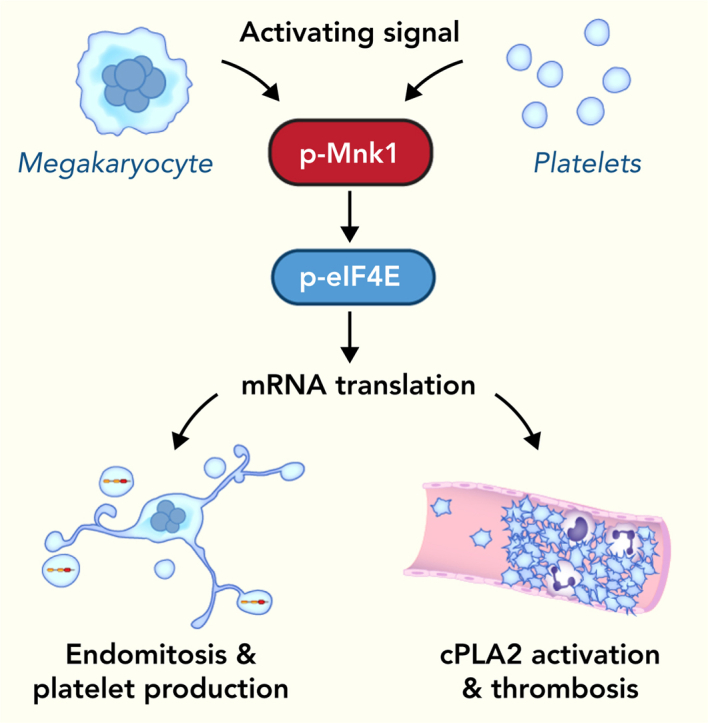
The MAPK-interacting kinase (Mnk) family includes Mnk1 and Mnk2, which are phosphorylated and activated in response to extracellular stimuli. Mnk1 contributes to cellular responses by regulating messenger RNA (mRNA) translation, and mRNA translation influences platelet production and function. However, the role of Mnk1 in megakaryocytes and platelets has not previously been studied. The present study investigated Mnk1 in megakaryocytes and platelets using both pharmacological and genetic approaches. We demonstrate that Mnk1, but not Mnk2, is expressed and active in human and murine megakaryocytes and platelets. Stimulating human and murine megakaryocytes and platelets induced Mnk1 activation and phosphorylation of eIF4E, a downstream target of activated Mnk1 that triggers mRNA translation. Mnk1 inhibition or deletion significantly diminished protein synthesis in megakaryocytes as measured by polysome profiling and [35S]-methionine incorporation assays. Depletion of Mnk1 also reduced megakaryocyte ploidy and proplatelet forming megakaryocytes in vitro and resulted in thrombocytopenia. However, Mnk1 deletion did not affect the half-life of circulating platelets. Platelets from Mnk1 knockout mice exhibited reduced platelet aggregation, α granule secretion, and integrin αIIbβ3 activation. Ribosomal footprint sequencing indicated that Mnk1 regulates the translation of Pla2g4a mRNA (which encodes cPLA2) in megakaryocytes. Consistent with this, Mnk1 ablation reduced cPLA2 activity and thromboxane generation in platelets and megakaryocytes. In vivo, Mnk1 ablation protected against platelet-dependent thromboembolism. These results provide previously unrecognized evidence that Mnk1 regulates mRNA translation and cellular activation in platelets and megakaryocytes, endomitosis and thrombopoiesis, and thrombosis.
丝裂原活化蛋白激酶相互作用激酶(MAPK-interacting kinase,Mnk)家族包括 Mnk1 和 Mnk2,它们在外源刺激下被磷酸化和激活。Mnk1 通过调节信使 RNA(mRNA)翻译来促进细胞反应,而 mRNA 翻译影响血小板的生成和功能。然而,Mnk1 在巨核细胞和血小板中的作用尚未得到研究。本研究采用药理学和遗传学方法研究了 Mnk1 在巨核细胞和血小板中的作用。我们证明,Mnk1 而非 Mnk2 在人和鼠的巨核细胞和血小板中表达并具有活性。刺激人和鼠的巨核细胞和血小板可诱导 Mnk1 激活和 eIF4E 的磷酸化,eIF4E 是激活的 Mnk1 的下游靶标,可触发 mRNA 翻译。Mnk1 抑制或缺失可显著减少巨核细胞中的蛋白质合成,这可通过多核糖体谱分析和 [35S]-蛋氨酸掺入测定来衡量。Mnk1 的耗竭还可减少巨核细胞的核倍性和体外形成的原巨核细胞,并导致血小板减少。然而,Mnk1 缺失并不影响循环血小板的半衰期。Mnk1 敲除小鼠的血小板表现出血小板聚集、α 颗粒分泌和整合素 αIIbβ3 激活减少。核糖体足迹测序表明,Mnk1 调节巨核细胞中 Pla2g4a mRNA(编码 cPLA2)的翻译。与此一致,Mnk1 缺失可减少血小板和巨核细胞中 cPLA2 活性和血栓烷生成。在体内,Mnk1 缺失可防止血小板依赖性血栓栓塞。这些结果提供了以前未被认识到的证据,表明 Mnk1 调节血小板和巨核细胞中的 mRNA 翻译和细胞激活、有丝分裂和血小板生成以及血栓形成。