Centro de Investigación Biomédica En Red de Enfermedades Respiratorias (CIBERES), Instituto de Salud Carlos III, Madrid, Spain; Clinical Research/Epidemiology in Pneumonia & Sepsis (CRIPS), Vall d'Hebron Institute of Research (VHIR), Barcelona, Spain.
NESMOS Department of Dermatology, Sapienza University of Rome, Rome, Italy.
Eur J Intern Med. 2022 Oct;104:73-79. doi: 10.1016/j.ejim.2022.07.022. Epub 2022 Aug 1.
Varicella zoster virus (VZV) reactivation has been reported following vaccination for severe acute respiratory syndrome coronavirus 2 (SARS-CoV-2), but the real extent remains unknown.
We conducted a systematic review to summarize evidence of VZV reactivation or infection following SARS-CoV-2 vaccination. Episodes after coronavirus disease-2019 (COVID-19) were also identified. Related articles were identified in PubMed and EMBASE databases till December 31, 2021 using the terms "varicella zoster" and "COVID-19″. PROSPERO Register Number: CRD42021289399.
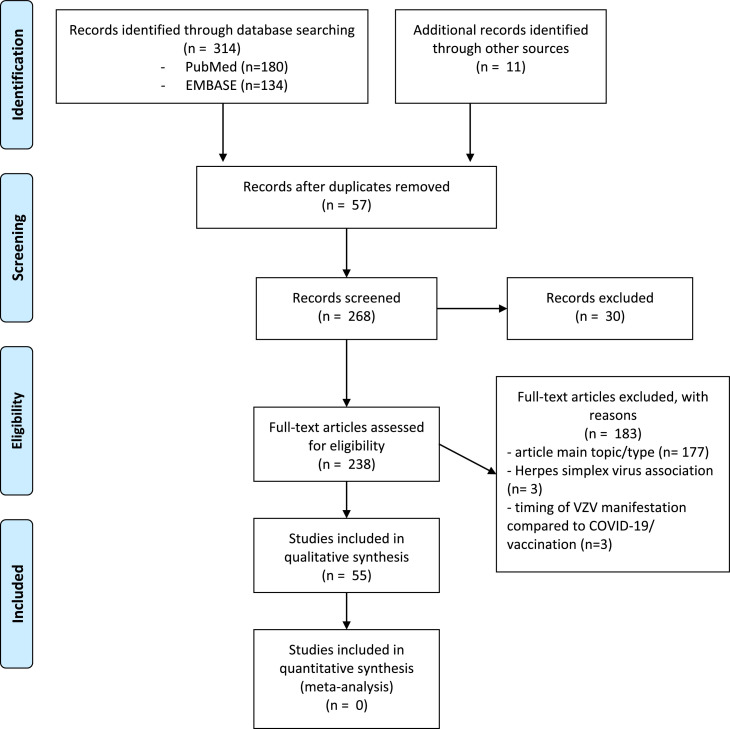
The search revealed 314 articles, of which 55 met the inclusion criteria. VZV manifestations were documented in 179 (82.1%) subjects following SARS-CoV-2 vaccination and in 39 (17.9%) patients with COVID-19. Among the vaccinated, median (IQR) age was 56.5 (42-70) years, and 56.8% were female. Twenty-one (16.8%) were immunosuppressed. The median (IQR) latency time after vaccination was 6 (3-10) days, and 84.4% received mRNA vaccines. VZV reactivation occurred following a first dose (68.2%), a second dose (12.8%) or a booster (0.6%). The most important VZV manifestation was dermatome herpes zoster rash, which accounted for 86.4% of events in vaccinated subjects. Twenty patients (11.3%) presented serious VZV events after vaccination, with Herpes Zoster ophthalmicus (5.6%) and post-herpetic neuralgia (3.4%) predominating. No VZV pneumonia or deaths were recorded. Antiviral prescriptions were made in 96.2% of vaccinated subjects. No significant differences between vaccinated and infected subjects were found.
This study indicates that the occurrence of VZV reactivation is clinically relevant. However, our findings suggest that COVID-19 vaccination is safe, and remains strongly recommended.
带状疱疹病毒(VZV)在接种严重急性呼吸综合征冠状病毒 2(SARS-CoV-2)疫苗后被报告有再激活的情况,但实际程度仍不清楚。
我们进行了一项系统评价,以总结 VZV 再激活或感染 SARS-CoV-2 疫苗接种后的证据。还确定了冠状病毒病 2019(COVID-19)后的病例。使用术语“带状疱疹”和“COVID-19”在 PubMed 和 EMBASE 数据库中检索截至 2021 年 12 月 31 日的相关文章。PROSPERO 注册号:CRD42021289399。
搜索结果显示有 314 篇文章,其中 55 篇符合纳入标准。在接种 SARS-CoV-2 疫苗后,179 例(82.1%)和 39 例(17.9%)COVID-19 患者出现了 VZV 表现。在接种疫苗的患者中,中位(IQR)年龄为 56.5(42-70)岁,56.8%为女性。21 例(16.8%)为免疫抑制者。接种疫苗后中位(IQR)潜伏期为 6(3-10)天,84.4%接受了 mRNA 疫苗。VZV 再激活发生在第一剂(68.2%)、第二剂(12.8%)或加强剂(0.6%)后。最重要的 VZV 表现是疱疹性带状疱疹皮疹,占接种疫苗患者中事件的 86.4%。20 例(11.3%)患者在接种疫苗后出现严重的 VZV 事件,其中眼带状疱疹(5.6%)和疱疹后神经痛(3.4%)居多。未记录 VZV 肺炎或死亡。在接种疫苗的患者中,96.2%使用了抗病毒药物。在接种疫苗和感染的患者之间未发现显著差异。
本研究表明 VZV 再激活的发生具有临床相关性。然而,我们的发现表明 COVID-19 疫苗接种是安全的,仍然强烈建议接种。