Medical Research Council Unit The Gambia at London School of Hygiene & Tropical Medicine, Banjul, The Gambia.
Department of Health Data Sciences, University of Liverpool, Liverpool, UK.
Int J Obes (Lond). 2022 Oct;46(10):1892-1900. doi: 10.1038/s41366-022-01193-1. Epub 2022 Aug 6.
AIMS/HYPOTHESIS: Translocation of bacterial debris from the gut causes metabolic endotoxemia (ME) that results in insulin resistance, and may be on the causal pathway to obesity-related type 2 diabetes. To guide interventions against ME we tested two hypothesised mechanisms for lipopolysaccharide (LPS) ingress: a leaky gut and chylomicron-associated transfer following a high-fat meal.
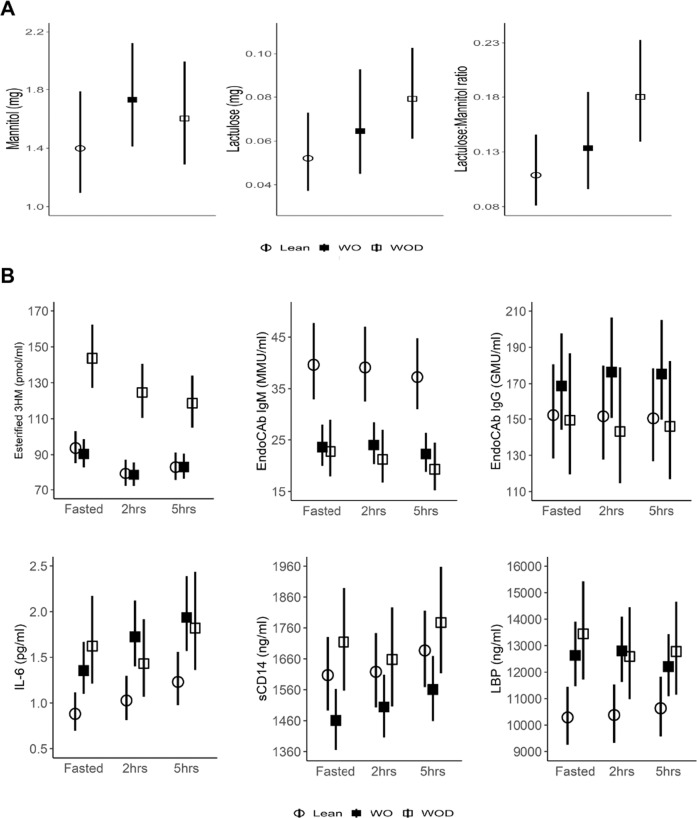
In lean women (n = 48; fat mass index (FMI) 9.6 kg/m), women with obesity (n = 62; FMI 23.6 kg/m) and women with obesity-diabetes (n = 38; FMI 24.9 kg/m) we used the lactulose-mannitol dual-sugar permeability test (LM ratio) to assess gut integrity. Markers of ME (LPS, EndoCAb IgG and IgM, IL-6, CD14 and lipoprotein binding protein) were assessed at baseline, 2 h and 5 h after a standardised 49 g fat-containing mixed meal. mRNA expression of markers of inflammation, macrophage activation and lipid metabolism were measured in peri-umbilical adipose tissue (AT) biopsies.
The LM ratio did not differ between groups. LPS levels were 57% higher in the obesity-diabetes group (P < 0.001), but, contrary to the chylomicron transfer hypothesis, levels significantly declined following the high-fat challenge. EndoCAb IgM was markedly lower in women with obesity and women with obesity-diabetes. mRNA levels of inflammatory markers in adipose tissue were consistent with the prior concept that fat soluble LPS in AT attracts and activates macrophages.
CONCLUSIONS/INTERPRETATION: Raised levels of LPS and IL-6 in women with obesity-diabetes and evidence of macrophage activation in adipose tissue support the concept of metabolic endotoxemia-mediated inflammation, but we found no evidence for abnormal gut permeability or chylomicron-associated post-prandial translocation of LPS. Instead, the markedly lower EndoCAb IgM levels indicate a failure in sequestration and detoxification.
目的/假设:肠道细菌残骸的转移会导致代谢性内毒素血症(ME),从而导致胰岛素抵抗,并且可能是肥胖相关 2 型糖尿病的因果途径。为了指导针对 ME 的干预措施,我们测试了两种内毒素(LPS)进入的假设机制:高脂肪餐后肠漏和乳糜微粒相关转移。
在瘦女性(n=48;脂肪质量指数(FMI)9.6kg/m)、肥胖女性(n=62;FMI 23.6kg/m)和肥胖糖尿病女性(n=38;FMI 24.9kg/m)中,我们使用乳果糖-甘露醇双糖通透性试验(LM 比值)评估肠道完整性。在标准 49g 含脂肪混合餐后 2 小时和 5 小时,评估 ME 的标志物(LPS、EndoCAb IgG 和 IgM、IL-6、CD14 和脂蛋白结合蛋白)。测量脐周脂肪组织(AT)活检中炎症、巨噬细胞激活和脂质代谢标志物的 mRNA 表达。
各组间 LM 比值无差异。肥胖糖尿病组 LPS 水平高出 57%(P<0.001),但与乳糜微粒转移假设相反,高脂肪餐后 LPS 水平显著下降。肥胖和肥胖糖尿病女性的 EndoCAb IgM 明显降低。脂肪组织中炎症标志物的 mRNA 水平与先前的概念一致,即脂肪组织中脂溶性 LPS 吸引并激活巨噬细胞。
结论/解释:肥胖糖尿病女性 LPS 和 IL-6 水平升高,脂肪组织中存在巨噬细胞激活的证据,支持代谢性内毒素血症介导的炎症概念,但我们没有发现肠道通透性异常或乳糜微粒相关餐后 LPS 转移的证据。相反,明显较低的 EndoCAb IgM 水平表明隔离和解毒失败。