Department of Surgery, Wake Forest University School of Medicine, Winston-Salem, NC, 27157, USA.
Department of Cancer Biology, Wake Forest University School of Medicine, Winston-Salem, NC, 27157, USA.
Microbiome. 2024 Oct 4;12(1):192. doi: 10.1186/s40168-024-01901-1.
Obesity, and in particular abdominal obesity, is associated with an increased risk of developing a variety of chronic diseases. Obesity, aging, and menopause are each associated with differential shifts in the gut microbiome. Obesity causes chronic low-grade inflammation due to increased lipopolysaccharide (LPS) levels which is termed "metabolic endotoxemia." We examined the association of visceral adiposity tissue (VAT) area, circulating endotoxemia markers, and the gut bacterial microbiome in a cohort of aged postmenopausal women.
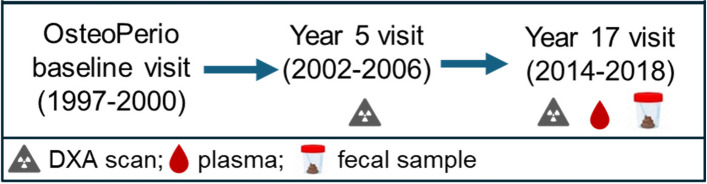
Fifty postmenopausal women (mean age 78.8 ± 5.3 years) who had existing adipose measurements via dual x-ray absorptiometry (DXA) were selected from the extremes of VAT: n = 25 with low VAT area (45.6 ± 12.5 cm) and n = 25 with high VAT area (177.5 ± 31.3 cm). Dietary intake used to estimate the Healthy Eating Index (HEI) score was assessed with a food frequency questionnaire. Plasma LPS, LPS-binding protein (LBP), anti-LPS antibodies, anti-flagellin antibodies, and anti-lipoteichoic acid (LTA) antibodies were measured by ELISA. Metagenomic sequencing was performed on fecal DNA. Female C57BL/6 mice consuming a high-fat or low-fat diet were treated with 0.4 mg/kg diet-derived fecal isolated LPS modeling metabolic endotoxemia, and metabolic outcomes were measured after 6 weeks.
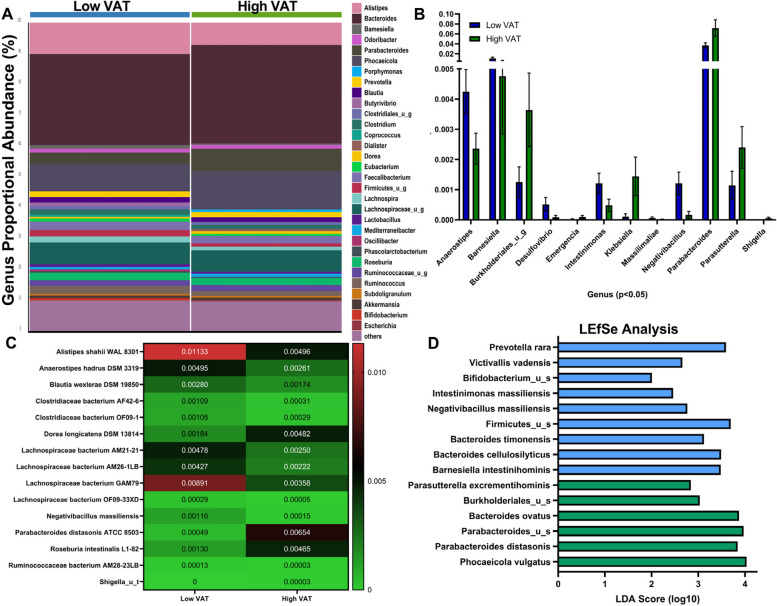
Women in the high VAT group showed increased Proteobacteria abundance and a lower Firmicutes/Bacteroidetes ratio. Plasma LBP concentration was positively associated with VAT area. Plasma anti-LPS, anti-LTA, and anti-flagellin IgA antibodies were significantly correlated with adiposity measurements. Women with high VAT showed significantly elevated LPS-expressing bacteria compared to low VAT women. Gut bacterial species that showed significant associations with both adiposity and inflammation (anti-LPS IgA and LBP) were Proteobacteria (Escherichia coli, Shigella spp., and Klebsiella spp.) and Veillonella atypica. Healthy eating index (HEI) scores negatively correlated with % body fat and anti-LPS IgA antibodies levels. Preclinical murine model showed that high-fat diet-fed mice administered a low-fat diet fecal-derived LPS displayed reduced body weight, decreased % body fat, and improved glucose tolerance test parameters when compared with saline-injected or high-fat diet fecal-derived LPS-treated groups consuming a high-fat diet.
Increased VAT in postmenopausal women is associated with elevated gut Proteobacteria abundance and immunogenic metabolic endotoxemia markers. Low-fat diet-derived fecal-isolated LPS improved metabolic parameters in high-fat diet-fed mice giving mechanistic insights into potential pro-health signaling mediated by under-acylated LPS isoforms. Video Abstract.
肥胖,尤其是腹部肥胖,与多种慢性疾病的发病风险增加有关。肥胖、衰老和绝经都会导致肠道微生物组发生不同的变化。肥胖会因脂多糖(LPS)水平升高而导致慢性低度炎症,这种情况被称为“代谢性内毒素血症”。我们在一组老年绝经后妇女中研究了内脏脂肪组织(VAT)面积、循环内毒素血症标志物和肠道细菌微生物组之间的关系。
从通过双能 X 线吸收法(DXA)进行的现有脂肪测量中选择 50 名绝经后妇女(平均年龄 78.8±5.3 岁),这些妇女处于 VAT 的极值:n=25 名 VAT 面积低(45.6±12.5 cm)和 n=25 名 VAT 面积高(177.5±31.3 cm)。通过食物频率问卷评估用于估计健康饮食指数(HEI)评分的饮食摄入量。通过 ELISA 测量血浆 LPS、LPS 结合蛋白(LBP)、抗 LPS 抗体、抗鞭毛抗体和抗脂磷壁酸(LTA)抗体。对粪便 DNA 进行宏基因组测序。用 0.4 mg/kg 饮食衍生粪便分离 LPS 处理食用高脂肪或低脂肪饮食的雌性 C57BL/6 小鼠,模拟代谢性内毒素血症,并在 6 周后测量代谢结果。
VAT 较高组的妇女表现出变形菌丰度增加和厚壁菌门/拟杆菌门比值降低。血浆 LBP 浓度与 VAT 面积呈正相关。血浆抗 LPS、抗 LTA 和抗鞭毛 IgA 抗体与肥胖测量值显著相关。与 VAT 较低的女性相比,VAT 较高的女性 LPS 表达细菌显著升高。与肥胖和炎症均显著相关的肠道细菌种类(抗 LPS IgA 和 LBP)为变形菌(大肠杆菌、志贺氏菌属和克雷伯氏菌属)和韦荣球菌属。健康饮食指数(HEI)评分与体脂百分比和抗 LPS IgA 抗体水平呈负相关。临床前小鼠模型表明,用高脂肪饮食喂养并给予低脂肪饮食粪便衍生 LPS 的小鼠与给予生理盐水或高脂肪饮食粪便衍生 LPS 处理的继续食用高脂肪饮食的组相比,体重减轻、体脂百分比降低和改善葡萄糖耐量试验参数。
绝经后妇女 VAT 增加与肠道变形菌丰度增加和免疫原性代谢性内毒素血症标志物有关。低脂肪饮食衍生的粪便分离 LPS 改善了高脂肪饮食喂养的小鼠的代谢参数,为潜在的低酰化 LPS 异构体介导的有益健康信号提供了机制见解。