Department of Plant & Microbial Biology, University of California Berkeley, Berkeley, California, USA.
Institute of Microbiology, Chinese Academy of Sciences, Beijing, China.
Mol Ecol. 2022 Oct;31(19):4962-4978. doi: 10.1111/mec.16640. Epub 2022 Aug 25.
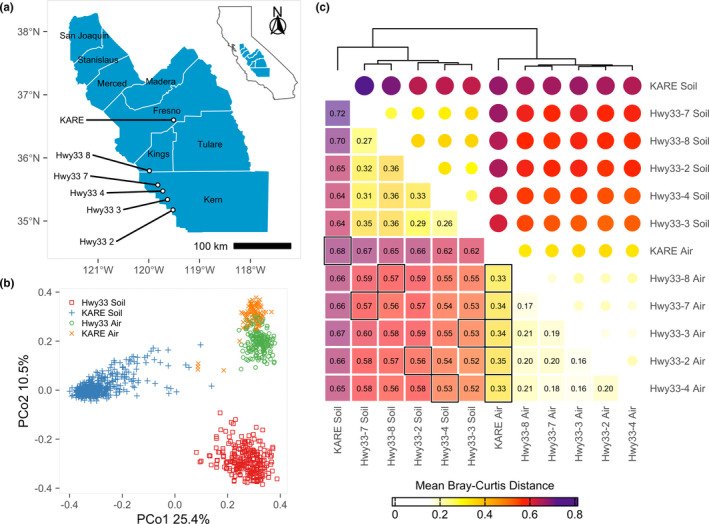
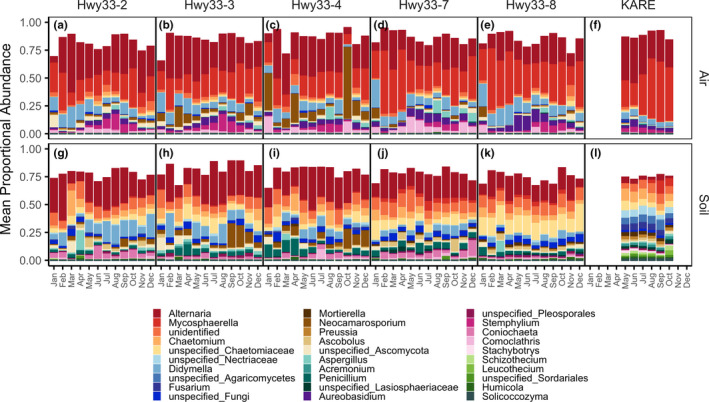
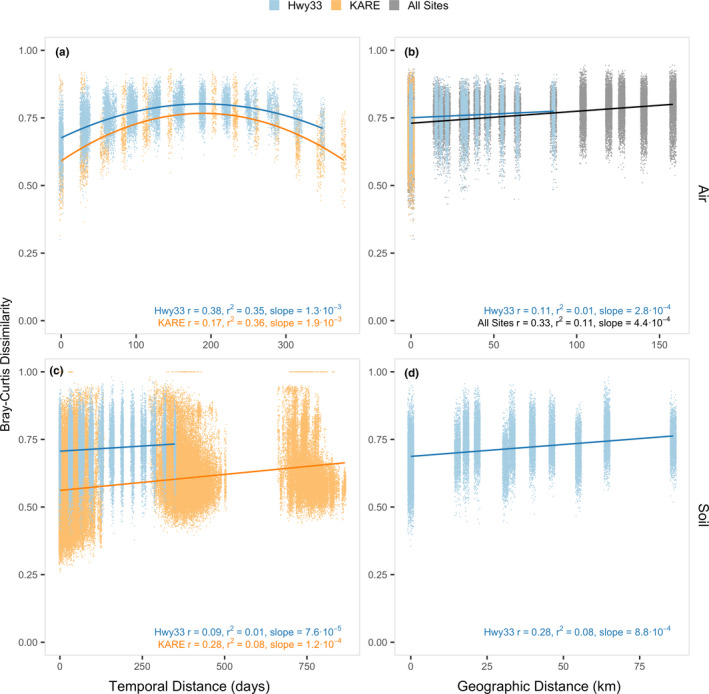
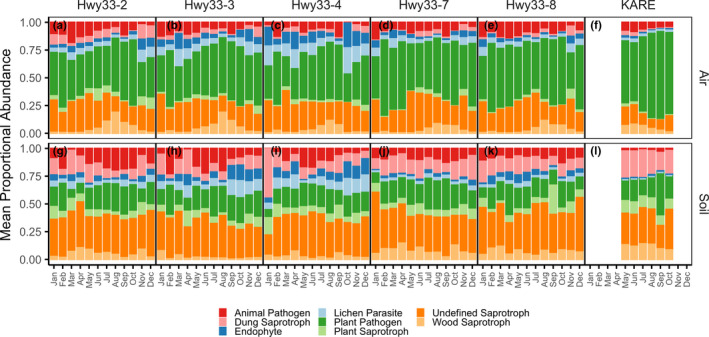
Dispersal is a key force in the assembly of fungal communities and the air is the dominant route of dispersal for most fungi. Understanding the dynamics of airborne fungi is important for determining their source and for helping to prevent fungal disease. This understanding is important in the San Joaquin Valley of California, which is home to 4.2 million people and where the airborne fungus Coccidioides is responsible for the most important fungal disease of otherwise healthy humans, coccidioidomycosis. The San Joaquin Valley is the most productive agricultural region in the United States, with the principal crops grown therein susceptible to fungal pathogens. Here, we characterize the fungal community in soil and air on undeveloped and agricultural land in the San Joaquin Valley using metabarcoding of the internal transcribed spacer 2 variable region of fungal rDNA. Using 1,002 individual samples, we report one of the most extensive studies of fungi sampled simultaneously from air and soil using modern sequencing techniques. We find that the air mycobiome in the San Joaquin Valley is distinct from the soil mycobiome, and that the assemblages of airborne fungi from sites as far apart as 160 km are far more similar to one another than to the fungal communities in nearby soils. Additionally, we present evidence that airborne fungi in the San Joaquin Valley are subject to dispersal limitation and cyclical intra-annual patterns of community composition. Our findings are broadly applicable to understanding the dispersal of airborne fungi and the taxonomic structure of airborne fungal assemblages.
传播是真菌群落形成的关键力量,空气是大多数真菌传播的主要途径。了解空气中真菌的动态对于确定其来源以及帮助预防真菌病非常重要。这一认识在加利福尼亚州圣华金谷尤为重要,该谷拥有 420 万人口,空气中的真菌荚膜组织胞浆菌是 otherwise healthy 人类中最重要的真菌病——球孢子菌病的罪魁祸首。圣华金谷是美国生产力最高的农业区,其中种植的主要作物易受真菌病原体的影响。在这里,我们使用真菌 rDNA 内转录间隔区 2 可变区的 metabarcoding 技术,对圣华金谷未开发和农业土地上的土壤和空气中的真菌群落进行了表征。使用 1002 个个体样本,我们报告了使用现代测序技术同时从空气和土壤中采样的最广泛的真菌研究之一。我们发现,圣华金谷的空气真菌生物群与土壤真菌生物群不同,即使相隔 160 公里的地点的空气传播真菌组合彼此之间也比附近土壤中的真菌群落更为相似。此外,我们提供的证据表明,圣华金谷空气中的真菌受到传播限制和周期性的年内群落组成变化的影响。我们的研究结果广泛适用于理解空气传播真菌的传播以及空气真菌组合的分类结构。