Department of Psychology, Université du Québec à Montréal, Montreal, QC, Canada; Research Centre of the Institut Universitaire en Santé Mentale de Montréal, Montreal, QC, Canada.
Department of Psychology, Université du Québec à Montréal, Montreal, QC, Canada; Research Centre of the Institut Universitaire en Santé Mentale de Montréal, Montreal, QC, Canada.
Psychoneuroendocrinology. 2022 Oct;144:105888. doi: 10.1016/j.psyneuen.2022.105888. Epub 2022 Aug 2.
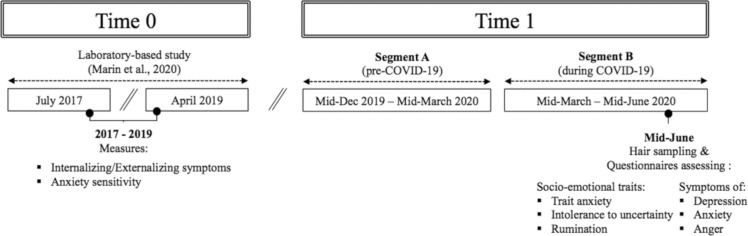
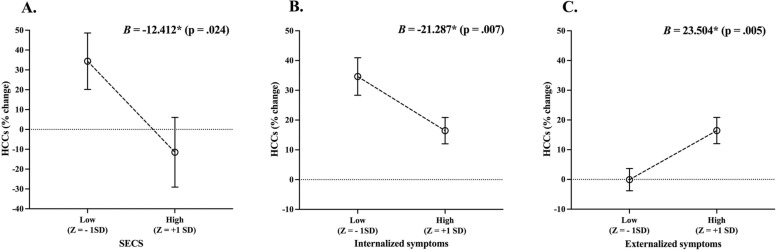
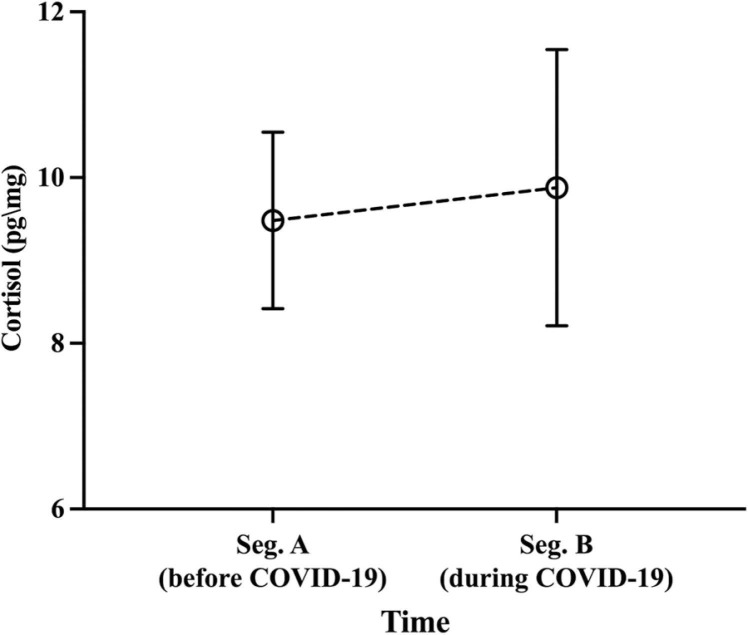
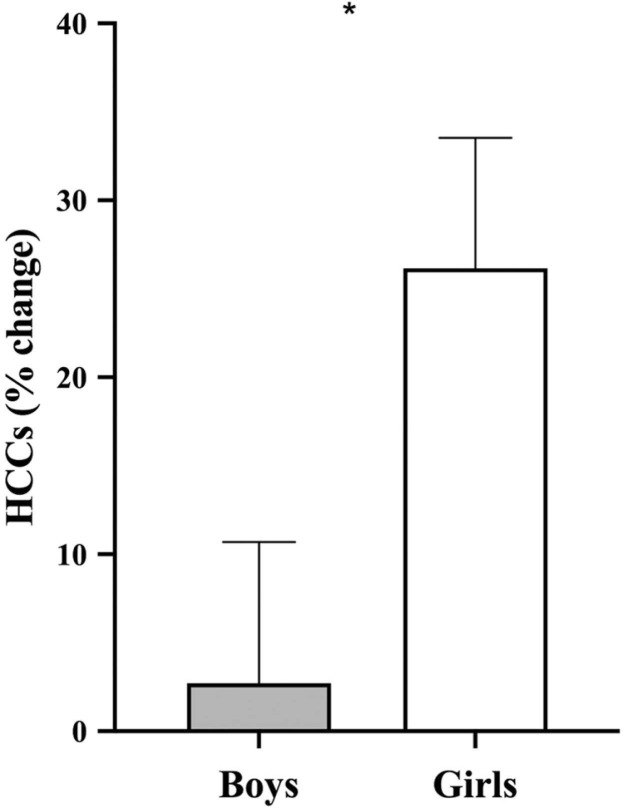
The COVID-19 pandemic led to increased distress in many children, particularly in girls. Socio-emotional vulnerability, as well as psychiatric symptomatology prior to or during the initial stages of the pandemic, have been identified as important predictors of this distress. Still, it is unclear whether the pandemic also had physiological repercussions in children. If so, it remains to be determined whether these same predictors could provide insight into inter-individual variability. This longitudinal study aimed to investigate the effects of socio-emotional vulnerability, as well as pre-pandemic internalizing and externalizing symptoms, on hair cortisol concentrations (HCC) in response to the COVID-19 pandemic in healthy youth. In June 2020 (T1), 69 healthy children (M = 11.57 y/o) who visited the laboratory between 2017 and 2019 (T0) provided a 6 cm hair sample. This technique allowed us to quantify cortisol secretion during the three months preceding the COVID-19 pandemic (Segment A) and during the first three months of the first wave of the pandemic in Quebec, Canada (Segment B). At T0, participants completed the Dominic Interactive to assess pre-pandemic internalizing and externalizing symptoms. A socio-emotional composite score (SECS) was derived using a weighted z-score with the following constructs: anxiety sensitivity (Childhood Anxiety Sensitivity Index) measured at T0, trait anxiety (Trait subscale of the State-Trait Anxiety Inventory for Children (STAI-C)), intolerance of uncertainty (Intolerance of Uncertainty Scale for Children), and trait rumination (Children's Response Style Scale) measured at T1. A linear regression was conducted using the percent change in HCC across Segment A and B as the dependent variable, where SECS, pre-pandemic internalizing and externalizing symptoms, and sex were used as predictors. We found a main effect of sex, with girls presenting increased HCC reactivity compared to boys. We also found that SECS and internalizing symptoms negatively predicted HCC, whereas the opposite relationship was found between externalizing symptoms and HCC reactivity. For healthy children, our results suggest that previous psychiatric symptoms and socio-emotional vulnerability may be risk factors for the presentation of diverging cortisol response patterns in response to an adverse life event (such as the COVID-19 pandemic).
COVID-19 大流行导致许多儿童,尤其是女孩,出现更多的困扰。在大流行的初始阶段之前或期间,社会情感脆弱性以及精神病症状已被确定为这种困扰的重要预测因素。然而,目前尚不清楚大流行是否对儿童也有生理影响。如果是这样,那么仍需确定这些相同的预测因素是否可以深入了解个体间的差异。这项纵向研究旨在调查社会情感脆弱性以及大流行前的内化和外化症状对健康青少年对 COVID-19 大流行的头发皮质醇浓度 (HCC) 的影响。在 2020 年 6 月(T1),69 名健康儿童(M = 11.57 岁)在 2017 年至 2019 年期间访问实验室(T0)时提供了 6 厘米的头发样本。这项技术使我们能够量化大流行前三个月(A 段)和加拿大魁北克省 COVID-19 大流行第一波的前三个月(B 段)期间的皮质醇分泌。在 T0 时,参与者完成了 Dominic 互动评估以评估大流行前的内化和外化症状。使用加权 z 分数得出社会情感综合评分(SECS),该分数使用以下结构:T0 时测量的焦虑敏感性(儿童焦虑敏感性指数)、特质焦虑(儿童状态-特质焦虑问卷的特质子量表(STAI-C))、不确定性容忍度(儿童不确定性容忍度量表)和 T1 时测量的特质沉思(儿童反应风格量表)。使用 HCC 在 A 段和 B 段之间的百分比变化作为因变量,使用 SECS、大流行前的内化和外化症状以及性别作为预测因子进行线性回归。我们发现性别的主要作用,与男孩相比,女孩的 HCC 反应性增加。我们还发现,SECS 和内化症状负预测 HCC,而外化症状与 HCC 反应性之间则存在相反的关系。对于健康儿童,我们的结果表明,先前的精神症状和社会情感脆弱性可能是对不利生活事件(如 COVID-19 大流行)表现出不同皮质醇反应模式的风险因素。