Department of Internal Medicine, School of Medicine, University of New Mexico, Albuquerque, NM; Department of Environmental Health, Harvard T.H. Chan School of Public Health, Boston, MA.
Department of Human Genetics, Graduate School of Public Health, University of Pittsburgh, Pittsburgh, PA; University of Pittsburgh Medical Center Hillman Cancer Center, Pittsburgh, PA.
Am J Obstet Gynecol. 2022 Dec;227(6):885.e1-885.e12. doi: 10.1016/j.ajog.2022.07.031. Epub 2022 Aug 4.
Early natural menopause has been regarded as a biomarker of reproductive and somatic aging. Cigarette smoking is the most harmful factor for lung health and also an established risk factor for early menopause. Understanding the effect of early menopause on health outcomes in middle-aged and older female smokers is important to develop preventive strategies.
This study aimed to examine the associations of early menopause with multiple lung health and aging biomarkers, lung cancer risk, and all-cause and cause-specific mortality in postmenopausal women who were moderate or heavy smokers.
This study was conducted on postmenopausal women with natural (n=1038) or surgical (n=628) menopause from the Pittsburgh Lung Screening Study. The Pittsburgh Lung Screening Study is a community-based research cohort of current and former smokers, screened with low-dose computed tomography and followed up for lung cancer. Early menopause was defined as occurring before 45 years of age. The analyses were stratified by menopause types because of the different biological and medical causes of natural and surgical menopause. Statistical methods included linear model, generalized linear model, linear mixed-effects model, and time-to-event analysis.
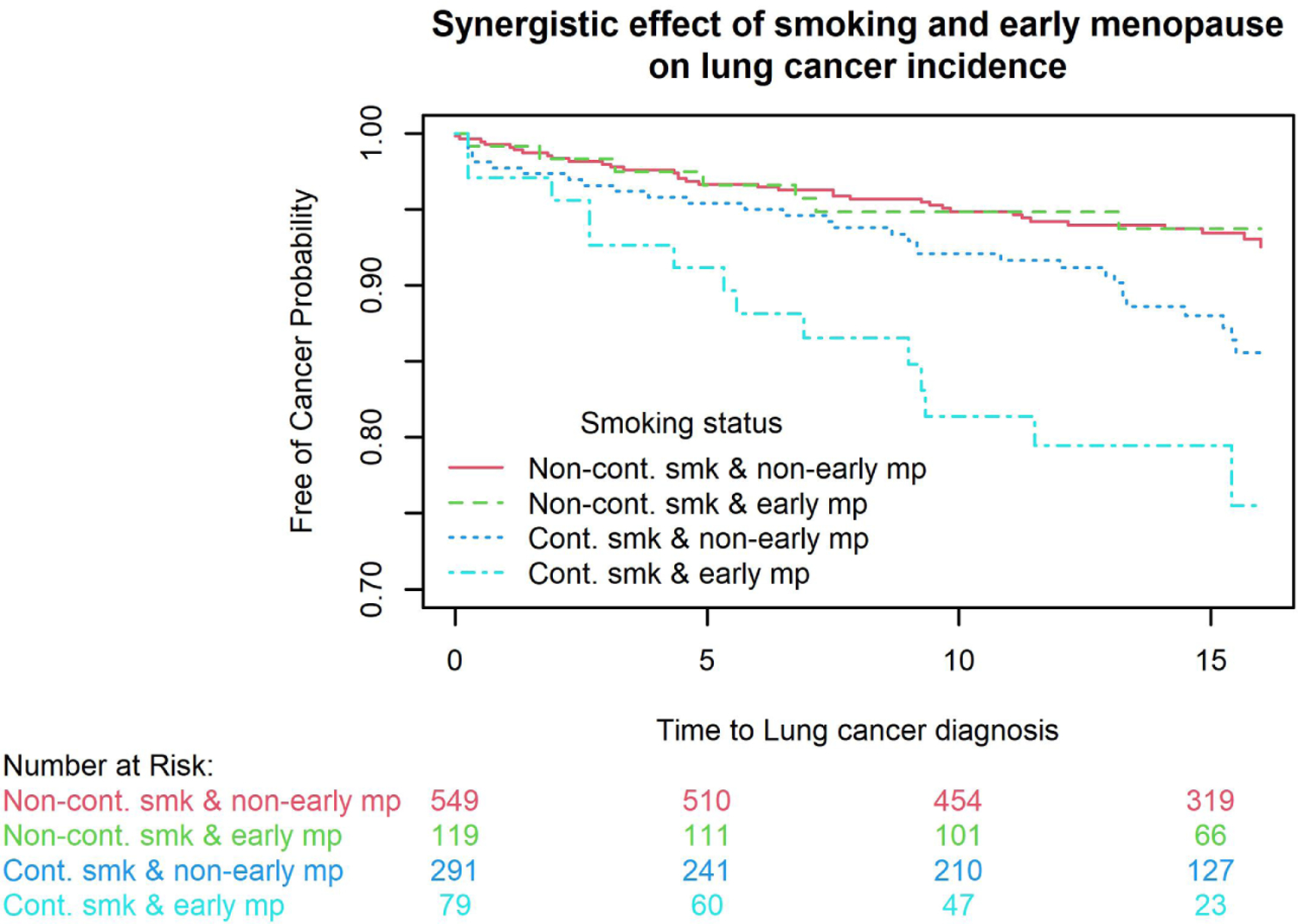
The average age of the 1666 female smokers was 59.4±6.7 years, with 1519 (91.2%) of the population as non-Hispanic Whites and 1064 (63.9%) of the population as current smokers at baseline. Overall, 646 (39%) women reported early menopause, including 198 (19.1%) women with natural menopause and 448 (71.3%) women with surgical menopause (P<.001). Demographic variables did not differ between early and nonearly menopause groups, regardless of menopause type. Significant associations were identified between early natural menopause and higher risk of wheezing (odds ratio, 1.65; P<.01), chronic bronchitis (odds ratio, 1.73; P<.01), and radiographic emphysema (odds ratio, 1.70; P<.001) and lower baseline lung spirometry in an obstructive pattern (-104.8 mL/s for forced expiratory volume in the first second with P<.01, -78.6 mL for forced vital capacity with P=.04, and -2.1% for forced expiratory volume in the first second-to-forced vital capacity ratio with P=.01). In addition, early natural menopause was associated with a more rapid decline of forced expiratory volume in the first second-to-forced vital capacity ratio (-0.16% per year; P=.01) and incident airway obstruction (odds ratio, 2.02; P=.04). Furthermore, women early natural menopause had a 40% increased risk of death (P=.023), which was mainly driven by respiratory diseases (hazard ratio, 2.32; P<.001). Mediation analyses further identified that more than 33.3% of the magnitude of the associations between early natural menopause and all-cause and respiratory mortality were explained by baseline forced expiratory volume in the first second. Additional analyses in women with natural menopause identified that the associations between continuous smoking and subsequent lung cancer risk and cancer mortality were moderated by early menopause status, and females with early natural menopause who continued smoking had the worst outcomes (hazard ratio, >4.6; P<.001). This study did not find associations reported above in female smokers with surgical menopause.
Early natural menopause was found to be a risk factor for malignant and nonmalignant lung diseases and mortality in middle-aged and older female smokers. These findings have strong public health relevance as preventive strategies, including smoking cessation and chest computed tomography screening, should target this population (ie, female smokers with early natural menopause) to improve their postmenopausal health and well-being.
早期自然绝经被认为是生殖和躯体衰老的生物标志物。吸烟是对肺部健康最有害的因素,也是绝经提前的既定危险因素。了解中年和老年女性吸烟者中早期绝经对健康结果的影响,对于制定预防策略非常重要。
本研究旨在探讨早期绝经与多个肺部健康和衰老生物标志物、肺癌风险以及绝经后女性全因和特定原因死亡率之间的关系,这些女性是中度或重度吸烟者。
本研究在匹兹堡肺筛查研究中对自然(n=1038)或手术(n=628)绝经的绝经后女性进行了研究。匹兹堡肺筛查研究是一项基于社区的当前和前吸烟者研究队列,采用低剂量计算机断层扫描进行筛查,并对肺癌进行随访。早期绝经定义为 45 岁之前发生。由于自然和手术绝经的生物学和医学原因不同,分析按绝经类型进行分层。统计方法包括线性模型、广义线性模型、线性混合效应模型和时间事件分析。
1666 名女性吸烟者的平均年龄为 59.4±6.7 岁,其中 1519 人(91.2%)为非西班牙裔白人,1064 人(63.9%)为当前吸烟者。总体而言,646 名(39%)女性报告了早期绝经,其中 198 名(19.1%)女性为自然绝经,448 名(71.3%)女性为手术绝经(P<.001)。无论绝经类型如何,早期和非早期绝经组的人口统计学变量没有差异。早期自然绝经与喘息(优势比,1.65;P<.01)、慢性支气管炎(优势比,1.73;P<.01)和放射影像肺气肿(优势比,1.70;P<.001)的风险较高以及基线阻塞性肺通气功能模式下的肺功能较低相关(用力呼气第一秒量降低 104.8 毫升/秒,P<.01,用力肺活量降低 78.6 毫升,P=.04,用力呼气第一秒量与用力肺活量比值降低 2.1%,P=.01)。此外,早期自然绝经与用力呼气第一秒量与用力肺活量比值的快速下降相关(每年下降 0.16%;P=.01)和新出现的气道阻塞(优势比,2.02;P=.04)。此外,早期自然绝经的女性死亡风险增加了 40%(P=.023),这主要是由呼吸系统疾病引起的(危险比,2.32;P<.001)。中介分析进一步确定,早期自然绝经与全因和呼吸死亡之间关联的幅度的 33.3%以上是由基线用力呼气第一秒量解释的。在自然绝经的女性中进行的额外分析表明,连续吸烟与随后的肺癌风险和癌症死亡率之间的关系受到早期绝经状态的调节,继续吸烟的早期自然绝经女性的结局最差(危险比,>4.6;P<.001)。本研究在手术绝经的女性吸烟者中未发现上述关联。
早期自然绝经是中年和老年女性吸烟者恶性和非恶性肺部疾病及死亡的危险因素。这些发现具有很强的公共卫生相关性,因为预防策略,包括戒烟和胸部计算机断层扫描筛查,应该针对这一人群(即,早期自然绝经的女性吸烟者),以改善她们的绝经后健康和福祉。