Department of Earth and Environmental Sciences, University of Manchester, Manchester, UK.
Department of Experimental Psychology, University of Oxford, Oxford, UK.
Philos Trans R Soc Lond B Biol Sci. 2022 Sep 26;377(1860):20210296. doi: 10.1098/rstb.2021.0296. Epub 2022 Aug 8.
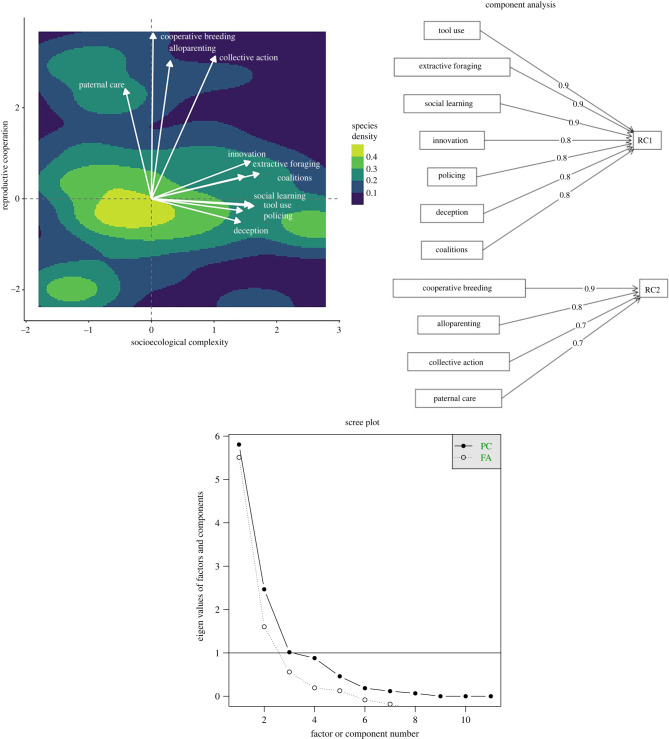
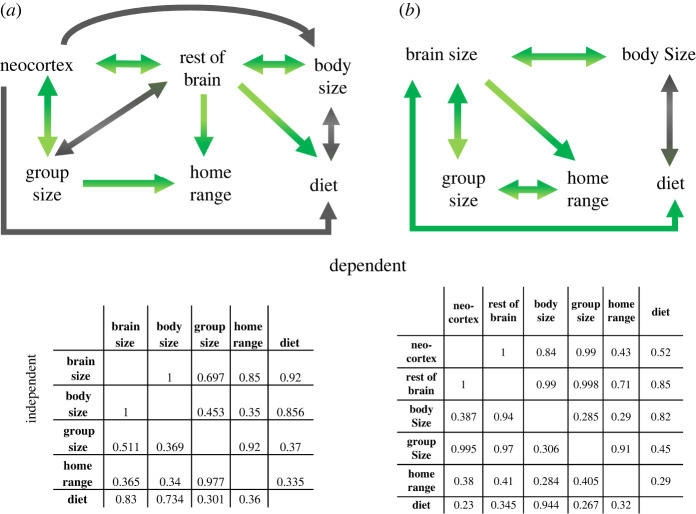
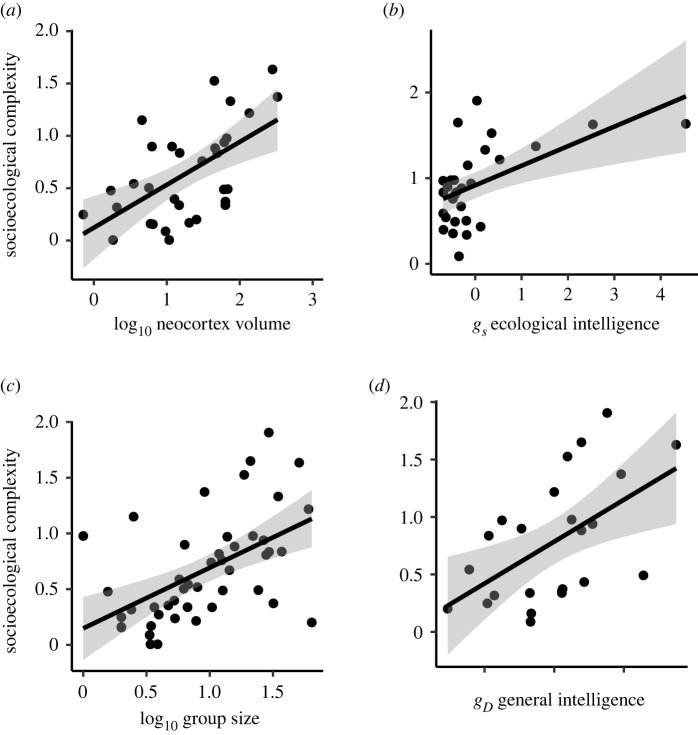
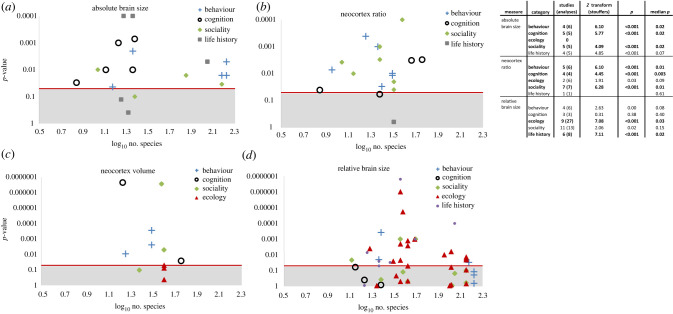
Characterizing non-human primate social complexity and its cognitive bases has proved challenging. Using principal component analyses, we show that primate social, ecological and reproductive behaviours condense into two components: (including most social and ecological variables) and (comprising mainly a suite of behaviours associated with pairbonded monogamy). We contextualize these results using a meta-analysis of 44 published analyses of primate brain evolution. These studies yield two main consistent results: cognition, sociality and cooperative behaviours are associated with absolute brain volume, neocortex size and neocortex ratio, whereas diet composition and life history are consistently associated with relative brain size. We use a path analysis to evaluate the causal relationships among these variables, demonstrating that social group size is predicted by the neocortex, whereas ecological traits are predicted by the volume of brain structures other than the neocortex. That a range of social and technical behaviours covary, and are correlated with social group size and brain size, suggests that primate cognition has evolved along a continuum resulting in an increasingly flexible, domain-general capacity to solve a range of socioecological challenges culminating in a capacity for, and reliance on, innovation and social information use in the great apes and humans. This article is part of the theme issue 'Cognition, communication and social bonds in primates'.
描述非人类灵长类动物的社会复杂性及其认知基础一直具有挑战性。我们使用主成分分析表明,灵长类动物的社会、生态和生殖行为可以归结为两个组成部分:(包括大多数社会和生态变量)和(主要由一套与配对一夫一妻制相关的行为组成)。我们使用对 44 项已发表的灵长类动物大脑进化分析的荟萃分析来将这些结果置于上下文中。这些研究产生了两个主要的一致结果:认知、社会性和合作行为与大脑的绝对体积、大脑新皮层大小和大脑新皮层比例相关,而饮食成分和生活史则与大脑的相对大小一致相关。我们使用路径分析来评估这些变量之间的因果关系,表明大脑新皮层预测社会群体的大小,而大脑新皮层以外的脑结构的体积则预测生态特征。一系列社会和技术行为的共变以及与社会群体大小和大脑大小的相关性表明,灵长类动物的认知沿着一个连续体进化,从而产生了一种更加灵活、普遍适用的能力,以解决一系列社会生态挑战,最终在大猩猩和人类中产生了创新和社会信息利用的能力和依赖。本文是主题为“灵长类动物的认知、沟通和社会联系”的一部分。