IFM Biology, Linköping University, Linköping, SE-581 83, Sweden.
Instituto de Neuroetologia, Universidad Veracruzana, Xalapa, C.P. 91000, Mexico.
Anim Cogn. 2024 Aug 13;27(1):56. doi: 10.1007/s10071-024-01897-z.
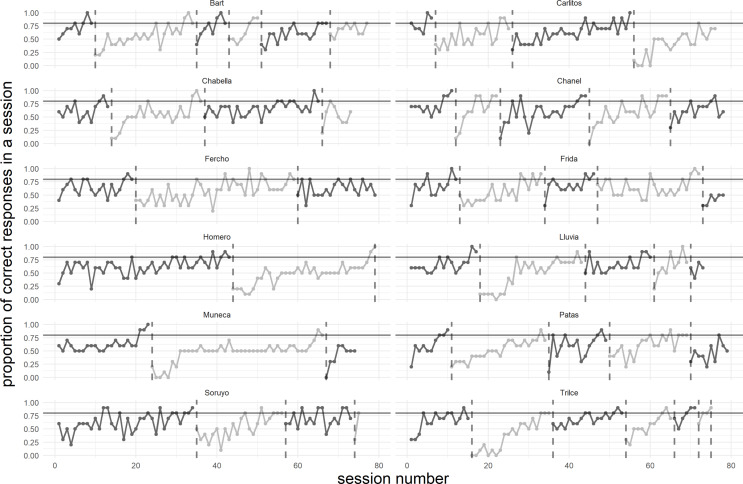
Recent research suggests that socio-ecological factors such as dietary specialization and social complexity may be drivers of advanced cognitive skills among primates. Therefore, we assessed the ability of 12 black-handed spider monkeys (Ateles geoffroyi), a highly frugivorous platyrrhine primate with strong fission-fusion dynamics, to succeed in a serial visual reversal learning task. Using a two-alternative choice paradigm we first trained the animals to reliably choose a rewarded visual stimulus over a non-rewarded one. Upon reaching a pre-set learning criterion we then switched the reward values of the two stimuli and assessed if and how quickly the animals learned to reverse their choices, again to a pre-set learning criterion. This stimulus reversal procedure was then continued for a total of 80 sessions of 10 trials each. We found that the spider monkeys quickly learned to reliably discriminate between two simultaneously presented visual stimuli, that they succeeded in a visual reversal learning task, and that they displayed an increase in learning speed across consecutive reversals, suggesting that they are capable of serial reversal learning-set formation with visual cues. The fastest-learning individual completed five reversals within the 80 sessions. The spider monkeys outperformed most other primate and nonprimate mammal species tested so far on this type of cognitive task, including chimpanzees, with regard to their learning speed in both the initial learning task and in the first reversal task, suggesting a high degree of behavioral flexibility and inhibitory control. Our findings support the notion that socio-ecological factors such as dietary specialization and social complexity foster advanced cognitive skills in primates.
最近的研究表明,社会生态因素,如饮食专业化和社会复杂性,可能是灵长类动物高级认知技能的驱动因素。因此,我们评估了 12 只黑掌蜘蛛猴(Ateles geoffroyi)的能力,这些猴子是高度以果实为食的阔鼻猴类动物,具有强烈的分裂-融合动态。我们使用二选一的选择范式,首先训练这些动物可靠地选择奖励的视觉刺激而不是非奖励的视觉刺激。达到预设的学习标准后,我们切换了两个刺激的奖励值,并评估了动物是否以及多快学会了反转他们的选择,再次达到预设的学习标准。然后,这个刺激反转程序总共进行了 80 个 10 次试验的会话。我们发现,蜘蛛猴很快学会了可靠地区分两个同时呈现的视觉刺激,它们成功地完成了视觉反转学习任务,并且在连续的反转中显示出学习速度的提高,这表明它们能够用视觉线索进行序列反转学习集的形成。学习最快的个体在 80 个会话中完成了五次反转。在这种认知任务上,蜘蛛猴的学习速度超过了迄今为止测试的大多数其他灵长类和非灵长类哺乳动物物种,包括黑猩猩,无论是在初始学习任务还是在第一次反转任务中,这表明它们具有高度的行为灵活性和抑制控制能力。我们的发现支持了这样一种观点,即社会生态因素,如饮食专业化和社会复杂性,促进了灵长类动物的高级认知技能。