Åkerström Thorbjörn, Stolpe Malene N, Widmer Renate, Dejgaard Thomas F, Højberg Jens M, Møller Kirsten, Hansen Jakob S, Trinh Beckey, Holst Jens J, Thomsen Carsten, Pedersen Bente K, Ellingsgaard Helga
Centre of Inflammation and Metabolism and Centre for Physical Activity Research, Rigshospitalet, Copenhagen University Hospital - Rigshospitalet, DK 2100 Copenhagen, Denmark.
Department of Cardiothoracic Anesthesiology and Intensive Care, Rigshospitalet, DK 2100 Copenhagen, Denmark.
J Endocr Soc. 2022 Jul 26;6(9):bvac111. doi: 10.1210/jendso/bvac111. eCollection 2022 Sep 1.
Obesity and inactivity are risk factors for developing impaired glucose tolerance characterized by insulin resistance and reduced beta-cell function. The stimulatory effect of glucagon-like peptide 1 (GLP-1) on insulin secretion is also impaired in obese, inactive individuals. The aim of this study was to investigate whether endurance training influences beta-cell sensitivity to GLP-1.
Twenty-four female participants, age 46 ± 2 years, body mass index 32.4 ± 0.9 kg/m, and maximal oxygen consumption 24.7 ± 0.8 mL/kg/min participated in a 10-week exercise training study.
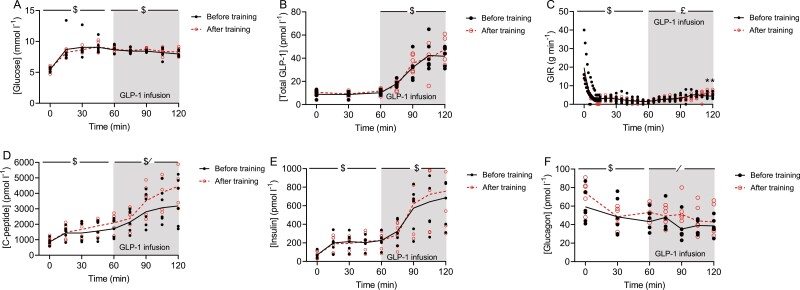
Beta-cell sensitivity to GLP-1 was assessed in a subset of participants (n = 6) during a 120-minute hyperglycemic glucose clamp (8.5 mM) including a 1-hour GLP-1 (7-36 amide) infusion (0.4 pmol/kg/min). Changes in glucose tolerance, body composition, and cardiorespiratory fitness were assessed by oral glucose tolerance tests (OGTTs), dual-energy X-ray absorptiometry scans, magnetic resonance scans, and maximal oxygen consumption (VOmax) tests, respectively.
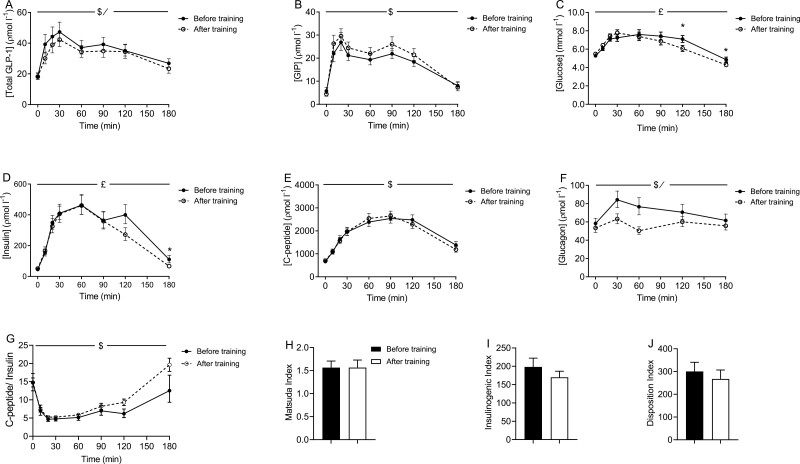
The c-peptide response to infusion of GLP-1 increased 28 ± 3% ( < 0.05) toward the end of the hyperglycemic clamp. The insulin response remained unchanged. Training improved glucose tolerance and reduced GLP-1, insulin, and glucagon levels during the OGTTs. Training increased VOmax (from 24.7 ± 0.8 to 27.0 ± 0.7 mL/kg/min; < 0.05) and reduced visceral fat volume (from 4176 ± 265 to 3888 ± 266 cm; < 0.01).
Along with improved glycemic control, endurance training improved beta-cell sensitivity to GLP-1 in overweight women. The study was deemed not to constitute a clinical trial and was not registered as such.
肥胖和缺乏运动是导致糖耐量受损的风险因素,其特征为胰岛素抵抗和β细胞功能降低。在肥胖、缺乏运动的个体中,胰高血糖素样肽1(GLP-1)对胰岛素分泌的刺激作用也会受损。本研究的目的是调查耐力训练是否会影响β细胞对GLP-1的敏感性。
24名年龄为46±2岁、体重指数为32.4±0.9kg/m²、最大摄氧量为24.7±0.8mL/kg/min的女性参与者参加了一项为期10周的运动训练研究。
在120分钟的高血糖葡萄糖钳夹试验(8.5mM)期间,对部分参与者(n=6)进行β细胞对GLP-1的敏感性评估,该试验包括1小时的GLP-1(7-36酰胺)输注(0.4pmol/kg/min)。分别通过口服葡萄糖耐量试验(OGTT)、双能X线吸收法扫描、磁共振扫描和最大摄氧量(VO₂max)测试来评估糖耐量、身体成分和心肺适能的变化。
在高血糖钳夹试验接近尾声时,输注GLP-1后C肽反应增加了28±3%(P<0.05)。胰岛素反应保持不变。训练改善了糖耐量,并降低了OGTT期间的GLP-1、胰岛素和胰高血糖素水平。训练使VO₂max增加(从24.7±0.8提高到27.0±0.7mL/kg/min;P<0.05),并减少了内脏脂肪体积(从4176±265减少到3888±266cm³;P<0.01)。
除了改善血糖控制外,耐力训练还提高了超重女性β细胞对GLP-1的敏感性。该研究被认为不构成临床试验,因此未进行注册。