Palumbo Sara, Mariotti Veronica, Vellucci Stefano, Antonelli Klizia, Anderson Nathaniel, Harenski Carla, Pietrini Pietro, Kiehl Kent A, Pellegrini Silvia
Department of Surgical, Medical and Molecular Pathology and Critical Care, University of Pisa, Pisa, Italy.
Department of Clinical and Experimental Medicine, University of Pisa, Pisa, Italy.
Front Psychiatry. 2022 Jul 22;13:868804. doi: 10.3389/fpsyt.2022.868804. eCollection 2022.
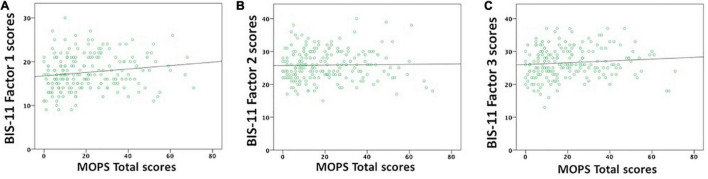
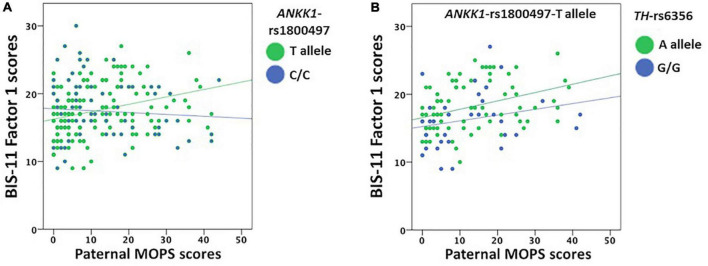
Recent scientific findings suggest that dopamine exerts a central role on impulsivity, as well as that aversive life experiences may promote the high levels of impulsivity that often underlie violent behavior. To deepen our understanding of the complex gene by environment interplay on impulsive behavior, we genotyped six dopaminergic allelic variants (-rs1800497, -rs6356, -rs1800955, -exonIII-VNTR, -VNTR and -rs4680) in 655 US White male inmates convicted for violent crimes, whose impulsivity was assessed by BIS-11 (Barratt Impulsiveness Scale). Furthermore, in a subsample of 216 inmates from the whole group, we also explored the potential interplay between the genotyped dopaminergic variants and parental maltreatment measured by MOPS (Measure of Parental Style) in promoting impulsivity. We found a significant interaction among paternal MOPS scores, -rs1800497-T allele and -rs6356-A allele, which increased the variance of BIS-11 cognitive/attentive scores explained by paternal maltreatment from 1.8 up to 20.5%. No direct association between any of the individual genetic variants and impulsivity was observed. Our data suggest that paternal maltreatment increases the risk of attentive/cognitive impulsivity and that this risk is higher in carriers of specific dopaminergic alleles that potentiate the dopaminergic neurotransmission. These findings add further evidence to the mutual role that genetics and early environmental factors exert in modulating human behavior and highlight the importance of childhood care interventions.
近期的科学研究结果表明,多巴胺在冲动行为中发挥着核心作用,同时,不良的生活经历可能会促使冲动水平升高,而冲动往往是暴力行为的潜在根源。为了更深入地理解基因与环境在冲动行为方面的复杂相互作用,我们对655名因暴力犯罪被定罪的美国白人男性囚犯进行了六种多巴胺能等位基因变体(-rs1800497、-rs6356、-rs1800955、外显子III - VNTR、-VNTR和-rs4680)的基因分型,这些囚犯的冲动性通过BIS - 11(巴拉特冲动性量表)进行评估。此外,在来自整个群体的216名囚犯的子样本中,我们还探究了基因分型的多巴胺能变体与通过MOPS(父母教养方式量表)测量的父母虐待之间在促进冲动性方面的潜在相互作用。我们发现父亲的MOPS得分、-rs1800497 - T等位基因和-rs6356 - A等位基因之间存在显著的相互作用,这使得父亲虐待所解释的BIS - 11认知/注意力得分的方差从1.8%增加到了20.5%。未观察到任何单个基因变体与冲动性之间的直接关联。我们的数据表明,父亲的虐待会增加注意力/认知冲动性的风险,并且在增强多巴胺能神经传递的特定多巴胺能等位基因携带者中,这种风险更高。这些发现进一步证明了基因和早期环境因素在调节人类行为中所起的相互作用,并突出了儿童期护理干预的重要性。