Department of Psychiatry and Clinical Psychobiology, University of Barcelona, Barcelona, Spain.
PLoS One. 2012;7(7):e41482. doi: 10.1371/journal.pone.0041482. Epub 2012 Jul 25.
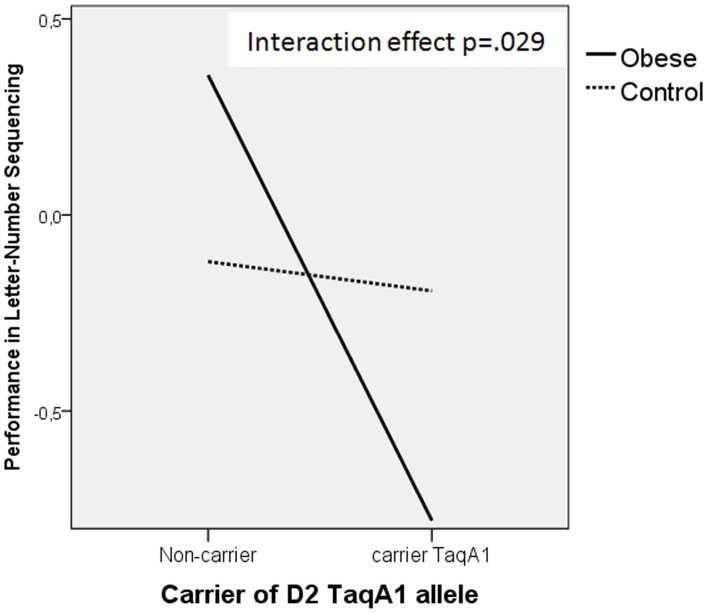
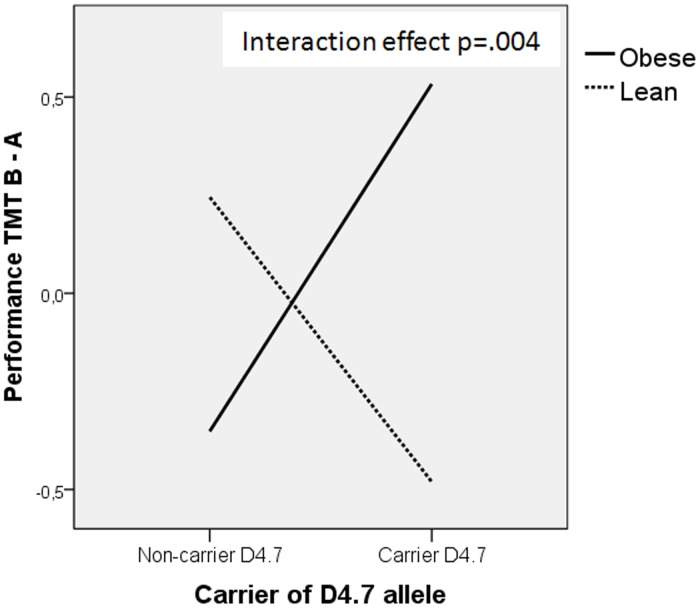
Obesity is a multifactorial disease caused by the interaction between genotype and environment, and it is considered to be a type of addictive alteration. The A1 allele of the DRD2/ANKK1-TaqIA gene has been associated with addictive disorders, with obesity and with the performance in executive functions. The 7 repeat allele of the DRD4 gene has likewise been associated with the performance in executive functions, as well as with addictive behaviors and impulsivity. Participants were included in the obesity group (N = 42) if their body mass index (BMI) was equal to or above 30, and in the lean group (N = 42) if their BMI was below 25. The DRD2/ANKK1-TaqIA and DRD4 VNTR polymorphisms were obtained. All subjects underwent neuropsychological assessment. Eating behavior traits were evaluated. The 'DRD2/ANKK1-TaqIA A1-allele status' had a significant effect on almost all the executive variables, but no significant 'DRD4 7R-allele status' effects were observed for any of the executive variables analyzed. There was a significant 'group' x 'DRD2/ANKK1-TaqIA A1-allele status' interaction effect on LN and 'group' x 'DRD4 7R-allele status' interaction effect on TMT B-A score. Being obese and a carrier of the A1 allele of DRD2/ANKK1-TaqIA or the 7R allele of DRD4 VNTR polymorphisms could confer a weakness as regards the performance of executive functions.
肥胖是一种由基因型和环境相互作用引起的多因素疾病,被认为是一种成瘾性改变。DRD2/ANKK1-TaqIA 基因的 A1 等位基因与成瘾障碍、肥胖以及执行功能表现有关。DRD4 基因的 7 重复等位基因同样与执行功能表现、成瘾行为和冲动有关。如果参与者的体重指数(BMI)等于或高于 30,则将其纳入肥胖组(N=42),如果 BMI 低于 25,则将其纳入瘦组(N=42)。获得了 DRD2/ANKK1-TaqIA 和 DRD4 VNTR 多态性。所有受试者均接受神经心理学评估。评估了饮食行为特征。“DRD2/ANKK1-TaqIA A1-等位基因状态”对几乎所有执行变量都有显著影响,但对分析的任何执行变量都没有观察到“DRD4 7R-等位基因状态”的显著影响。在 LN 上观察到“组”x“DRD2/ANKK1-TaqIA A1-等位基因状态”的显著交互作用,在 TMT B-A 评分上观察到“组”x“DRD4 7R-等位基因状态”的显著交互作用。肥胖和携带 DRD2/ANKK1-TaqIA 的 A1 等位基因或 DRD4 VNTR 多态性的 7R 等位基因可能会导致执行功能表现出现弱点。